HROUS
HROUS Canadian property owners should compare vapour-intrusion proposals by the conceptual site model, evidence lines, operating conditions, applicable jurisdiction and promised decision-ready report—not by sampling count alone.[1][5]
Define the suspected source-to-receptor pathway
Vapour intrusion is the migration of volatile or semi-volatile chemicals from contaminated soil or groundwater into indoor air. An assessment asks whether subsurface vapours could enter a building and pose a potential human-health risk.[1]
Define the complete pathway: the suspected contaminant source, subsurface migration route, possible building entry point and people who may be exposed. Potential entry points include foundation cracks, control joints, floor drains and utility penetrations, according to Premier Environmental Services.[5]
Where a Phase I or Phase II Environmental Site Assessment identifies a follow-up need, Premier recommends characterizing potential sources in soil, groundwater and soil vapour and using the findings to develop a conceptual site model. This is vendor guidance, not a universal regulatory requirement.[5]
Request a conceptual site model before approving the scope
Health Canada’s federal framework proceeds through conceptual-site-model development, initial screening and a multiple-lines-of-evidence investigation.[1] Ask the consultant to document:
- Source: suspected contaminants and potential origins, along with relevant soil, groundwater and soil-vapour conditions.[5]
- Migration: groundwater depth and the vectors by which contamination could move toward the building.[5]
- Building: use, foundation construction and condition, basement depth and thickness, crawl spaces, sumps and possible entry points.[5]
- Exposure: ventilation, air exchange, possible indoor sources and the people who could be exposed if vapours enter.[1][5]
Have the proposal identify which elements are established, assumed or uncertain, and connect each proposed evidence line to an uncertainty. Request at least a preliminary model or documented assumptions before approval, although Health Canada and Premier do not make delivery before quotation a formal requirement.[1][5]
Compare evidence lines and operating conditions
The proposal should explain what each evidence line contributes to the conceptual site model:
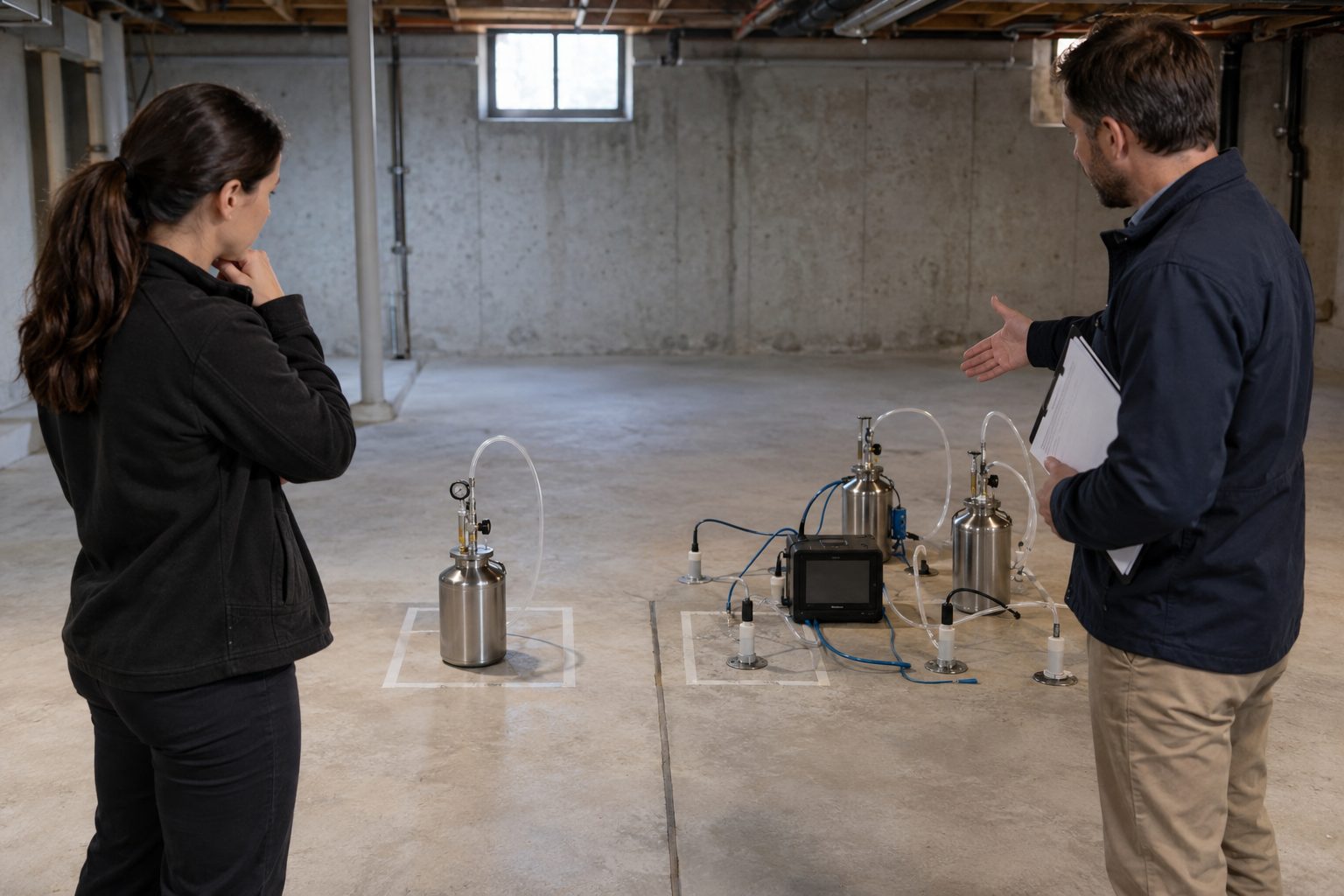
- Soil vapour and sub-slab vapour: Premier identifies samples from discretely screened vapour probes as evidence for evaluating the subsurface pathway.[5]
- Indoor air: sampling addresses the occupied space, but many volatile organic compounds are common indoors and may originate above the slab. Premier therefore recommends auditing possible indoor sources before sampling.[5]
- Background air: sampling can provide context for regional outdoor-air quality and other non-subsurface contributions.[5]
- Tracer gases and isotope analysis: tracer gases may clarify the pathway. Compound-Specific Isotope Analysis may help distinguish vapour intrusion from indoor sources when the compound is reliably detectable in both media being compared.[5]
Not every site requires every medium. The consultant should justify the combination of soil-vapour, sub-slab, indoor-air and background-air samples against the suspected pathway and the decision the investigation must support.[5]
Premier lists specially prepared canisters, desorption tubes and passive samplers as possible collection methods, selected according to the target contaminants and expected concentrations. It identifies laboratory gas chromatography/mass spectrometry and a field and laboratory QA/QC programme as parts of a meaningful, representative and reproducible investigation.[5]
Require the report to record ventilation, air-exchange conditions, seasonal climate variation and regional outdoor-air quality because these factors can affect interpretation.[5] Do not accept absent odour or one negative sample as a complete conclusion; require an integrated interpretation of the evidence and its limitations.
Compare the federal and Ontario frameworks
A technical framework is not automatically the governing standard for private property. Identify the site’s jurisdiction and the assessment’s purpose before adopting criteria.[1][2]
Health Canada federal guidance
- Status: Federal technical guidance organized around conceptual-site-model development, initial screening and multiple lines of evidence.[1]
- Intended user: Federal departments assessing federal contaminated sites.[1][4]
- Applicability: Federally owned or operated properties and non-federal lands for which the federal government has accepted full responsibility under the Federal Contaminated Sites Action Plan. It is not established as a universal legal standard for private property.[1]
Ontario proposed technical guidance
- Status: Proposed technical guidance identified as under active review, not finalized binding guidance.[2]
- Intended user: Ontario stakeholders, including Qualified Persons conducting or reviewing soil-vapour-intrusion assessments.[2]
- Applicability: The proposal addresses soil-vapour and indoor-air characterization and is associated with the Records of Site Condition programme and related proposed guidance under Part XV.1 of the Environmental Protection Act.[2]
Health Canada and Ontario’s notice do not establish one national set of thresholds, sample numbers, durations, seasonal rounds, deadlines or filing forms for every province and territory.[1][2] Dragun Corporation’s Canadian reference page also advises confirming requirements with the applicable regulator because requirements vary and can change.[6]
Compare vendor-described approaches
Commercial pages can help identify scope questions, but they do not establish the applicable legal requirements or prove service performance.
Premier Environmental Services
- Published scope: Source audits; soil-vapour, sub-slab, indoor- and background-air sampling; GC/MS analysis; QA/QC; conceptual-site modelling; conditional isotope analysis; and mitigation options.[5]
- Evidence status: The page describes the vendor’s methods but does not independently demonstrate outcomes.[5]
- Role in the decision: Use the methods as a scope checklist while confirming the applicable framework and project-specific requirements.
Dragun Corporation Canada
- Published scope: Assistance with understanding, assessing or remediating vapour intrusion, supported by provincial and territorial reference links.[6]
- Evidence status: The page provides jurisdictional commentary but no measured service-performance evidence.[6]
- Role in the decision: Use the jurisdictional links as a starting point, then confirm requirements with the applicable regulator.[6]
Separate assessment, mitigation and verification
Use written approvals to prevent an initial investigation from expanding automatically into design, construction or recurring monitoring:
- Initial assessment: commission conceptual-site-model development, initial screening and justified evidence collection. Health Canada’s federal framework is intended to support conclusions about potential human-health risks and management decisions.[1]
- Further investigation: authorize additional work separately to resolve named data gaps, source-attribution questions or limitations caused by operating conditions. Require the consultant to explain how each task could change the decision.
- Mitigation design: commission remedial or engineering design after integrating the evidence. Premier lists sealing entry points, sub-slab barriers or depressurization, aerated floors and HVAC pressurization as possible controls.[5]
- Verification: give post-mitigation testing separate objectives, operating conditions and acceptance criteria. Premier notes that remedial systems may require regulatory approvals and recurring assessments.[5]
For each phase, define deliverables, approval authority and change-authorization rules in the contract.
Require a decision-ready report
The final report should answer the management question, not merely list concentrations. Require the author to update the conceptual site model by connecting suspected sources, migration routes, building-entry conditions, receptors and the evidence collected.[1][5]
- Name the framework: identify the applicable regulatory or technical framework and explain every screening or assessment criterion used. Health Canada’s framework supports human-health-risk conclusions and management decisions at federal contaminated sites; it is not automatically the governing standard for private property.[1]
- Reconcile the evidence: explain agreements or conflicts among soil-vapour, sub-slab, indoor-air and background-air results, considering indoor sources, outdoor background, ventilation and seasonal limitations.[5]
- State uncertainty: distinguish what the data support from what remains uncertain, and identify which gaps would trigger more investigation, monitoring or mitigation design.
- Recommend the next decision: distinguish source remediation from engineered building controls. Premier describes integrating evidence into the conceptual site model, comparing results with applicable standards and then considering remediation or building controls.[5]
Request analytical results and field and laboratory QA/QC records with an executive conclusion understandable to a non-specialist. Health Canada’s page and Ontario’s notice do not prescribe a universal report format, uncertainty section, decision matrix or acceptance criteria.[1][2]
Confirm responsibility, reliance and commercial terms
- Responsible parties: identify who will develop the conceptual site model, direct fieldwork, oversee the laboratory, review QA/QC, interpret health-risk implications, design controls and sign the report.
- Professional authority: verify the designation and sign-off rules applicable in the province or territory. Ontario’s proposed guidance refers to stakeholders such as Qualified Persons, but it does not establish province-by-province practice rules.[2]
- Reliance: define the client, intended users, permitted transaction or regulatory uses, third-party reliance and exclusions.
What to confirm with each provider
The cited Premier and Dragun pages do not state the following commercial details.[5][6]
- Fees, taxes and assumptions that could generate additional charges
- Minimum engagement, schedule and turnaround commitments
- Geographic and contractual service coverage
- Cancellation and change-authorization terms
- Insurance, liability allocation and report-reliance terms
- Records retention, warranties and post-report support
Accept a proposal only if it identifies the applicable framework, tests a documented conceptual site model with justified evidence lines, addresses operating conditions, separates project phases and defines a decision-ready report.[1][5][6]
References
- Federal Contaminated Site Risk Assessment in Canada: Supplemental Guidance for Soil Vapour Intrusion Assessment at Federal Contaminated Sites, Version 2.0 – Canada.ca (canada.ca, 2023)
- Technical Guidance for Soil Vapour Intrusion Assessment | Environmental Registry of Ontario (ontario.ca, 2021)
- Federal contaminated site risk assessment in Canada : supplemental guidance for soil vapour intrusion assessment at federal contaminated sites.: H129-135/2022E-PDF – Government of Canada Publications – Canada.ca (gc.ca, 2013)
- Vapour Intrusion – Assessment and Mitigation – Premier Environmental Services (premiercorp.ca)
- Vapour Intrusion Reference Guide: Canadian Provinces and Territories – Dragun Corporation | Canada (dragun.ca)