HROUS
HROUS Investigate unexplained metered use in stages: reconcile the bill and operating demand, use authorised isolation to narrow the affected section, commission localisation with a written repair boundary, then verify the result under comparable operating conditions.[3][5] Water Plus describes an audit-led service for complex consumption, while Castle Water focuses its published offer on underground leak detection and repair.[1][2]
Establish whether the increase is genuinely unexplained
Start with the bill rather than invasive detection. Check the billing period, meter units and whether readings were actual or estimated. A longer period, or an actual reading following estimates, can create an apparent increase without proving a leak.[3][4]
Reconcile the same period against occupancy, production, cleaning, irrigation, cooling-tower make-up, water-treatment equipment, appliances, softener regeneration and other scheduled or continuous demand.[3][4] Keep dated meter photographs and readings taken at consistent times. The business-market leak-allowance guidance published by CCW, the statutory consumer body for water in England and Wales, advises taking regular meter readings where it is safe to do so and contacting your retailer about unexplained high consumption.[7]
If conditions permit, run a controlled no-use test: record the meter, stop authorised water use, wait, then reread. Castle Water suggests half an hour, AquaSwitch suggests a few hours and Leak Fix London describes an eight-hour overnight baseline; these pages do not establish one mandatory interval for UK commercial sites.[2][4][6]
Dŵr Cymru says continued meter movement after closing the internal stop tap may indicate a leak between the meter and stop tap. If movement stops, the problem may instead be within internal pipework or fittings.[5] A passing valve can make this test unreliable.[4]
Use emergency controls rather than routine data collection where there is active flooding, water near electrical equipment, sewage release, rapidly spreading damage or loss of an essential service.[3]
Compare Water Plus with Castle Water
Give both providers the same site information and required deliverables. Their published offers begin from different investigation models.
Water Plus
- Investigation model: detailed audits, benchmarking, smart metering and data loggers to analyse consumption.[1]
- Physical work: leak detection and repair are included in its described service range.[1]
- Suitable scope: Water Plus describes this approach for high-use or complex water operations and hidden leaks.[1]
Castle Water
- Investigation model: underground leak detection using unspecified specialist technology to pinpoint a location and reduce disruption.[2]
- Physical work: its published offer includes leak detection and repair; allowance assistance may be available in certain cases.[2]
- Suitable scope: the published service focuses on suspected underground leakage rather than a wider consumption audit.[2]
Choose the audit-led route where multiple meters, complex operations or uncertain legitimate demand still need analysis. A locate-and-repair quotation is more directly aligned with evidence already pointing to a concealed underground leak.[1][2]
Build a safe meter-and-isolation schedule
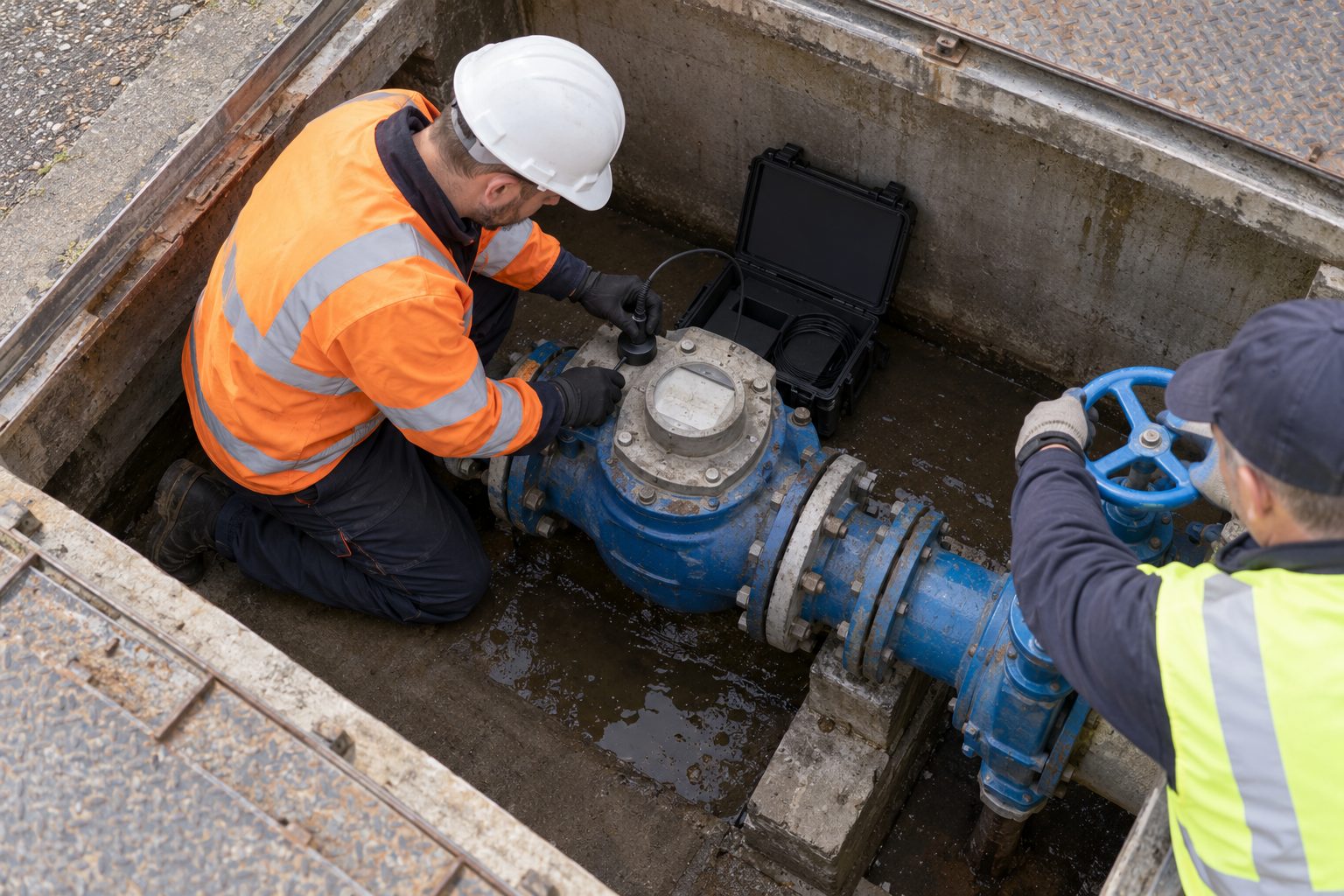
Before closing a valve, identify the services and occupiers affected, the approved access window and the person authorised to approve the shutdown. Map meters, submeters, major users, shared connections and uncertain valves. Coordinate planned isolation with fire-protection and water-management teams, using authorised, qualified personnel.[3] If you cannot locate or operate the external stop tap to isolate the supply, the CCW-published guidance says to contact your wholesaler.[7]
- Fictional card — M-01, boundary meter: Serves two occupied units and shared welfare facilities. Record the baseline reading, time, photograph reference, expected legitimate use, proposed test window, access permission and tenant notifications. Valve V-01 is unverified, so confirm its function, condition and shutdown authority before isolation. Name the authorised isolator and record restoration checks and the test result.
- Fictional card — M-02, production submeter: Record its location, systems served, baseline reading, time and photograph reference. Restrict testing to an approved shutdown window with the process owner present. Note expected process use, valve identity and condition, access approval, notifications, restoration procedure and result.
Fire-protection constraint: keep fire systems out of routine isolation testing. Route any planned effect through the relevant site authority and specify restoration checks.[3]
Record shared supplies, inaccessible meter banks and uncertain, seized or passing valves as constraints. A stop valve that does not close fully can invalidate downstream isolation results, so an inconclusive reading does not establish that the section is leak-free.[4]
Match localisation methods to the site
Require bidders to explain how each proposed method fits the pipe route and access conditions. Acoustic or ultrasonic equipment listens for escaping-water sounds; ground microphones target underground or hard-to-reach pipes; thermal imaging looks for temperature differences associated with hidden moisture.[6]
Section isolation, pressure testing, moisture mapping and tracer gas are vendor-published options rather than universal stages.[4] Flow monitoring can flag an abnormal consumption pattern without locating the failed pipe, while a moisture sensor detects water only where it is installed.[3] Cameras may support drain or sewer investigations but are not a universal method for pressurised supply leaks.[3]
Provide available pipe-route and valve-condition records. Ask how the method sequence will address seized or passing valves, shared supplies, remote meter banks and pipes beneath drives, slabs or extensions.[4]
Define where localisation ends and repair begins
Ask quotations to separate these work packages so detection is not confused with the work needed to stop the loss:[3]
- Investigation and localisation: methods, areas surveyed and required deliverables.
- Access and opening-up: required wall, ceiling, floor or slab openings and protection for occupied areas.
- Excavation: the extent of digging and access required.
- Pipe repair: shutdowns, repair method and materials.
- Testing: the test method and acceptance evidence.
- Reinstatement: backfilling, surfaces, finishes and the required standard.
Localisation should produce written location evidence, the methods used, access limitations, findings and any remaining uncertainty—not merely a verbal indication of a possible leak.[3] If the repair needs the meter removed and refitted, permission must first be obtained from the wholesaler.[7]
Keep confirmed work separate from provisional allowances for concealed conditions. State who may authorise additional work, what evidence the contractor must provide and whether work pauses pending approval.[3]
Confirm pipe responsibility before ordering work
The business-market guidance sets out the usual split for non-household premises:[7]
- Wholesaler: owns the water mains and the communication pipe, normally up to the property boundary or the company stop tap, and repairs leaks on meter unions unless there is evidence of wilful damage.
- Customer or landlord: normally responsible for the supply pipe from the boundary, any stop taps along it and the internal plumbing, excluding wholesaler-owned meters and meter unions. If the premises are rented, the landlord is probably responsible for the pipework.
- Retailer: should review high usage, alert you to a possible leak, help identify the cause of high bills and advise whether an allowance claim is realistic.
There are exceptions, for example where a private supply pipe joins the main some distance from the property, so ask the wholesaler where your boundary lies if it is unclear.[7] Dŵr Cymru, Castle Water and AquaSwitch describe the same boundary in their own terms, and AquaSwitch notes that a lease may allocate repair costs between owner and occupier.[2][5][6]
If the wholesaler becomes aware of a leak on private pipework, it can serve a leakage notice under section 75 of the Water Industry Act 1991 on the customer or landlord, copied to the retailer. The guidance describes a 14-day repair period under such a notice, after which the wholesaler may repair the leak and recharge the cost or turn off the supply.[7] Outside a notice, it says leaks on the supply pipe should be repaired within 30 days of becoming aware of them.[7]
Understand what a leak allowance requires
A leak allowance is granted by the wholesaler, through your retailer, to reduce charges caused by a leak; wholesaler policies differ on whether they reduce water charges, sewerage charges or both, and for how long.[7] Detection alone does not establish one. Castle Water describes assistance only in certain cases, and customers are charged for water passing through the meter, including downstream leakage.[2]
The CCW-published guidance sets out these conditions:[7]
- no allowance where the leak was caused by negligence of the customer, landlord, retailer or a third party, by vandalism, or by leaking internal fixtures and fittings;
- a completed leak-allowance form with evidence of the repair, such as the repair invoice or at least two actual meter reads after the repair, at least two weeks apart, showing consumption back to normal;
- photographs of the leak and meter readings where possible, and evidence that water did not enter the sewer if a sewerage allowance is claimed;
- the retailer’s application to the wholesaler within six months of the repair being completed; and
- the retailer passing any agreed allowance on within 21 days.
Because policies change, confirm the current process with your retailer and wholesaler before the repair, so the evidence is collected as the work is done.[7]
Verify the repair under comparable conditions
Agree the acceptance evidence before work starts. Require dated meter readings and photographs before and after repair, photographs of the work, documented test results, the repair location and pipe material, confirmation that operating conditions were restored, and follow-up meter data.[3][4] Plan the post-repair reads so they also meet the allowance evidence requirement of two actual reads at least two weeks apart.[7]
Repeat the relevant meter or submeter observation after restoration. Record reading times, valve positions, systems running and authorised exclusions. Compare the result with the original baseline under similar occupancy, production, irrigation and cooling demand; a lower bill alone is weak evidence if site activity also changed.[3]
- If abnormal use remains: record it as unresolved consumption, quantify it where possible and assign the next investigation step.[3]
- For the maintenance file: retain repair photographs and test records, record the location and material used, and correct inaccurate drawings and valve labels.[3]
- For an allowance application: keep the retailer’s written requirements and claim evidence together, separate from technical verification.[7]
What to confirm with each provider
The cited Water Plus and Castle Water pages do not state comparable prices or independently validated detection success rates.[1][2] Ask each provider to confirm in writing:
- total investigation price and the rates or allowances for access, excavation, repair, testing and reinstatement;
- geographical coverage and response time for the site;
- contract term, cancellation provisions and whether any performance commitment is offered;
- the exact technologies proposed and their limits;
- responsibility for permits, occupied-area protection and concealed conditions;
- the written location report and post-repair evidence supplied; and
- what support it gives with the leak-allowance claim and the evidence it will provide for it.
Issue every bidder the same meter schedule, access constraints, work-package boundaries, responsibility matrix and approval requirements. AquaSwitch also recommends asking the business-water supplier about its leakage team before appointing a commercial contractor.[6]
References
- Water efficiency | Water Plus (water-plus.co.uk)
- Business Water Leak Responsibility: Who Pays? | Castle Water (castlewater.co.uk)
- Commercial Water Leak Investigation: A Buyer Guide (thetustingroup.com)
- Unexplained Increase in Water Usage: How to Trace It – Leak Fix London (leakfixlondon.co.uk)
- Testing for water leaks at your business | Dŵr Cymru Welsh Water (dwrcymru.com)
- Commercial Water Leaks | Find, Fix and Prevent | AquaSwitch (aquaswitch.co.uk)
- Leak Allowances — Customer Guidance (Retailer Wholesaler Group good-practice document, published by CCW) (ccw.org.uk)