HROUS
HROUS Commission a Canadian office air-quality investigation by starting with complaint patterns and building conditions, then approving only measurements tied to testable hypotheses, corrective actions and reassessment—not a generic test panel.[1]
Health Canada’s office-building guidance, published September 19, 2025, applies across Canada to offices and other non-industrial, non-residential workplaces. It replaces the department’s 1995 technical guide.[1]
Start with the complaint chronology
Office air quality changes with ventilation, building condition, outdoor air, materials, furnishings, work processes, occupancy and occupant activities.[1] Before requesting measurements, record:
- dates, times and locations of concerns;
- occupancy levels and HVAC operating status;
- odours, temperature, humidity and air movement; and
- recent changes to the space, equipment or work activities.
Pair this chronology with the office history. Relevant factors include renovations, leaks or moisture events, changed space use or occupant numbers, insufficient outdoor-air intake, building age, materials, furnishings and equipment.[1] Record noise, lighting and ergonomic concerns as well because perceived air-quality problems may involve non-IAQ conditions.[1]
These fields are procurement tools, not a prescribed Health Canada interview form. The guidance does not give exact intake questions or rules for connecting an individual’s symptoms with particular places or times.[1]
Turn the walkthrough into testable hypotheses
Connect each complaint pattern to relevant office history, walkthrough observations, a plausible source or ventilation hypothesis, and an investigation capable of strengthening or weakening it. Potential sources include moisture or mould, cleaning products, fragrances, furnishings, photocopiers, cooking or combustion, renovations, attached garages, outdoor pollution, wildfire smoke and contaminants entering through outdoor-air intakes or envelope openings. Shared ventilation with neighbouring businesses may also matter.[1]
Fictional complaint-to-hypothesis mapping
The following examples are editorial procurement tools, not an official Health Canada protocol.[1]
- Afternoon odour in one zone: A nearby photocopier and return grille suggest a local or neighbouring source may be redistributed. Trace airflow and compare conditions near the equipment, grille and adjacent areas while recording occupancy, HVAC operation and copier use. The result should inform source control, relocation or airflow changes.
- Concerns beginning after renovation: New furnishings, finishes or ventilation changes suggest a renovation-related source or airflow problem. Inspect the materials and ventilation before choosing targeted measurements. Record the renovation timeline, HVAC status and space use.
Health Canada advises identifying potential causes before selecting controls and choosing solutions that prevent recurrence without creating another problem.[1]
Choose justified measurements and record conditions
Match each measurement to the decision it could change. Use three distinct paths:
- Ventilation or comfort investigation: Assess airflow, temperature, humidity and other relevant indicators in relation to occupancy, space use and HVAC operation. Do not treat one indicator as proof of overall air quality.[1]
- Contaminant-specific investigation: Select a contaminant, location and timing only when supported by a source hypothesis, such as moisture, cleaning products, renovations or outdoor-air entry.[1]
- Medical assessment: Keep individual health evaluation separate from the building investigation. Building measurements should not be used to diagnose an occupant’s illness.
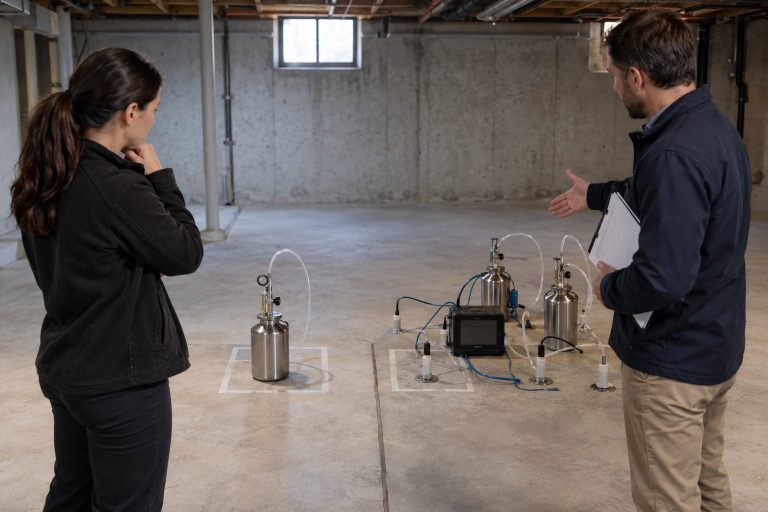
For each proposed measurement, require the scope to identify the hypothesis, method, location, timing, duration, comparison or baseline, limitations and corrective decision the result could support. Site records should capture occupancy, space use, relevant activities, HVAC mode, equipment status, recent renovations, location, time and environmental conditions.
Where ventilation is relevant, assess airflow against occupancy and use, and inspect HVAC equipment, thermostats, humidity controls and blocked grilles. Health Canada also recommends checking airflow against the applicable ASHRAE Standard 62.1.[1]
Health Canada recommends relative humidity of 30%–50%. CSA Standard Z412 temperature ranges cited in the guidance are 20°C–23.5°C in winter and 23°C–26°C in summer.[1] Use these figures as investigation context, not as proof the entire office is acceptable.
Do not turn workplace exposure limits into universal office pass-or-fail criteria. Health Canada’s guidance does not establish a mandatory test package, sampling duration or quality-assurance method for every office investigation.[1]
Compare five regional investigation options
Compare service territory, investigation approach and alignment with the suspected problem. The provider details below come from the companies’ own pages.
AirQualityInspections.ca
- Service area: The GTA and listed Ontario locations including Barrie, Muskoka, Hamilton, Waterloo, London, Niagara Falls, Sarnia and Windsor.[2]
- Investigation approach: Walkthrough-based source investigation and extended monitoring.[2]
- Suited to: Ontario commercial owners and property managers seeking source investigation or monitoring over time.[2]
Inch By Inch Inspections
- Service area: Toronto and the surrounding GTA, with local pages for Mississauga, Scarborough and Etobicoke.[3]
- Investigation approach: Air testing combined with services such as moisture and leak detection, thermal imaging, mould inspection and designated-substance surveys.[3]
- Suited to: GTA commercial properties where moisture or building materials may contribute to airborne findings.[3]
SafeAir
- Service area: The GTA and Southern Ontario.[4]
- Investigation approach: Testing-only services, with no sale of related products or services; the company says each Toronto/GTA IAQ service includes a 15–30-page report with findings and proposed solutions.[4]
- Suited to: Offices seeking separation between testing and the sale of remediation work.[4]
Air Quality Testing Canada
- Service area: Greater Montreal, Ottawa–Gatineau and Eastern Ontario communities including Kingston, Brockville, Belleville, Cornwall and Carleton Place.[5]
- Investigation approach: Its published residential workflow includes a walkthrough, calibrated sampling, an outdoor baseline, third-party laboratory analysis and reporting; the company also says it serves businesses.[5]
- Suited to: Ontario or Quebec buyers seeking a written estimate that identifies sample counts and turnaround pricing.[5]
PSL Patrick Sprack Limited
- Service area: Northern Ontario communities including Sudbury, Parry Sound, North Bay, Timmins, Manitoulin and Kirkland Lake.[6]
- Investigation approach: Particulate, gas, mould, moisture, airflow and HVAC assessment, followed where applicable by filtration, ventilation, humidity-control or source-control work.[6]
- Suited to: Northern Ontario offices or mixed commercial and industrial properties seeking assessment and implementation from one contractor.[6]
Specify the quote and report deliverables
Make the quote describe an investigation, not merely a sample count. Health Canada notes that qualified HVAC professionals or occupational hygienists may be needed in some situations, but its guidance does not prescribe detailed quality-assurance or report-acceptance specifications.[1]
- Purpose and boundaries: Connect each walkthrough task, measurement and sample to a documented complaint pattern or hypothesis. Identify exclusions, assumptions and access requirements.
- People and methods: Name who will conduct the walkthrough, ventilation assessment and sampling, who will perform laboratory analysis, and who will interpret the results. Confirm that each person’s professional scope suits the location and assignment.
- Evidence and pricing: Request measurement methods, equipment and calibration evidence, laboratory identity and relevant accreditation evidence, chain-of-custody arrangements, sample counts, turnaround times, limitations and additional-sample pricing.
- Report: Require visit conditions, findings by location, contextual interpretation, unresolved uncertainties, prioritized corrective options and a reassessment method.
Assign corrective-action ownership
Attach a corrective-action register to the scope. For each issue, identify the interim control, permanent action, responsible party, target date, completion evidence and reassessment trigger.
- Building operations: Assign building-envelope, moisture, ventilation and HVAC work.
- Employer: Assign changes to office activities, products or procurement.
- Investigator: Assign agreed clarification, verification and follow-up tasks.
This is a practical ownership model, not a federal matrix. Health Canada identifies building operators, employers, health-and-safety committees or representatives, and employees as participants in office IAQ management.[1]
Corrective options may include source reduction, moisture correction, ventilation maintenance or adjustment, and suitable filtration.[1] Account for commercial interests when assigning the work: PSL describes both assessment and implementation services, while SafeAir describes itself as testing-only.[4][6]
Reassess instead of stopping at one result
Define success before corrective work begins by connecting it to the original complaint pattern, observed deficiency and operational objective. After the work, confirm completion and repeat relevant observations or justified targeted measurements.
Where possible, compare conditions under similar occupancy, space use, HVAC operation, timing and outdoor influences. Indoor-air factors vary over time, and ventilation and energy-conservation objectives may need to be balanced.[1]
If concerns persist, move to another zone or appear only under conditions missed during the first visit, revise the hypothesis. Health Canada treats corrective action, reassessment, maintenance and monitoring as distinct stages rather than treating one laboratory result as conclusive.[1] It does not specify a universal reassessment deadline, so the scope should set timing based on the corrective work and complaint pattern.[1]
What to confirm with each provider
The cited pages for AirQualityInspections.ca, Inch By Inch Inspections and SafeAir [2][3][4], Air Quality Testing Canada and PSL [5][6] do not state commercial-office prices, standard contract terms, travel charges or sample limits, or show named laboratories, calibration records or sample office reports; Air Quality Testing Canada’s posted prices apply to residential packages.[5]
- Request a commercial-office quote separating professional time, equipment, laboratory charges, travel, additional samples and rush work.
- Confirm deposits, payment schedule, cancellation or rescheduling terms, turnaround commitments and sample limits.
- Request relevant qualifications, insurance evidence, calibration records, laboratory accreditation evidence and a redacted office-report example.
- Define who owns corrective work, what follow-up is included and what would trigger a new fee.
Approve a scope only when it connects complaint patterns to building and ventilation conditions, justifies each measurement, records operating conditions, assigns corrective actions and provides a reassessment plan.
References
- Guidance on improving indoor air quality in office buildings – Canada.ca (canada.ca, 2025)
- INDOOR AIR TESTING TORONTO | Indoor Air Test Toronto Ontario (airqualityinspections.ca)
- Indoor Air Quality Testing Toronto | Inch by Inch Inspections (inchbyinchinspections.com)
- Air Quality Testing Toronto | Mold Inspection | SafeAir (safeair.ca)
- Air Quality Testing Services in Canada: How to Choose a Pro (airqualitytesting.ca, 2025)
- Why Indoor Air Quality Matters for Businesses – PSL: Full-Service Contracting (psltd.ca, 2024)