HROUS
HROUS Separate Public Notification From Private-Line Coverage
Commission private utility locating across the complete disturbance area when public notification does not establish the private-service layout. The private locate supplements public markings; it does not replace the applicable notification process.[4][5]
Before excavation opens, OSHA requires the estimated locations of underground installations reasonably expected to be encountered to be determined. Utility companies or owners must be contacted, told about the proposed work and asked to establish their installations’ locations before excavation starts.[1]
Potential private facilities include:
- Site lighting and irrigation wiring
- Communications and private fire-water lines
- Sewer and storm drainage
- Electric, water or other services between buildings[3][4]
Do not classify a line solely by its location on private property. ProMark says private responsibility generally begins after the meter, service connection or designated service point.[3] Trinity first describes private lines as extending beyond the utility-owned endpoint but later reverses that relationship for large facilities.[4] Both say ownership can depend on the utility, site configuration, easements and local rules.[3][4]
Define the Complete Disturbance Area
Issue a written request tied to the physical work rather than asking a provider to “mark the site.” State the jobsite address, exact work limits, schedule, excavation method, expected disturbance, known facilities and access arrangements.[5]
- Trenching: Include the trench route and associated disturbed area.[5]
- Grading: Include every planned cut and disturbed surface.[5]
- Boring: Include the alignment, entry and exit locations, and other affected areas.[5]
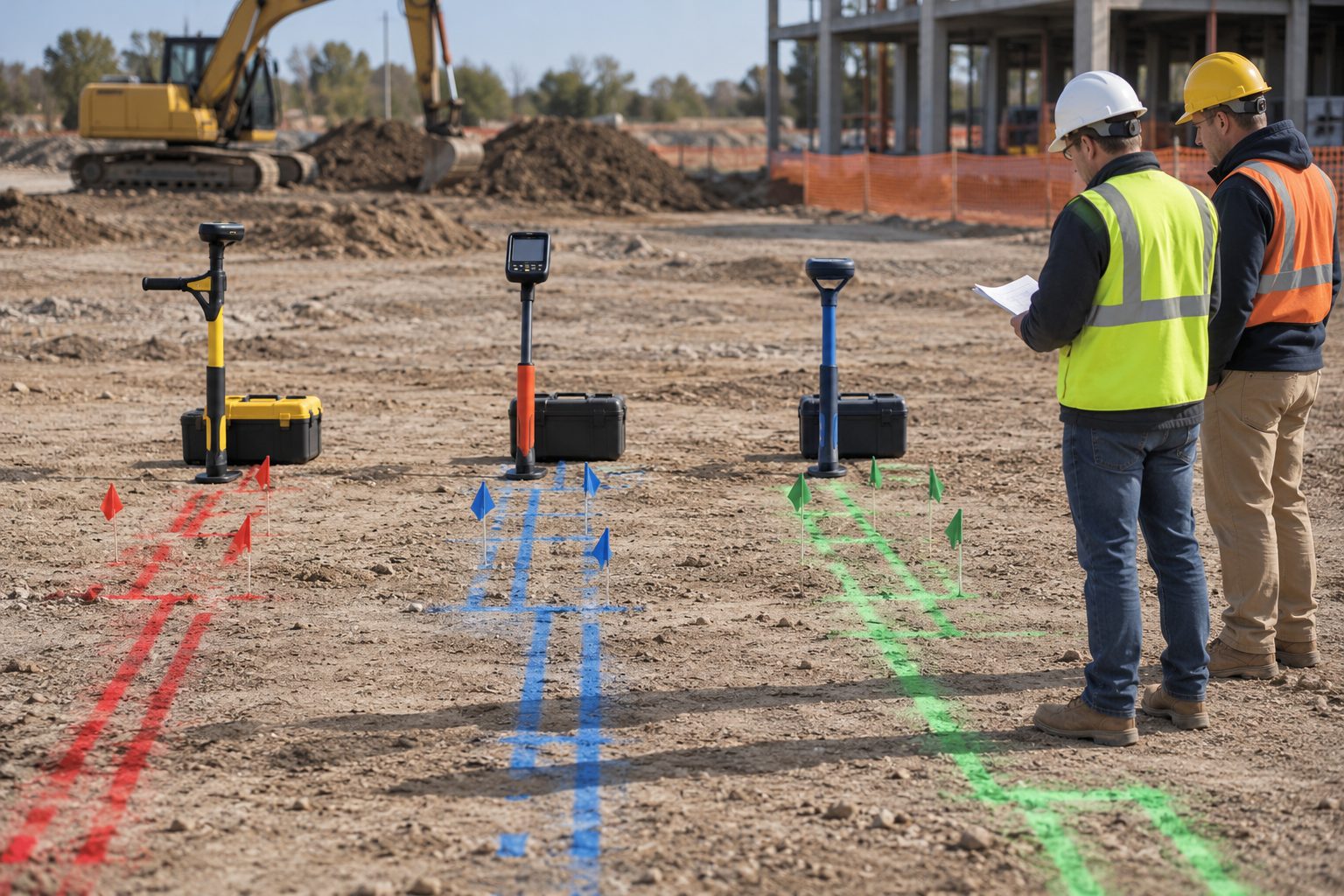
Include equipment-access areas and establish the boundaries through plans, measurements, site paint or stakes, or a field walk with the locator.[5]
Provide available site plans, as-builts, utility records and repair history. Flag renovations and ask site personnel about detached structures, lighting, gate operators, irrigation, added services and cross-property or interbuilding connections.[3]
Arrange access to meters, panels, valves, handholes, cleanouts and irrigation controls.[5] Require the provider to document what will be searched, what is excluded or inaccessible, and which conclusions depend on records or usable connection points.
Compare Three Private Utility Locating Providers
Compare each provider on the same three factors: published capabilities, described project fit and disclosed service area.
ProMark Locating
- Published capabilities: ProMark discusses private-utility field verification for soil disturbance, slab cutting, coring and drilling when public markings or records are incomplete.[3]
- Suited to (provider description): Contractors, owners, facility managers and project managers handling commercial sites, older properties, campuses, multifamily developments, trenching or slab penetrations.[3]
- Disclosed service area: The cited page identifies no states, cities or other operating territory.[3]
Trinity Subsurface
- Published capabilities: Trinity lists utility locating, vacuum excavation, concrete scanning, CAD/GIS mapping, manhole imaging and subsurface utility engineering.[4]
- Suited to (provider description): Corporate campuses, universities, retail properties and sites containing mixed public and private utilities.[4]
- Disclosed service area: The cited page lists headquarters in Wilmington, Delaware, but no state-by-state operating area.[4]
Private Utility Locating LLC
- Published capabilities: The company describes contractor locating and pre-excavation scanning tailored to defined work limits, excavation method, site access and schedule.[5]
- Suited to (provider description): Trenching, grading and boring near parking-lot lighting, detached-building services, irrigation, communications and site-equipment lines.[5]
- Disclosed service area: The company states that it serves Cape Cod, the Islands and surrounding areas, and addresses Massachusetts contractors using Dig Safe/811.[5]
Specify Markings, Mapping and Unresolved Areas
Treat paint and flags as temporary indicators of detected facilities’ apparent routes within the requested area—not as a complete underground map or a guarantee of exact depth.[5] Specify these contract deliverables:
- Coverage record: The requested area and area actually searched, including inaccessible or unresolved locations.[5]
- Detection record: Detected facilities, identifiers, offsets and notes, including unexplained gaps or responses that could not be confidently identified.[5]
- Supporting record: Photographs, field notes, records reviewed, and marked-up plans or mapping when included in the quote.[5]
- Limitations record: Uncertainty, exclusions, inaccessible areas and conditions affecting detection. Incorporate unresolved uncertainty into the excavation plan rather than treating it as evidence that no facility exists.[5]
No nationwide requirement for a deliverable formally called a “limitations record” is established by the cited material, so request it expressly. Detection can vary with utility material, depth, access, interference, congestion, connection points and site conditions. Records may omit renovations, abandoned facilities, undocumented work or inaccessible endpoints.[3][5]
Set Verification and Escalation Rules
Before intrusive work, compare the complete excavation route with the field markings and resolve conflicts, unexplained gaps and unexpected conditions.[5]
The escalation plan should call for work to stop and the locate to be reassessed when:
- Work limits are unclear or records conflict with field markings.
- Marks are missing, deteriorated or unsuitable for planning.
- A facility is unidentified, an area was inaccessible or site conditions do not match the locate.
- A later phase or field change extends beyond the area previously addressed.[5]
Assign who may stop work, request another locate, contact the facility owner, arrange project-appropriate professional verification, revise the documentation and authorize work to resume. OSHA requires an installation’s exact location to be determined by safe and acceptable means as excavation approaches its estimated location.[1]
Do not assume an apparently unused line is abandoned. Locating a facility and establishing whether it remains operational are separate questions.[5]
Use a separate escalation path for slab cutting, coring or drilling. ProMark says the investigation should consider embedded conduit, energized circuits, rebar, post-tension cable and other concrete hazards that may fall outside an outdoor utility locate.[3]
What to Confirm With Each Provider
The cited pages for ProMark, Trinity and Private Utility Locating LLC do not state prices, minimum or travel charges, quote validity, payment terms, contract duration, cancellation or rescheduling terms, warranties, insurance limits, or independently validated accuracy and detection results.[3][4][5]
Give each provider the same scope and request written confirmation of:
- Price, fees, payment terms and quote validity
- Cancellation, rescheduling and return-visit terms
- Methods proposed for the expected facilities and site conditions
- Personnel qualifications, certifications and insurance limits
- Availability and geographic coverage for the project
- Included markings, maps, photographs, notes and limitations documentation
- Authorization and cost treatment for additional investigation
Choose based on documented scope fit, useful deliverables, disclosed limitations and a workable escalation process—not an unsupported promise that every buried facility will be found.
Verify State and Local Rules
Check the applicable state and local one-call and excavation rules before authorizing work. The cited sources do not establish nationwide notice periods, ticket life, positive-response procedures, tolerance zones, white-lining rules, remarking requirements, emergency procedures or penalties.[1][2][4][5]
The City of Los Angeles procedure, for example, applies to Bureau of Engineering projects and includes California-specific requirements; it does not establish requirements for commercial projects elsewhere.[2]
Release excavation only after the project team confirms:
- The applicable public-notification requirements have been identified and addressed.[1][2]
- The private locate covers the complete disturbance area, and the planned work has been compared with the markings.[5]
- Plans, photographs, field notes and other locate records should be retained.[5]
- Unclear markings, unidentified facilities, conflicts and other unresolved conditions have been escalated before work begins.[5]
References
- 1926.651 – Specific Excavation Requirements. | Occupational Safety and Health Administration (osha.gov)
- 8.5 Utility Coordination | Bureau of Engineering (lacity.gov)
- Who Is Responsible for Private Utilities? – ProMark Locating (pmlocating.com)
- What are Private Underground Utilities? (trinitysubsurface.com)
- Contractor Utility Locating Before Trenching & Boring (privateutilityllc.com, 2026)