HROUS
Water bowser hire for UK site managers: compare two options
Compare Maximus’s 2,000-litre site-only bowser with PSM’s 1,100-litre road-towable option: the choice depends on confirmed usable water, intended movements and an agreed delivery-to-refill scope—not tank capacity alone.[1][2] Drinking-water supply is outside this comparison. PSM expressly excludes drinking-water use; Maximus’s “fresh water” description does not establish a drinking-water designation or certification.[1][2]
Compare capacity, movements and water connections
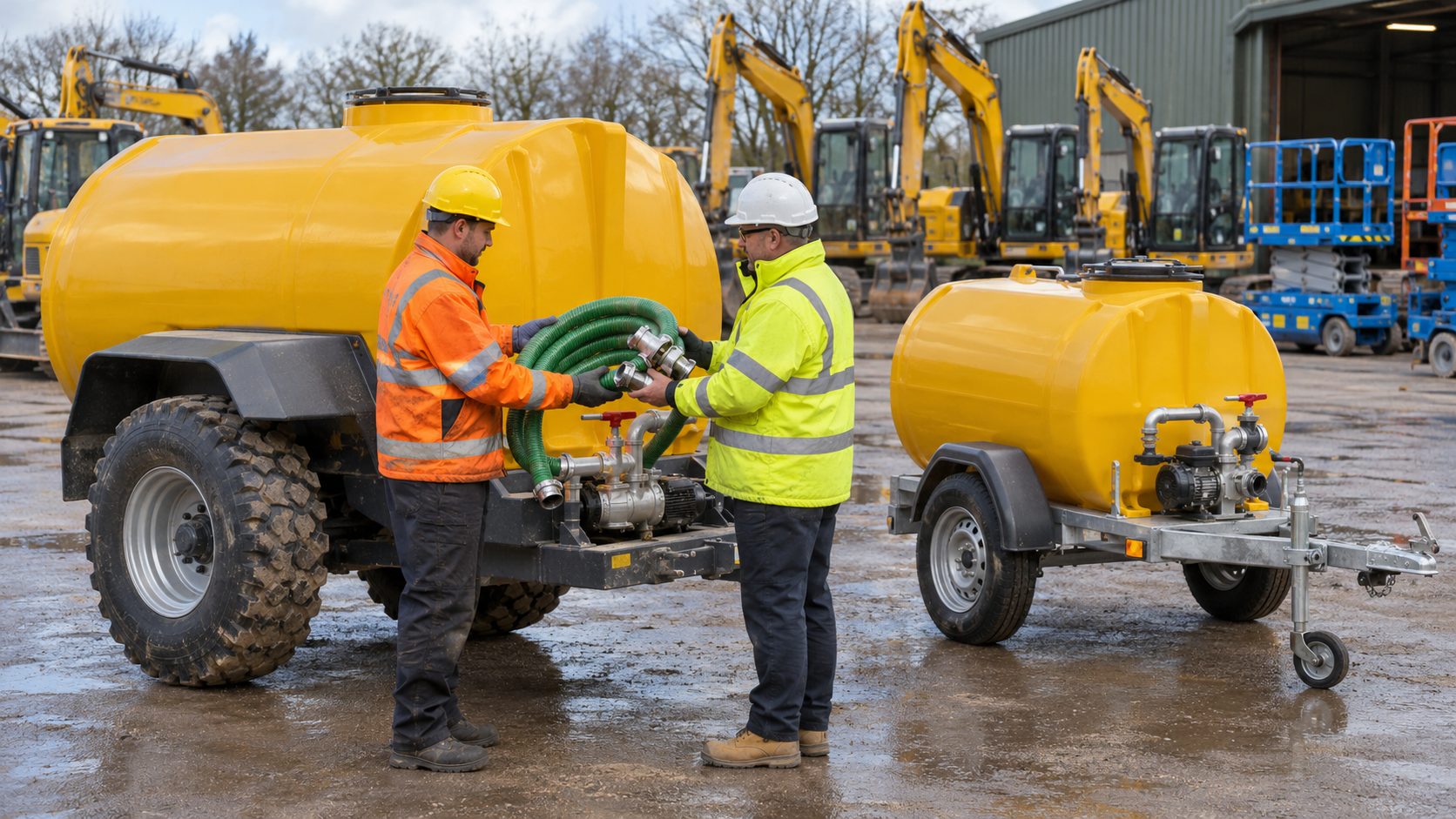
Maximus Hire Group — 2,000-litre site-only bowser
- Capacity and usable volume: Maximus states a tank capacity of 2,000 litres. Maximus Hire Group lists water bowser capacities of 1000L and 2000L for estimating working duration.[1]
- Road/site suitability and delivery scope: This option is explicitly on-site-only, for off-road use. Maximus requires firm, level ground and vehicular access.[1]
- Pump, outlets and refills: Request the pump specification, outlet connections and refill method in the quotation.[1]
PSM Hire — 1,100-litre road-towable bowser
- Capacity and usable volume: PSM states a tank capacity of 1,100 litres. Ask for its usable litres per fill rather than using the stated capacity as available working water.[2]
- Road/site suitability and delivery scope: PSM describes the bowser as “highway approved”. Agree delivery scope, site access and tow-vehicle suitability for the actual unit supplied.[2]
- Pump, outlets and refills: An electric on-demand pump can be fitted, making it an option rather than confirmed standard equipment. Ask PSM to confirm outlet connections and refill arrangements.[2]
The larger tank and the road-towable description address different requirements. Keep both options conditional until the supplier confirms usable volume and the arrangements needed to keep water available.
Calculate the refill interval from usable water
Start with your site’s water demand per working day and the longest practical gap between refill opportunities. Obtain usable litres per fill from each supplier, and ask what daily consumption assumptions support any estimate of how many operating days a tank will cover.[1][2]
Illustrative daily-demand calculation — insert your site figures
- D = demand in litres per working day, supplied by your site team.
- U = supplier-confirmed usable litres per fill.
- R = a planning reserve, in litres, selected for the job.
- G = working days between available refills, based on the site’s access windows.
Planned working duration per fill = (U − R) ÷ D. To bridge the refill gap, require U − R ≥ D × G. This is a planning calculation using your inputs, not a supplier performance claim. Keep the reserve separate from water allocated to planned work.
Apply the calculation separately to each bowser, using its own confirmed usable volume but the same demand, reserve and refill gap. Do not substitute the published 2,000-litre or 1,100-litre tank capacity for U without supplier confirmation.[1][2]
If neither result covers the gap, ask for a revised supply arrangement or additional capacity. Identify who will arrange and complete replenishment, then check that they can attend during the available refill windows. A tank choice is not a complete supply plan until those responsibilities are agreed.
Choose site-only or road-towable use
Establish whether the bowser will move only within the site or also travel on public roads. Have the supplier confirm that the quoted unit suits those movements and the proposed towing arrangement.
- Maximus: the selected option is site-only/off-road. Lights and indicators described for Maximus’s separate road units should not be assumed to apply to it. Check the delivery and positioning route against its requirement for firm, level ground and vehicular access.[1]
- PSM: the supplier describes its option as “highway approved”; ask for the approval standard or certificate, tow-vehicle requirements and site-access conditions.[2] Request confirmation for the actual unit and intended towing arrangement.
Assign responsibility for delivery, positioning, movement, refilling and collection. Ask the supplier to specify these services for the bowser in the quote, including initial water and replenishment where needed. [1][2]
Obtain delivery-area confirmation for the site postcode from either supplier. Ask Maximus and PSM to confirm coverage rather than treating addresses and depot listings as evidence that the site is served.[1][2] Agree access windows before accepting the delivery arrangement.
Match the pump, hoses and refill access
PSM says its water bowsers can be fitted with an electric on-demand pump.[2] Ask for it to be included explicitly if the proposed setup needs it.
Ask PSM for its pump price and power requirements, Maximus for its pump specification, and each supplier for the outlet diameter, hose connections, flow rate, filler opening, fill height and refill method.[1][2]
Send the supplier the equipment details and ask for a compatible setup:
- Equipment and demand: identify what the bowser will supply and the required flow. Ask whether the proposed setup can meet that demand.
- Pump and power: establish who provides the pump, its power requirements and whether the available site supply is suitable.
- Outlets and hoses: confirm outlet type and diameter, matching connections, hose reach from the intended bowser position and any adapters.
Check filling separately from discharge. Identify the water source and refill provider, then agree the connection or filler access, filling position and access window. Ask whether the proposed refill equipment can connect to—or reach—the bowser in that position.
Record who supplies the pump, hoses, adapters and refill equipment, with any charges included in the quote. Seek confirmation against the equipment being supplied, rather than a general assurance that a pump is available.
Compare the quoted scope, not just the weekly rate
PSM lists £108.50 per week excluding VAT and a separate £500 deposit.[2] Maximus directs customers to request a quote without displaying a hire amount or deposit.[1]
Ask both suppliers for the minimum booking period and price effective date, and ask PSM for its deposit-return conditions.[1][2] PSM’s weekly price unit does not expressly establish a one-week minimum.[2] Ask PSM when the deposit is returned and what deductions may apply.
Request a like-for-like written breakdown, marking each item as included, separately charged or your responsibility:
- Equipment hire for the planned duration.
- Optional pump, hoses and connections.
- Delivery and collection.
- Initial water provision and subsequent replenishment.
- Cleaning and hire-extension charges.
This is a scope checklist, not a list of established extras. Compare the total quoted arrangement rather than assuming PSM’s weekly rate covers the same services as a Maximus quotation.
PSM allows the supplied make and model to differ from the displayed unit, so obtain the actual specification before booking.[2] Recheck the price and agreed equipment together: a quotation is useful only if it covers the setup being supplied.
Agree cleaning, collection and extensions
Before delivery, get the bowser’s care instructions, collection arrangements and contact for equipment problems. Agree cleaning and servicing responsibilities in the hire scope. [1][2]
Ask both suppliers for cleaning procedures, hire-extension rules, cancellation and refund conditions, late-return terms, damage charges and insurance requirements; ask PSM to confirm delivery, servicing and collection arrangements too.[1][2]
Put the end-of-hire responsibilities alongside the quotation:
- Preparation and care: who prepares the bowser before delivery, what care is expected during hire, who cleans it before return and who handles remaining water.
- Collection: the date or collection window, access to keep available and whom to contact if site conditions or the programme change.
- Extensions: how to request extra hire, the notice deadline, the price and how approval will be confirmed.
- Contract terms: cancellation charges or refunds, late-return terms, damage responsibilities and any insurance requirements.
Keep the written answers with the booking details and contact names. If the programme changes, use the agreed extension process rather than assuming the booking will renew or that additional days will be free.
Make the choice against the complete supply plan
Consider the Maximus 2,000-litre option for site-only movement and the PSM 1,100-litre option for a job that requires public-road movement of a non-drinking-water bowser. Confirm usable volume, connections, refilling, the towing arrangement and coverage for your actual site before deciding. [1][2]
The published offers do not establish equivalent service scopes or shared delivery coverage, so they do not demonstrate which is cheaper overall.[1][2]
Before booking, check that the written agreement answers these questions:
- Will the water last? Confirmed usable volume, less the planning reserve, covers demand until the next refill.
- Who replenishes it? A named party accepts responsibility for arranging and completing refills.
- Will movements work? The actual unit, towing arrangement and site access suit the intended use.
- Does the equipment connect? Pump, power, hoses and connections match the equipment being supplied.
- Is the full scope recorded?
Send the supplier the site postcode, daily demand, refill windows, equipment requirements and intended movements with the enquiry. Resolve any missing answer before relying on the bowser to sustain the work.
References
- Water Bowser Hire | Maximus Hire Group (maximushiregroup.co.uk)
- Road Towable Water Bowser – 1100 Litre | Bowsers | Building & Site (psmhire.co.uk)