HROUS
Thermal Shock Testing in Canada: Requirements for Engineering Teams
Before commissioning thermal shock testing, separate the exposure and acceptance requirements in the governing specification from optional monitoring and reporting additions, then obtain the laboratory’s agreement on the actual assembled, instrumented load. DEKRA’s Canadian-domain service page and Element Kitchener’s page establish relevant capabilities, but neither confirms specimen-specific performance or a promised evidence package. [1][2]
- Specification-required: identify the governing document, revision, method, exposure limits, cycle count and acceptance criteria.
- Proposed additions: label extra monitoring, inspection and reporting requests separately.
- For laboratory agreement: confirm specimen fit, loaded transfer and dwell, interruption handling and deliverables before commissioning.
Compare published capabilities
DEKRA: Canadian-domain service
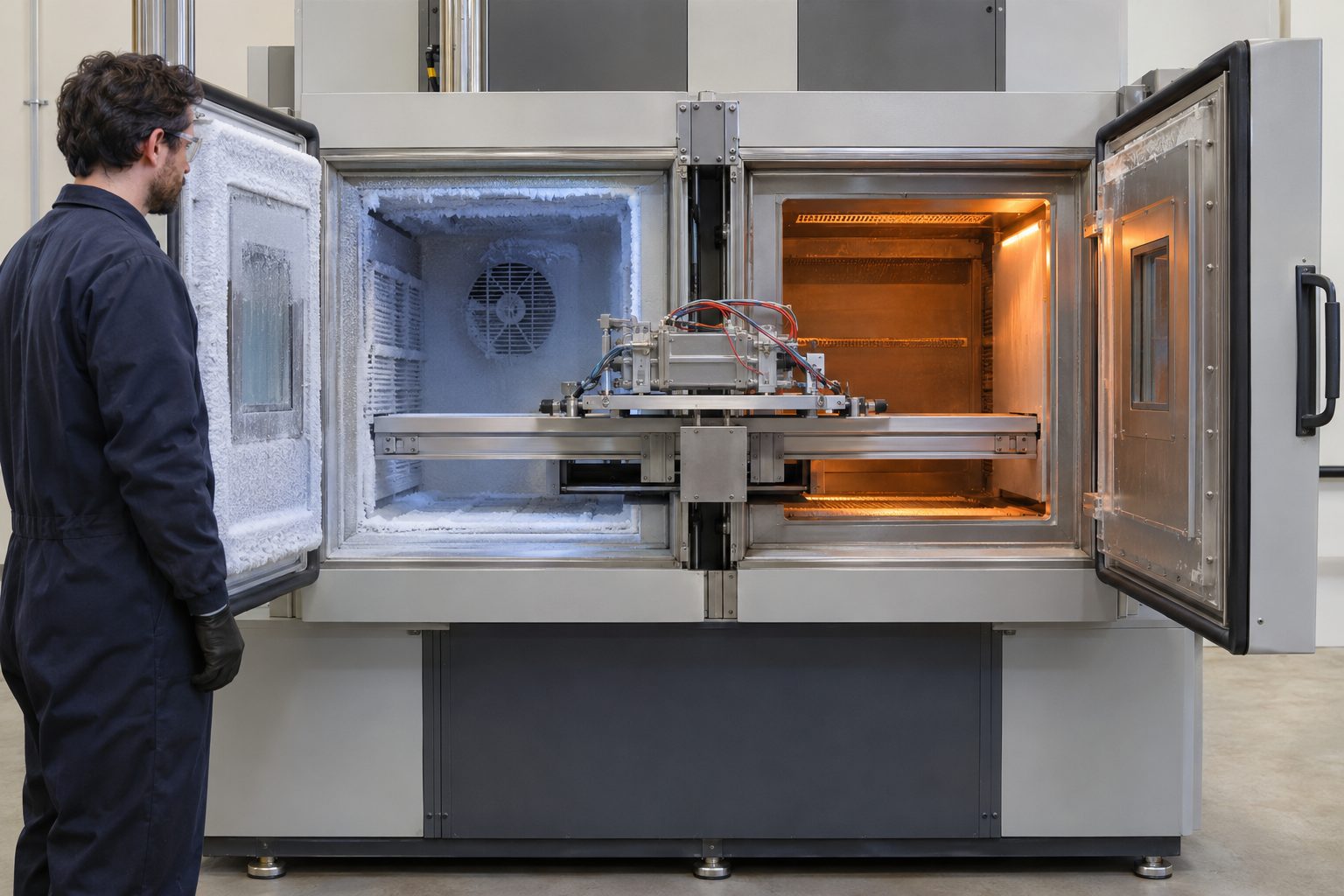
- Method: air-to-air testing, moving specimens between separate heated and cooled chambers. [1]
- Temperature range: −70 °C to 190 °C. [1]
- Location: the page describes global reach; establish the performing laboratory and shipping address before arranging shipment. [1]
- Transfer and dwell: DEKRA says temperature limits, transfer time, dwell and cycle count can be tailored to customer requirements. [1]
- Evidence: DEKRA reports A2LA accreditation for technical competence and data integrity and offers results-interpretation support; agree the specific records to be delivered. [1]
Element: Kitchener, Ontario
- Methods: air-to-air and liquid-to-liquid thermal shock. [2]
- Temperature range: request confirmation against the required hot and cold targets. [2]
- Location: Kitchener, Ontario. [2]
- Transfer and dwell: obtain confirmation for the assembly, fixtures and instrumentation. [2]
- Evidence: Element Kitchener lists its A2LA ISO/IEC 17025:2017 accreditation and a client portal. Check the current scope for the facility and the exact thermal-shock method you plan to order. Agree the exposure and inspection records separately. [2]
The cited DEKRA page does not state a Canadian test location, the cited Element page does not state a thermal-shock temperature range, and neither states loaded transfer performance or specific evidence deliverables. [1][2] The published temperature capabilities therefore cannot be compared directly; use these descriptions to begin a specimen-specific scope, not to rank the providers.
Separate governing requirements from additions
Start the scope sheet with the governing document and revision, applicable method or clause, customer amendments, exposure limits, cycle count and acceptance criteria. Take these requirements from the product or customer specification—not from a laboratory’s capability list.
Identify the clause behind each required condition. Mark additional monitoring, inspection or reporting as proposed additions, and flag unresolved feasibility or deliverables for written agreement.
DEKRA’s stated standards coverage includes MIL-STD-810G Method 503 and IEC 60068-2-14; it describes air-to-air test parameters as tailored to customer requirements and prevailing standards, rather than making every listed standard applicable to every test. [1] Element Kitchener likewise does not present its listed methods and approvals as mandatory conditions for every booking. [2]
Keep accreditation separate from the agreed scope. Specify the evidence needed to assess the result rather than treating an accreditation statement as a deliverables schedule.
Define the assembled specimen and instrumentation
Describe the complete test configuration, not merely the component name. DEKRA includes assemblies in its service scope; Element Kitchener lists subassemblies and industrial assemblies. [1][2] Neither cited page states chamber dimensions, specimen envelopes, mass limits, fixture restrictions or instrumentation capacity. [1][2]
Prepare a specimen description covering:
- Identity: sample IDs, quantity, part number, configuration and revision.
- Physical definition: assembled dimensions, mass and materials relevant to the test.
- Operating state: powered, unpowered or operated during exposure, with intended conditions described.
- Exposure configuration: fixtures, mounting orientation, cables, connectors, fluids and any packaging remaining during testing.
- Supporting details: dimensioned drawings or photographs showing the assembly and fixtures, plus sensor locations, attachment methods and cable routing.
Agree the sensor-channel quantity, who supplies and connects sensors and data-acquisition equipment, the sampling interval, and whether chamber-air and specimen temperatures will both be recorded.
Keep the specimen-and-instrumentation description under an agreed revision so the laboratory’s fit and performance confirmation refers to the configuration being tested.
Confirm rapid transition with the actual load
Ask the laboratory to confirm the required transition against the complete load description—not an unloaded chamber capability. DEKRA describes abrupt movement between separate heated and cooled chambers. [1] Check any proposed gradual temperature-cycling profile against the governing specification rather than treating it as equivalent.
DEKRA identifies transfer time as customer-tailored; Element Kitchener lists air-to-air and liquid-to-liquid methods. Neither cited page states numerical transfer capability or verifies it for an assembled, instrumented load. [1][2]
Put these conditions into the scope:
- Method and targets: identify the required thermal-shock method and hot and cold targets.
- Transfer limit: record the specified maximum time and the definition of when transfer starts and ends.
- Separate measurements: distinguish physical transfer time, chamber conditions and the recorded specimen-temperature response.
- Loaded confirmation: tie the laboratory’s response to the assembly, fixture and instrumentation revision, including conditions attached to achieving the transition.
If suitability remains unresolved, propose a preliminary demonstration or supporting evidence. Define its configuration, measurements and acceptance basis before proceeding; treat it as a proposed scope addition, not an assumed service inclusion.
Define dwell and the evidence demonstrating it
Define when the dwell clock starts, not only how long it runs. Use the governing specification to establish whether dwell is time-based, depends on temperature stabilisation or follows another condition. Resolve ambiguous wording before commissioning.
- Targets and tolerances: identify whether each applies to chamber air, the specimen or another measurement.
- Duration and start rule: state the required hold at each extreme and the event or temperature condition starting it.
- Cycle definition: define a complete cycle and the required total.
- Evidence: identify the recorded channel or log demonstrating each target, tolerance, dwell interval and completed cycle.
DEKRA offers customer-tailored dwell times and cycle counts for air-to-air testing, but its cited page does not state achievable dwell ranges or stabilisation criteria. [1] Element’s page does not state thermal-shock cycle-count details. [2]
Keep programmed setpoints separate from recorded exposure. Agree which temperature traces and timestamps will demonstrate the required dwell, including specimen-temperature records where required by the specification or agreed as an addition.
Agree interruption and restart handling
Neither cited page states interruption limits, cycle-invalidation rules or restart-reporting arrangements. [1][2] Propose a written protocol covering power loss, chamber alarms, aborted transfers, out-of-tolerance exposure and instrumentation failure.
For each event, request:
- Identity and timing: event identifier, timestamp, affected specimen IDs and monitoring channels.
- Exposure stage: cycle number, transfer or dwell stage, and observed condition.
- Response: action taken and the point from which testing resumed.
Keep the event record separate from the decision about its consequences. Apply the governing specification—or an agreed project rule where it leaves discretion—to determine whether the cycle counts, must be repeated or needs further disposition.
Define who may authorise a departure or restart. Retain that decision with the event record, and request event identifiers in the final report so reviewers can connect decisions to the exposure data.
Specify retained records and post-test inspection
Agree a deliverables schedule linking exposure records, specimen identity and the final report. Neither cited page promises raw temperature data, sensor-by-sensor traces, inspection evidence or retention terms. [1][2]
For each item below, identify the governing clause if required; otherwise mark it as a proposed addition:
- Temperature data and traces: agree exported data and plots linked to specimen ID, channel ID and sensor location.
- Chamber logs and transition measurements: agree timestamped records and measurement definitions linked to run and cycle identifiers.
- Completion, deviation and restart records: request an event log distinguishing completed and repeated cycles, linked to the exposure data.
- Inspection and functional checks: define methods and acceptance criteria; propose photographs and baseline comparisons unless already required. Link findings to specimen IDs and inspected features.
For each deliverable, agree the file format, delivery arrangements, retention period and customer access after testing.
Request final-report fields covering specimen identity and configuration, specification and revision, actual settings and recorded results, sensor locations, completed and repeated cycles, deviations and inspection findings. Agree calibration records, metadata and a signed report where relevant rather than assuming inclusion.
Keep the conclusion tied to the recorded exposure and governing acceptance criteria. A published capability range does not establish specimen acceptance or product life. [1][2]
Check the scope before commissioning
Mark each item confirmed, unresolved or not applicable, with its supporting document:
- Configuration: sample IDs, assembly state, fixtures and instrumentation fixed.
- Fit: complete load accepted by the performing laboratory.
- Exposure: required transfer and dwell confirmed for that load.
- Monitoring: sensor locations, recording channels and sampling interval agreed.
- Interruptions: invalid-cycle, restart and deviation-reporting rules agreed.
- Evidence: exposure records, post-test inspection and retention arrangements agreed.
Record the performing laboratory and resolve conditions essential to the governing test or post-test review. Optional evidence need not become a purchase requirement. Proceed when the laboratory confirms the required exposure for the actual assembly and agrees the evidence needed to review the result.
References
- Thermal Shock Testing | DEKRA Canada (dekra.ca)
- Element Kitchener (element.com)