HROUS
How to Choose US Labs for Accelerated Weathering Testing for Plastics
To choose a laboratory for an outdoor plastic component or coating, request the same written scope from each: exposed surface, specimen preparation, light source, exact exposure cycle, replicates, unexposed controls, measurement intervals and acceptance criteria. Treat these as quote requirements; identify additional assessments as optional rather than assuming they are included.

Define the exposed surface and qualification question
Mark the outdoor-facing surface on a drawing or photograph, identifying which faces should be exposed and which should be protected. Specify whether you will submit a finished component, coated substrate, coupon or assembly. Include material identification, coating and substrate details, production condition, preparation steps and proposed cutting or mounting.
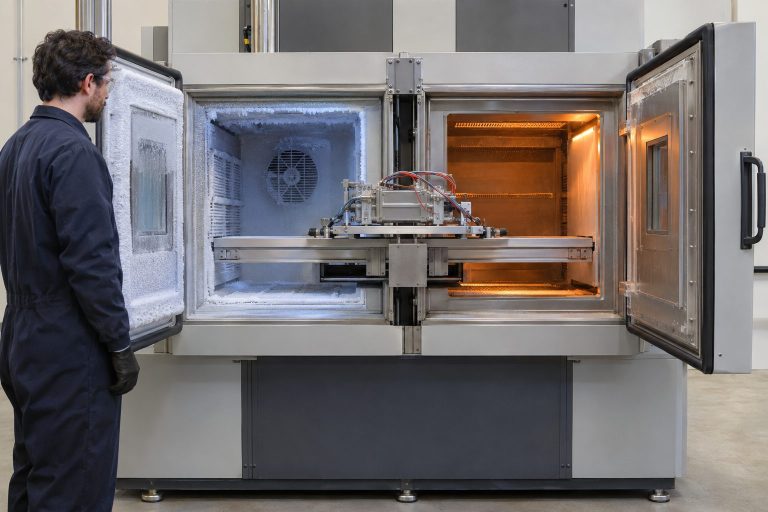
Ask the laboratory to approve the specimen form and preparation plan before preparing or shipping samples. Use published specimen descriptions as a fit check, not automatic approval. Westpak describes testing coupons and small assemblies. [1] Confirm availability for a US project.
Separate appearance qualification from mechanical-performance qualification—or request both. Applied Technical Services (ATS), which accepts US enquiries, lists color change, gloss, haze and optical transmission as visual evaluation options, and impact resistance, tensile strength and abrasion as structural options. These are available assessments, not mandatory measurements or acceptance limits. [2]
Name the properties to assess rather than requesting a generic “before-and-after evaluation.” A reusable scope statement is:
“Qualify the identified outdoor-facing surface of [part/material/coating] for retention of [appearance and/or mechanical property], using laboratory-approved specimen preparation and exposure, with agreed measurements and acceptance criteria.”
Choose the light source before discussing exposure hours
Start with the governing customer specification and intended outdoor exposure. Ask the laboratory to explain why its proposed light source addresses the qualification question—not simply how many hours it recommends.
S.A.M.A. Italia, a Tuscany, Italy-based equipment manufacturer—not a US third-party testing option—describes fluorescent UVA/UVB systems and xenon systems fitted with daylight or extended-UV filters. It describes the filtered xenon systems as reproducing full-spectrum sunlight, while its fluorescent systems combine UV exposure with moisture cycles. Those descriptions do not establish that the sources or controls are interchangeable. [3]
Ask the quote to identify the source, lamp designation and any filter, and have the lab explain how that combination meets the governing requirement. Resolve the source before evaluating proposed exposure hours.
Keep chamber time separate from service-life claims. Westpak describes outdoor correlation, and S.A.M.A. Italia describes compressing aging into shorter periods, but neither vendor description establishes a conversion from chamber hours to years outdoors. [1][3] Do not accept such a conversion without matching field evidence.
Require the exact exposure cycle—not just a standard name
Westpak and ATS both list ASTM G154, but neither cited service page identifies a complete cycle and operating conditions that automatically apply to a job. [1][2] Request a stage-by-stage cycle schedule covering:
- Method: designation, applicable edition and selected option or cycle.
- Lamp and irradiance: lamp designation, wavelength band, irradiance setpoint and the wavelength or band used to report it.
- Temperature and humidity: each setpoint, what temperature is measured and how, and any humidity settings.
- Moisture: condensation and spray stages, their sequence and individual durations, with omitted stages identified.
- Timing: light/dark periods, total exposure and rules for interruptions, restarting and counting exposure time.
Westpak illustrates why feature names need clarification: it describes fluorescent UV, hot water vapor and/or water spray, including long condensation cycles. It also identifies direct-spray applications for thermal shock and resulting mechanical erosion. These are capabilities to discuss—not a job-specific schedule. [1]
Westpak names ASTM G151, IEC 61646 and SAE J2020, and ATS lists ISO 11507. [1][2] ISO’s catalogue marks ISO 11507 as withdrawn. If an existing specification cites that method, have the lab identify the exact edition and check with the specification owner before substituting another method or cycle.
Resolve differences in proposed schedules through revised written offers. Have each lab confirm the agreed edition, cycle and setpoints rather than leaving them to an unspecified default.
Allocate replicates, unexposed controls and destructive specimens
Build a specimen allocation list alongside the exposure schedule, with an entry for each material or coating variant, exposure condition, assessment interval and endpoint. Ask the lab to make these counts explicit:
- Exposed replicates for each condition and endpoint.
- Retained unexposed controls.
- Specimens assigned to baseline destructive testing.
- Separate allocations for interim and final destructive testing.
- Any agreed reserve specimens.
Ask Westpak and ATS to specify replicate counts, control allocations, conditioning and control-storage arrangements. [1][2] Agree on project-specific counts rather than assuming controls are included or applying a universal replicate count.
Check geometry before preparing the full batch. ATS publishes a standard flat 3 × 6-inch specimen and allows other dimensions. [2] Treat this as a starting point for approval, not blanket acceptance of finished-part geometry. Confirm dimensions, preparation, conditioning, identification, mounting, handling and control storage in writing.
For each assessment, state whether the specimen remains available afterward or is consumed by testing. Keep destructive-test allocations separate from specimens needed at later intervals. Agree how failed, damaged or lost specimens will affect the schedule, including when reserves may be used.
Agree on measurements, intervals and pass/fail criteria
Document baseline observations and measurements before exposure, then specify which assessments repeat at each interim interval and at completion. Ask Westpak and ATS to confirm baseline schedules, interim measurement intervals and pass/fail thresholds. [1][2]
For each selected endpoint, ask the lab to document:
- Measurement details: method, units, specimen preparation or conditioning, and measurement location on the exposed surface.
- Timing and responsibility: baseline, interim and final assessment points tied to the exposure schedule; who performs each assessment; and arrangements for specimen removal, measurement and return where applicable.
- Result format: individual specimen results and changes from baseline.
Require buyer-approved acceptance criteria tied to the product or customer specification. State the decision point, how results across replicates determine pass or fail, and how deviations or missing results affect that decision. Avoid leaving “acceptable weathering” undefined.
A concise scope pattern is:
“Measure [property] using [method and units] at baseline, [specified exposure intervals] and [completion point]. Apply [buyer-approved limit] at [decision point], using [replicate decision rule] and [agreed handling of deviations or missing results].”
Specify the final report and supporting data
Put the evidence supporting the qualification decision into the written scope. Ask Westpak and ATS to confirm the following report checklist as a contractual inclusion. [1][2]
- Specimen records: identification and photographs documenting the exposed face.
- Results: baseline, agreed interim and endpoint measurements, plus the agreed pass/fail assessment.
- Exposure history: actual conditions, interruptions and deviations from the agreed procedure.
- Traceability: method edition, exposure cycle and measurement methods, with any required measurement uncertainty information.
ATS states that temperature, condensation and exposure duty-cycle conditions are captured digitally. [2] Ask whether raw chamber records and underlying measurement data are included, which file formats you will receive, how frequently data will be delivered and whether additional charges apply.
An ATS testimonial praises detailed reports and clear photographs, but it is customer-reported experience rather than a report-content commitment. [2] Have the quote list the photographs and supporting files.
Request separate dates for exposure completion, measurement completion and final report delivery, so the schedule identifies when the evidence—not just the exposure—will be ready.
Verify the performing facility and availability
Ask which facility will perform the exposure and assessments, then confirm equipment availability, accepted specimen geometry and any subcontracted work. ATS describes exposure and follow-on performance testing; have the quote identify where each task will happen. [2]
ATS reports A2LA accreditation for weathering work and lists ASTM G154 and ISO 11507. [2] Ask for the current scope covering the performing facility, test method and edition, including any work the laboratory will report outside its accreditation.
ATS’s enquiry form asks for project details, desired completion time and a standard or expedited service preference. These fields collect a request rather than promise turnaround. [2] Obtain written acceptance of the schedule and facility-specific capacity before treating dates as commitments.
Request itemized pricing and written booking terms
Ask Westpak and ATS for prices, minimum contract terms, cancellation and refund terms in writing; ATS provides an enquiry workflow rather than binding booking terms. [1][2]
Request separate charges—or explicit confirmation of inclusion—for preparation, exposure, controls, each measurement interval, destructive tests, data delivery and reporting. Ask whether minimum charges apply and how specimen return or disposal, expedited work, pauses, reruns and scope changes would affect the bill. Obtain payment, cancellation, refund and booking terms in writing.
Attach the technical scope to each quote request and ask the laboratory to confirm:
- Part: exposed face, specimen geometry and preparation.
- Exposure: method edition, source, exact cycle and total exposure.
- Allocation: replicates, unexposed controls, storage and destructive-test specimens.
- Assessment: baseline, interim and final measurements, with acceptance criteria.
- Delivery: report contents, raw data, photographs, deviation records, charges and completion dates.
Ask each lab to mark requested items included, excluded, optional or unresolved. Resolve substantive differences through revised written offers before evaluating totals. Any intentional difference in exposure, specimens, assessments or deliverables should remain explicit.
References
- Accelerated Weathering Testing (UV Weathering Test) | Westpak (westpak.com)
- UV Weathering – Applied Technical Services (atslab.com)
- Accelerated Aging Tests: Evaluating Material Weathering (google.com)