HROUS
How to Choose Sewer Smoke Testing for US Municipal Utilities
Choose a sewer smoke-testing proposal by making resident-notification arrangements, traceable findings and utility approval gates required deliverables; price follow-up testing separately when the need remains conditional. These are recommended procurement requirements, not a nationwide reporting standard.
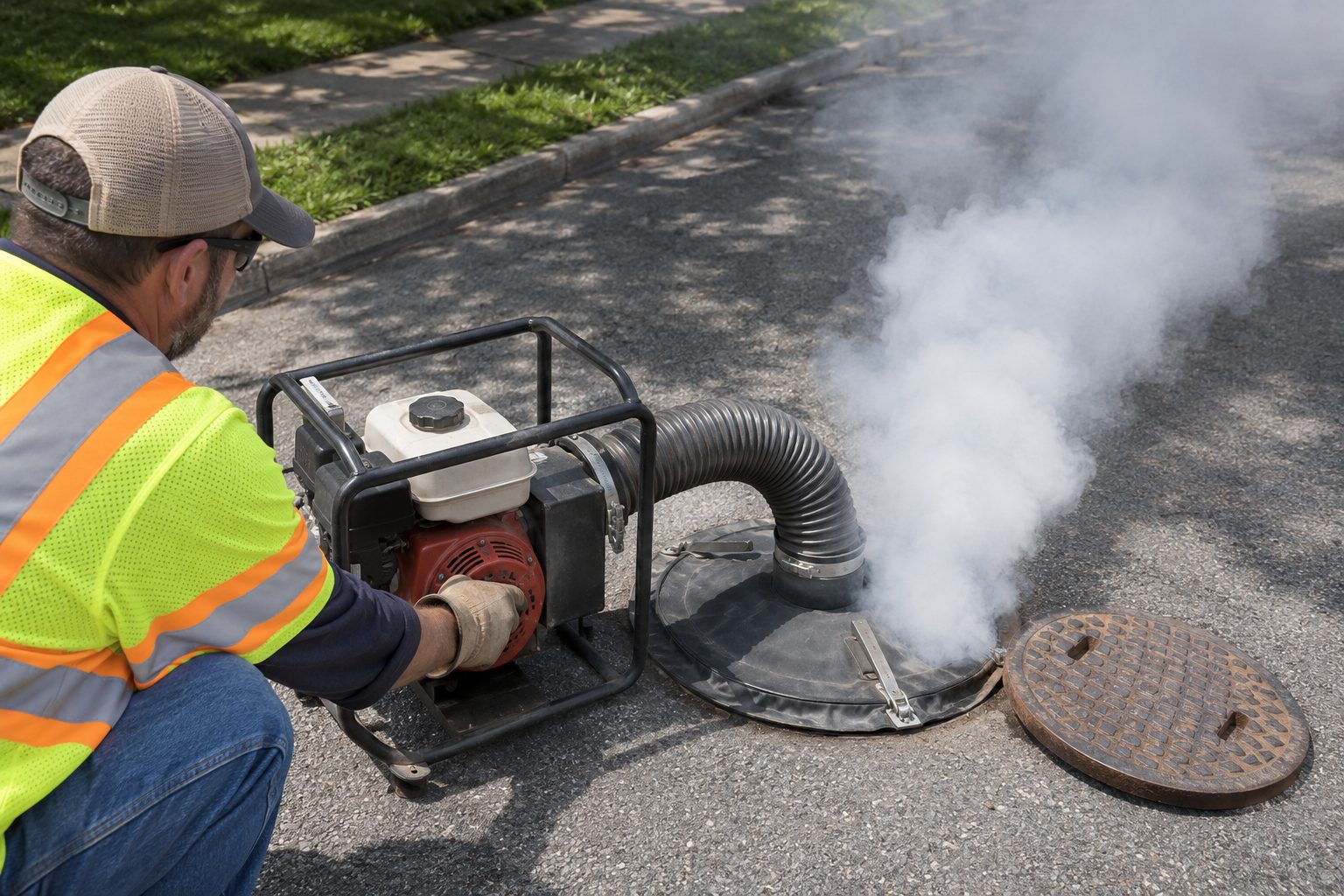
Hypothetical: A block has reported wet-weather flow concerns. The utility is selecting an external survey proposal, but the source of the additional flow has not been established.
Define the investigation boundary and responsibilities
Buy evidence supporting a next action—not simply smoke deployment or a list of sightings. Require findings that support a decision to investigate further, assign a repair or close an observation without work.
Flow monitoring can narrow the investigation. ADS describes temporary monitoring that ranks sub-basins by inflow and infiltration severity and can eliminate unnecessary fieldwork.[2] USG describes strategically placed meters and dry- versus wet-weather flow interpretation; RCAP recommends monitoring individual system sections where possible.[3][4]
Attach the following to the request for proposals, supplying available information and requiring bidders to identify gaps:
- Survey boundary: a map and asset list identifying included mains and laterals, with explicit exclusions.
- Municipal inputs: available maps, monitoring records and access information.
- Responsibilities: utility and contractor tasks, including notice delivery, access arrangements, findings review and follow-up authorization.
- Required versus optional work: base survey deliverables, conditional confirmation tests and the approval needed before additional work begins.
For the hypothetical block, define the area to investigate without treating the wet-weather concern as proof of a particular connection.
Specify resident notification, access and complaint handling
Require a written notification and access plan, not simply a promise to “notify residents.” Orlando provides a local example: employees or a competitive-bid contractor deliver a residential brochure to the front door or garage “at least 24-48 hours in advance.” That is Orlando’s practice, not a nationwide notice deadline.[1]
Ask the bidder to specify:
- Recipients and timing: which affected properties receive notice, the delivery method and how far ahead of testing.
- Delivery records and changes: how deliveries are recorded and residents are notified if testing is rescheduled.
- Access: where crews need entry, whether private-property access is necessary and who obtains required permissions.
- Questions and complaints: the resident-facing contact, who answers calls during fieldwork and how unresolved complaints reach the utility.
Orlando says individual locations average 15–45 minutes of testing, small-scale testing can take several days, and a citywide project can take 60–180 days.[1] Its page distinguishes between no required advance preparation and advice to run water or flush little-used fixtures for a few seconds.[1] Preserve that distinction in resident communications without assuming Orlando’s access arrangements apply elsewhere.
ADS describes advance warning to residential, commercial and industrial properties and local fire departments.[2] Ask bidders to confirm availability for the municipality and put their notice procedure in the quote.
Require a mapped finding, not just a smoke photo
ADS provides a documentation benchmark: it says every smoke-test defect is referenced to at least two permanent points, accompanied by a schematic with detailed directions and supported by photographs or video cross-referenced in the final report.[2] ADS also specifies smoke-testing blowers with a minimum capacity of 1,500 cfm.[2]
For each finding, request:
- Identity and location: a unique finding ID, associated asset or address, two permanent references and a schematic with directions.
- Observed evidence: where smoke appeared, a description of the observation and linked photographs or video carrying the same finding ID.
- Interpretation and next action: the suspected pathway, unresolved questions—including ownership—and the recommended confirmation or repair-planning step.
Keep observation separate from inference. USG says additional investigative methods may be needed to confirm exact sources and locations.[3] A report should preserve that uncertainty rather than turn the smoke’s emergence point into a confirmed connection through wording.
Fictional finding for the hypothetical block:
- Finding ID: BLOCK-A; associated address recorded.
- Observation: smoke emerged at a yard drain.
- Location record: measured offsets from a marked manhole cover and a building corner; directions on sketch BLOCK-A.
- Visual record: photos BLOCK-A-overview and BLOCK-A-detail linked to the sketch.
- Interpretation: a sewer connection is suspected; its route and ownership remain unresolved.
- Next action: confirm the pathway and review responsibility before assigning a repair.
Before award, request an anonymized sample finding and final report. ADS describes a final delivery explaining the findings and recommended action plan, and immediate client reporting of severe defects, including storm-drain connections, during smoke testing and manhole inspections.[2] Specify the utility’s escalation contact and the record required for urgent findings.
Resolve public-versus-private responsibility
Orlando draws an explicit boundary: City repairs occur only in the public right-of-way, and neither City crews nor competitive-bid contractors can repair private-property sewer systems. The City advises an owner who sees smoke indoors to call a plumber of the owner’s choice.[1] This is Orlando’s local responsibility rule—not a nationwide rule for lateral ownership or municipal repair authority.
RCAP warns that laterals can be significant sources of inflow and infiltration while ownership complicates responsibility. Its guidance recommends ordinance language addressing inspections and illegal cross-connections.[4] Check the utility’s asset records, easements, ordinances and responsibility policies rather than importing another city’s boundary.
Require an ownership-check field in each finding:
- Relevant asset: identify the main, manhole, lateral or suspected connection.
- Supporting local record: reference the asset record, easement, ordinance or policy supporting the proposed assignment.
- Unresolved questions: flag disputed boundaries, ownership gaps or uncertainty about municipal repair authority.
- Municipal approval: name the utility reviewer and record the responsibility decision.
For the hypothetical block, keep a suspected lateral finding on hold if responsibility remains unresolved. Record an owner referral separately from an authorized municipal repair.
Choose confirmation testing before authorizing repairs
Even after responsibility is resolved, hold the repair if the finding leaves the pathway or defect uncertain. USG describes follow-up investigation to confirm exact sources and locations; RCAP distinguishes smoke testing, dye testing and CCTV as separate investigative methods.[3][4] Require the report to separate observation, interpretation and confirmation rather than treating visible smoke as an excavation instruction.
Choose the next step by the unanswered question:
- Where does the suspected connection lead? Consider dye testing. ADS describes documenting the dye path and leak location to identify suspected cross-connections, roof drains and area drains, usually alongside internal TV inspection.[2] Request a record showing whether the suspected pathway was confirmed, not simply whether testing was completed.
- What is wrong inside the pipe? Consider CCTV. USG describes a visual record of cracks, separated joints, roots and structural defects; ADS identifies misaligned joints and notes that successful inspection depends partly on line cleanliness.[2][3] Specify how an obscured or incomplete inspection will be reported.
- Does water enter here during rain? Consider wet-weather inspection. USG recommends observing manholes and sewer structures during or immediately after rainfall for leaking covers, defective joints and direct surface-water entry.[3] Request documentation of the observed entry mechanism.
Set a follow-up authorization hold point: identify the proposed test, the question it must answer, the expected deliverable, the utility approver and whether a separate work order is required. The ADS and USG service pages do not establish mandatory work-order packaging or approval thresholds.[2][3] Put those boundaries and follow-up prices in the contract.
For the hypothetical yard-drain finding, authorize the test needed to resolve the pathway before selecting a repair. Keep a suspected connection distinct from a confirmed defect and its proposed remedy.
Check delivery formats and quality control
Request a sample deliverable in formats crews and asset-management staff can use. Specify map, GIS or CAD, spreadsheet, report and image/video formats as requested compatibility requirements—not formats every bidder promises. Ask bidders to confirm coordinate requirements, software compatibility, delivery schemas and file ownership.
ADS describes electronic data storage, final quality-control checks and a report explaining findings and recommended actions. It also says SSES project managers follow an ISO 9001:2015-certified quality-management system including a project-management plan.[2] Treat these as published process commitments, not independent validation of field accuracy.
Build acceptance requirements around the sample:
- Use a stable finding ID across the field log, schematic, visual files, map and action list.
- Require complete cross-references so staff can move from a mapped observation to supporting evidence.
- Agree on who corrects incomplete records, how corrections are tracked and when replacements are due.
USG describes metering followed by targeted investigation, including wet-weather surveys, CCTV and smoke testing.[3] Confirm local availability and request a sample showing how a flow concern becomes a located finding and recommendation.
Request itemized pricing and explicit follow-up terms
Ask ADS and USG for prices, minimum orders, cancellation terms, refunds, warranties and insurance terms.[2][3] Obtain a municipality-specific quotation covering those details.
Request an itemized breakdown of base survey work, optional confirmation tasks and repair work. This is a procurement recommendation, not a published provider package.
- Pricing basis: What unit or lump-sum basis applies, and what triggers additional charges?
- Included scope: Which boundaries, field activities, reporting and final deliverables does the base price cover? What is excluded?
- Additional costs: How are extra notices, access delays, repeat visits, confirmation tests and data revisions charged?
- Follow-up authorization: Who can approve extra work? What documentation must support a change, and will a written cost proposal precede follow-up?
- Written terms: What scheduling, postponement, cancellation, access, insurance and deliverable-acceptance provisions apply?
Request a written scope and price for optional tasks, and specify that survey approval does not itself authorize confirmation testing or repairs.
Apply a final evidence gate before releasing work
Use this proposed acceptance checklist before authorizing a repair:
- Locatable: permanent references, a schematic and cross-referenced images identify the same finding—the reporting practices ADS describes.[2]
- Confirmed as needed: observations remain separate from interpretation, and necessary pathway or condition testing is complete.[2][3]
- Responsibility established: the responsible asset owner and repair authority are recorded; Orlando’s local boundary illustrates why this matters.[1]
- Action authorized: the proposed remedy addresses the confirmed mechanism, and the utility has recorded approval.
RCAP describes manhole and pipe rehabilitation among infiltration remedies, while inflow corrections include relocating sump-pump discharges and disconnecting foundation drains.[4] Select the remedy for the confirmed finding rather than treating these as interchangeable fixes.
Assign each finding a workflow status: ready for authorized repair, confirmation required, ownership review required or insufficient documentation. Choose the proposal whose scope and sample deliverables support those decisions.
References
- Sanitary Sewer Smoke Testing – City of Orlando (orlando.gov, 2026)
- ADS Specialized Services – ADS (adsenv.com)
- Flow Metering from USG | USG (usginc.net)
- Investigating Inflow & Infiltration – The Rural Community Assistance Partnership (RCAP) (rcap.org, 2024)