HROUS
How to choose rubber compression molding for US seal buyers
Before paying for tooling, ask the molder to quote the compound, tooling, samples, inspection records and production charges, with written terms for corrections and a separate production release. Send prospective molders the same requirements so their quotes address the same seal.
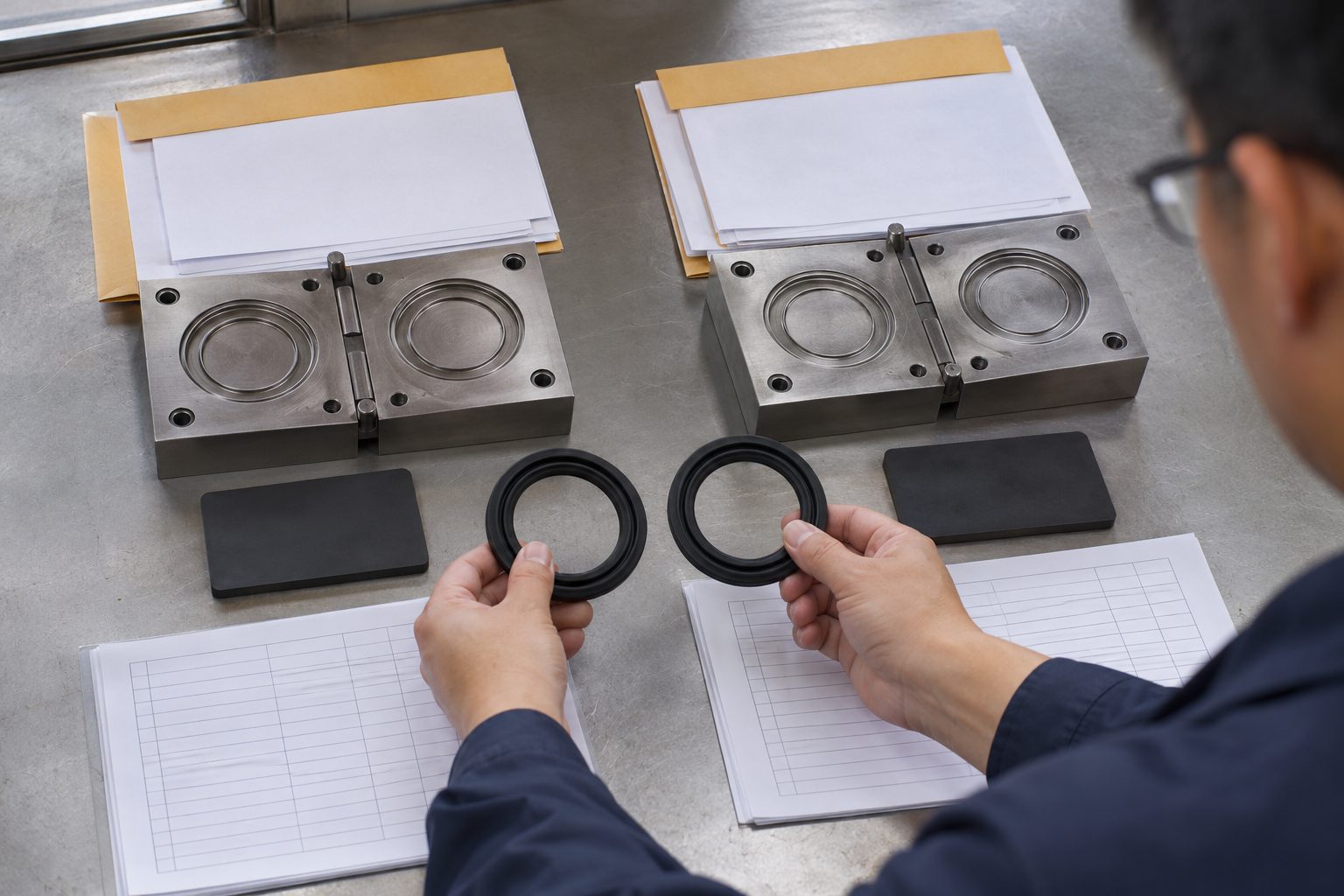
Send the same seal requirements to each molder
Use this checklist as recommended buyer practice, not a universal RFQ standard. Distinguish mandatory drawing requirements from proposals you want the supplier to make:
- Design baseline: Drawing number and revision, relevant CAD files and drawing tolerances.
- Quantities: Target short-run quantity and anticipated repeat-order quantities, marked as estimates where appropriate.
- Service conditions: Contact fluids, environmental exposure, operating temperatures, pressure and other conditions relevant to the seal.
- Material: Required or proposed compound and hardness; identify anything undecided.
- Acceptance and timing: Required testing, requested sample evidence and requested delivery date.
ACE Rubber Products in Kennedale, Texas, accepts PDF and CAD files and lists material, hardness, temperature, tolerance, testing, volume and application information—useful prompts for preparing the enquiry.[2] Pure Rubber describes working with customers’ design engineers and helping select the process and material.[1] Hawthorne Rubber Manufacturing Corporation offers design assistance and asks for exact specifications and testing requirements.[3]
Label a mandated compound “required” and an unresolved selection “supplier proposal requested.” Request a quote against the unchanged drawing, with alternatives and deviations listed separately. Ask the molder to identify its proposed material and assumptions in writing rather than treating a recommendation as approved.
Require a compound identity, not just an elastomer name
Ask the quote to identify the proposed compound—not merely “silicone” or “nitrile”—so approval refers to a specific selection. Request:
- Compound designation: A stable supplier code or other identifier, alongside the elastomer family.
- Hardness: The proposed value and scale, marked as awaiting approval if unresolved.
- Buyer specification: The required material specification and revision, with exceptions identified separately.
Hawthorne, a US custom rubber molder, advertises custom-mixed compounds and lists fluorocarbon, fluorosilicone, silicone and nitrile among its materials.[3] Use that capability as a prompt to ask which exact compound it proposes, not as the selection for your seal.
Keep availability separate from suitability. Ask how the proposed compound addresses your service conditions and what supporting evidence or testing the molder proposes. Do not treat a material listing as confirmation for a particular fluid, pressure, temperature or regulated application.
Request the material identification that will accompany samples and production deliveries, including whether batch or lot references can connect the seals to the agreed compound. Ask Hawthorne to define those sample documents and substitution controls in writing.
If formulation details are proprietary, request a stable designation and supporting documentation rather than the recipe. Agree whether compound changes require prior written approval and new samples or testing before release.
Itemize tooling, sampling and short-run charges
Separate the cost of reaching an accepted sample from the cost of manufacturing and delivering the authorized run. Ask what the tooling charge includes rather than assuming it covers samples, inspection or corrections.
Request these line items, each marked included, separately priced, excluded or not applicable:
- Tool design and manufacture.
- Setup charges.
- Samples, with quantity stated.
- Agreed inspection reports and external tests.
- Production quantity, unit price and extended total.
- Packaging, freight and taxes.
- Any minimum charge or minimum order quantity.
Pure Rubber says it designs and manufactures custom tooling in-house.[1] That describes a capability, not the contents of a tooling charge. Pure Rubber, ACE and Hawthorne publish no dollar prices, fee breakdowns, minimum order quantities, payment terms or cancellation terms.
Ask for quote validity, payment milestones, cancellation and refund terms, and conditions permitting a price change. Distinguish amounts due before tooling, before sampling and after production authorization.
Also request separate charging rules for correcting a sample that misses agreed requirements, making a buyer-requested revision and supplying additional sample rounds. Carry those terms into the correction procedure so costs can be settled while production remains on hold.
Define the first-sample inspection record before tooling
Ask what evidence will accompany the samples—not simply whether the seals will be inspected. Hawthorne states that it provides 100% inspection, offers samples and tests products to customer requirements.[3] The follow-up question is: “Exactly what first-sample record will we receive?”
Treat these as acceptance questions to negotiate, not requirements already contained in the drawing or records automatically supplied:
- Quantity and traceability: How many samples will be supplied and inspected? How will the report link them to the drawing revision, compound designation and sample or lot identification?
- Dimensional coverage: Which drawing characteristics will be measured? Will the report show tolerances, actual results and exceptions?
- Measurement agreement: Which methods and measurement conditions need agreement before sampling? What report format will be used?
- Material and test evidence: What will identify the compound, and which agreed test results will accompany the samples?
Keep dimensional results, compound identification and performance-test results separate. Request measured dimensions against the drawing, documentation identifying the compound and results against separately agreed test criteria. Do not let “passed inspection” substitute for those records.
Ask Pure Rubber, ACE and Hawthorne to specify first-article report contents, acceptance deadlines and whether sample approval authorizes production. Agree on those terms and the report format before tooling, including which records are covered by the sampling charge.
Turn advertised timing into an order schedule
ACE lists a typical lead time of 2–3 weeks and tooling lead time of 4–6 weeks.[2] Ask what starts each period and whether they overlap for the quoted design.
Hawthorne says molds and samples can be supplied in as little as 1–2 weeks, depending on design complexity. It also says prototypes and pre-production—and often the start of production—can happen in two weeks or less; existing-tool orders can begin shipping in one week or less.[3] These are vendor-reported capabilities, not guaranteed deadlines for a particular order.[3]
Request separate milestones for:
- Design clarification and receipt of buyer inputs.
- Tooling authorization.
- Sample submission with inspection and compound records.
- Buyer review and any correction or resubmission.
- Written production release.
- Shipment of the approved run.
For each date, ask for the starting event, required inputs and assumptions. Make the endpoint explicit: samples ready, production started or goods shipped. Agree how review and correction cycles affect later dates.
Ask whether prototype and production samples will use the same compound and tooling configuration, and connect payment milestones to the agreed schedule.
Resolve a sample mismatch without releasing production
Agree on a correction procedure before samples arrive. Ask Pure Rubber, ACE and Hawthorne to confirm rejection deadlines and rework rights in writing. Treat the following as a proposed purchasing workflow, not a guaranteed remedy.
Hypothetical example: A seal looks acceptable, but its report shows a dimension outside the agreed drawing tolerance—or its compound identification differs from the approved proposal. Record the discrepancy rather than accepting the sample on appearance.
- Identify the baseline. Name the sample, drawing revision, approved compound and affected result. State where the evidence differs from the agreement.
- Maintain the hold. Request written acknowledgment that production remains on hold during investigation. Keep sample review separate from authorization to manufacture.
- Request a correction proposal. Ask for the cause, corrective action, proposed drawing, compound or tooling changes, and replacement samples or revised evidence.
- Settle cost and timing. Apply the agreed terms, distinguishing failure to meet existing requirements from a buyer-requested change. Agree who pays and when corrected evidence is due; do not assume free rework.
- Approve changes explicitly. Record any approved change before treating it as the new sample baseline.
Proposed wording for the agreement:
Sample review does not authorize production. Keep production on hold pending resolution of the listed discrepancies and a separate written release.
If accepting a discrepancy by concession, document the affected characteristic, samples or production quantity, and whether acceptance applies to this order only. Avoid silently changing the baseline for repeat orders.
Set tool-control and reorder terms before paying
Do not assume a tooling payment buys ownership. Ask Pure Rubber, ACE and Hawthorne to confirm whether payment transfers title and to specify tool-control and reorder protections in writing.
Request written agreement on:
- Title and access: Who owns the tool, where it will be stored and who may use or alter it. Include conditions and costs for transfer, return, relocation or disposal.
- Upkeep: Responsibility for maintenance, repairs and storage; any agreed tool-life limits.
- Changes: Who authorizes and pays for engineering changes, and how the approved tool revision will be recorded.
- Repeat-order baseline: The retained drawing revision and compound identification, plus circumstances triggering resampling and responsibility for its cost.
- Reorder pricing: Setup charges, quantity assumptions and a process for confirming prices and delivery dates before each order.
Treat these as requested contract terms, not rights included in the tooling charge. Obtain agreement rather than planning around assumed tool life, unchanged pricing or continuing availability.
Choose on written answers, then release the run
Assess each quote against the same drawing, compound, quantity and evidence requirements. Mark each decision point confirmed in writing, unresolved or unacceptable:
- Requirements and compound identity.
- Itemized tooling, sampling, inspection and production charges.
- Sample quantities, records and acceptance criteria.
- Schedule, correction responsibilities and production hold.
- Tool ownership, permitted changes, maintenance and reorder terms.
Before paying for tooling, agree what that payment authorizes, what evidence the molder will submit and how production will remain on hold. Treat unresolved material identity, acceptance evidence and correction terms as reasons to seek clarification rather than trade them against a lower unit price.
After accepting the sample evidence, issue a separate written production authorization identifying:
- The accepted sample or inspection-report identifier.
- The drawing revision, compound designation and applicable tooling revision.
- The authorized quantity and expressly accepted deviations.
- The applicable quote, purchase order and agreed terms.
- Any unresolved deviations remaining on hold and outside the authorization.
The choice is which molder will identify, price, document and agree the work from tooling through repeat orders—not simply which quotes the lowest part price.
References
- Rubber Compression Molding — Pure Rubber Products Co. (purerubber.com)
- Custom Rubber Molded Parts – Kennedale, Texas – Ace Rubber Products (acerubberproducts.com)
- Rubber Parts Manufacturer | Hawthorne Rubber Mfr. Corp. (hawthornerubber.com)