HROUS
How to choose mobile line boring for Ontario equipment owners
Choose a mobile line-boring quote by its repair scope, confirmed site access and agreed dimensional handback—not the machining price alone. Ask who will assess the bare bushing seat, complete any rebuilding, supply parts and return the pivot to service.
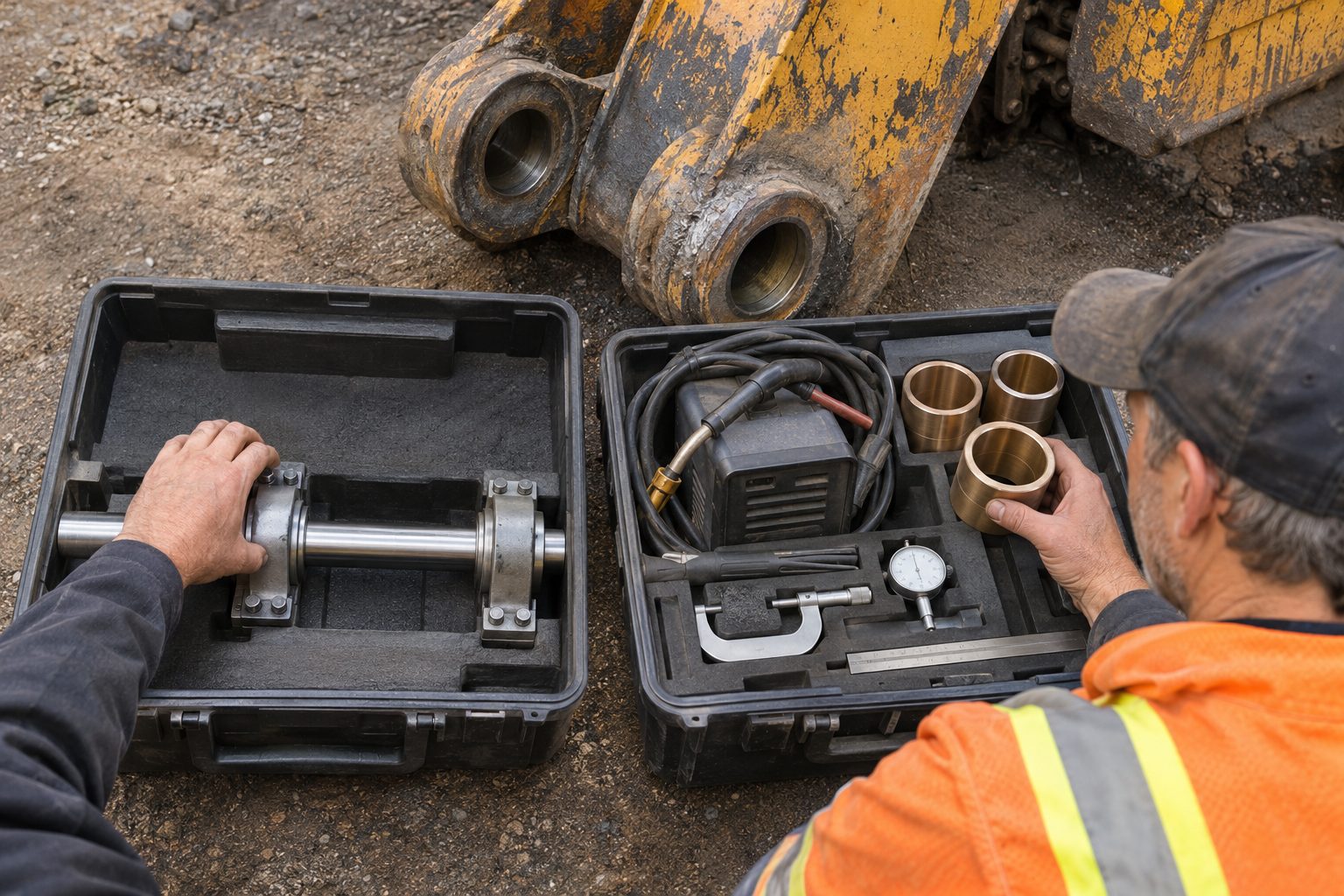
Maucotools’ technical guide describes restoration from assessment and bushing removal through seat inspection, preparation machining, welding overlay where needed, final boring, bushing and pin installation, lubrication and functional checks.[3] Use that sequence to identify responsibilities, not as evidence every quote includes the complete repair.
Send the same job information before mobilisation
Give each prospective repairer the same information, marking unknowns rather than guessing. Use this as an enquiry pack:
- Machine and joint: make, model, machine identification and the exact pivot needing attention.
- Location and contact: where the excavator stands and who can answer site questions.
- Observed symptoms: describe movement or other concerns. Attach available photographs and measurement records, identifying who took them.
- Assembly condition: explain what remains assembled or has been dismantled. Include available drawings or repair specifications.
- Parts and timing: identify known pin-and-bushing availability, who could supply replacements and the desired return-to-operation date.
Keep observations separate from findings requiring assessment after disassembly. Maucotools describes checking joint play, pin condition, bushing condition and the bare seat—not visible movement alone.[3] Its guidance calls for a secured, unloaded pivot and qualified personnel working under applicable safety rules and manufacturer instructions.[3] Do not attempt unsupported-joint measurements to complete an enquiry.
Ask which unknowns require an initial assessment, whether that means a separate visit and how assessment and mobilisation will be charged. Treat the requested completion date as a planning target until the contractor agrees to it.
Confirm whether the complete repair can stay on-site
Portable equipment can mount directly to the pivot. Maucotools says retaining the setup through weld build-up and final boring helps preserve alignment.[3] This supports on-site restoration as a possibility, not a completion promise for every excavator.
Before booking, ask the contractor to confirm these arrangements with the responsible site personnel:
- Access and mounting: Is there enough clearance to mount and operate the boring bar and welding equipment at the affected joint?
- Site support: What working-area arrangements, weather protection and power are needed, and who supplies them?
- Component handling: Is lifting assistance needed, and who plans and provides it?
- Safety responsibilities: Who manages energy isolation and any site welding controls before work starts?
- Completion: Who supplies parts, refits the joint and performs the agreed functional checks?
C.Patterson Equipment Repair advertises mobile line boring, bore welding, and pin-and-bushing repair in Ontario, including Peterborough and surrounding regions.[1] On-Site Welding serves Northern Ontario and lists line boring and machining alongside field and shop services.[2] Confirm coverage at your exact location and obtain job-specific site-support requirements before booking rather than assuming what the customer must supply.
Ask what access limitation or inspection finding would trigger component removal or shop work, who authorises the change, and how transport, remobilisation and revised downtime would be quoted.
Choose the setting around the contractor’s confirmed ability to finish the agreed scope. A mobile machining visit does not settle who handles disassembly, parts or refitting; Maucotools’ restoration sequence extends through installation, greasing and functional checks.[3]
Separate rebuilding, machining and replacement parts
Request a written scope with each item marked included, excluded or conditional, alongside the responsible party and price basis:
- Assessment: identifying the joint and assessing wear.
- Disassembly and extraction: exposing the seat and removing the bushing.
- Cleaning and inspection: measuring the bare seat and recording its condition.
- Build-up: preparation machining and welding overlay, if approved.
- Final machining: boring to the agreed approved dimensions.
- Parts: supplying replacement bushings and pins, or approved pin restoration.
- Reassembly: fitting parts, lubrication and functional checks.
- Handback: measurements, parts records and sign-off.
- Mobilisation: travel, equipment movement and any return visit.
A machining-only quote may suit an arrangement where others handle the remaining work. Assign those responsibilities explicitly rather than assuming the machinist will complete them.
Keep rebuilding and machining separate. In Maucotools’ sequence, preparation machining creates a clean cylindrical surface; weld overlay replaces missing material; final boring after cooling establishes the diameter required for the bushing’s interference fit.[3] These are distinct operations, not interchangeable descriptions of “line boring”.
Assess the parts separately, too. Maucotools describes replacing the bushing and restoring or replacing a scored or undersized pin.[3] Ask the quote to identify the proposed parts and whether their supply, delivery and installation are included.
Agree on the repair path after inspecting the bare seat
Maucotools explains that fitting a new bushing does not restore an ovalised seat underneath it.[3] Its technical framework distinguishes three repair paths, subject to the manufacturer’s instructions:
- In-size and cylindrical: where the seat retains the required dimensions and correct interference fit, bushing replacement may be sufficient.[3]
- Slightly oversized but cylindrical: a clean-up pass and oversize bushing may be possible where the manufacturer permits the repair.[3]
- Ovalised or missing material: ovalisation or material loss from bushing rotation can call for weld overlay followed by boring to nominal size, subject to the manufacturer’s instructions.[3]
Use this framework to discuss the work, not to approve a particular excavator repair. Ask who supplies the applicable approved dimensions and who approves an oversize repair or other departure from the original dimensions.
Set an inspection hold point. Request the bare-seat findings and proposed repair route before authorising conditional work. Maucotools’ assessment includes seat dimensions and observed damage such as scoring, rotation marks, cracks or upset material.[3]
Ask the repairer to assess structural suitability and refer additional defects for an agreed decision rather than treating every damaged seat as weld-repairable. Record who can approve the revised method, cost and completion schedule.
Check local capability against the actual joint
On-Site Welding serves all of Northern Ontario and lists excavator bucket maintenance, wear-package replacement—including teeth and adapters—and new-bucket fabrication.[2] Those related capabilities do not define the scope of a particular pivot-restoration quote.
Use those service descriptions as a starting point for questions tied to the machine:
- Job acceptance: Will the contractor accept the identified pivot repair at the equipment’s exact location?
- Repair route: Does the quote cover the required restoration, rather than bucket work or machining alone?
- Responsibility: Which operations will its crew perform, which will be subcontracted, and who takes responsibility for the completed scope?
Obtain job-specific acceptance and subcontracting arrangements in writing from On-Site Welding.[2] Carry the confirmed responsibilities into the quote, including work assigned to the equipment owner or another contractor.
Specify the dimensional handback before approving the quote
Put the acceptance dimensions and requested evidence into the scope before work starts. Ask Patterson or On-Site Welding to agree to before-and-after dimensions, alignment reports, fitted-parts records and signed functional-test handbacks.[1][2]
Organise the requested record into four blocks:
- Machine, joint and parts identification. Request the model, serial number and exact pivot repaired. Include supplied pin and bushing identifiers, who supplied them and any approved substitutions.
- Approved specification. Identify the governing drawing or repair specification, its revision and who confirms it applies. Request target dimensions and acceptance criteria against that document—not simply “within tolerance”.
- Before-and-after findings. Request the measurements, observed damage and selected repair route, followed by final results against the approved dimensions.
- Responsible sign-offs. Assign who records measurements, approves additional defects or deviations, gives dimensional approval and records the agreed functional checks.
For the initial findings, Maucotools describes recording play, pin diameters, and bushing and bare-seat measurements on two axes at several depths.[3] These distinguish wear at the pin and bushing from damage to the underlying seat.[3]
For final inspection, request diameter readings and, where applicable to the approved specification and scope, roundness, surface finish, alignment or coaxiality across multiple bores, and fitted-bushing interference. Maucotools states that its portable line-boring machines achieve tolerances down to H7, suitable for the interference press fits typical of earthmoving pivots; this stated capability does not establish an Ontario acceptance standard.[3]
If an OEM certificate, specialist non-destructive testing report or weld record is needed, name it separately. Agree who supplies it, what it covers and its cost. Keep technical dimensional approval separate from commercial acceptance of the completed job.
Compare written costs and downtime on the same basis
Patterson and On-Site Welding do not publish prices, minimum charges or job-duration commitments sufficient to budget this repair.[1][2] Request a job-specific written quote with the currency stated.
Check each quote against the same cost groups:
- Getting there: mobilisation, travel, site support and any transport or return visit if on-site completion proves impractical.
- Repair work: assessment, disassembly, preparation, conditional weld build-up and final machining.
- Finishing: pins and bushings, delivery, installation, reassembly and the agreed inspection records.
For each amount, ask whether it is fixed, estimated, provisional or time-based. Clarify how taxes, extra work and owner-supplied parts will be handled. Where build-up depends on inspection, agree an approval point and pricing basis before it proceeds.
Separate attendance from return to service. Ask the quote to distinguish the planned visit, active repair time, parts lead time, approval delays and the expected return-to-service milestone. Identify which dates are commitments and which depend on access, parts or inspection findings.
Request written terms for scope changes, delays, cancellation or rescheduling, payment and warranty. Ask who handles defects discovered later and how responsibility and additional charges will be agreed.
Approve the scope, then check the handback
Before booking, resolve exclusions and assign the remaining work. The quote should identify the joint, inspection hold point, applicable specification, conditional repair route, site or shop arrangements, parts responsibilities and authority for extra costs.
At handback, check the completed scope against the requested measurements, parts information, sign-offs and documented exceptions. Maucotools specifies full pivot greasing, slow no-load functional test cycles, verification of the absence of play with a dial indicator, and a check after the first working hours.[3]
Authorising work and accepting the finished repair are separate decisions. Agree what evidence will support acceptance before the contractor mobilises.
References
- Mobile Line Boring & Heavy Equipment Repair Precision On-Site Repairs That Minimize Downtime.c.Patterson Equipment Repair (pattersonlineboring.ca)
- Welcome to ON-SITE Welding servicing all of Northern Ontario since 2000. No project is too small or too big for us. (on-sitewelding.ca)
- Line Boring Ovalized Excavator Bushings: On-Site Repair | Maucotools (maucotools.com)