HROUS
How Florida Homeowners Can Choose Wind Mitigation Inspections
To commission a Florida wind mitigation inspection, confirm the inspector’s qualifications, require the current signed form and supporting photographs, and get the total fee and delivery terms in writing. Florida’s Department of Financial Services says OIR-B1-1802 Rev. 04/26 must be used for inspections performed from April 1, 2026. [4]
1. Confirm which inspection you need
Ask your insurer or agent for the exact document request before booking. Wind mitigation documents storm-resistant features for possible insurance credits; a four-point inspection assesses roofing, plumbing, electrical and HVAC for underwriting. Neither replaces the other. Kin says Florida does not require every homeowner to obtain a wind mitigation inspection. [3]
Don Meyler Inspections (DMI), which says it serves all 67 Florida counties, separately lists wind mitigation, four-point, roof-certification and flood-elevation services. Specify the requested deliverable rather than asking for “an insurance inspection.” [1] If flood documentation is requested, have the insurer identify exactly what it needs.
My Safe Florida Home is a separate program route. Kin describes it as offering free wind mitigation inspections and matching grants for eligible upgrades, with eligibility and funding changing by cycle. Kin also says approval must precede work for grant eligibility. [3]
2. Require Rev. 04/26 before booking
Ask in writing: “Will the inspection and signed report use OIR-B1-1802 Rev. 04/26?” DFS identifies this as the required revision for inspections performed from April 1, 2026. [4]
The superseded Rev. 01/12 form, issued in 2012, remains accessible as an official PDF, but it is not the checklist to request for a new inspection. An inspection completed before the change may remain valid for its normal term; the revision change alone does not necessarily mean another inspection is needed. [2][4]
Ask your insurer or agent for submission instructions and supporting-document requirements before paying. DFS says insurers may independently verify a submitted form at their own expense before accepting it. [4]
3. Verify who will inspect and who will sign
Ask who will visit—not just whose license appears on the report. DFS identifies eligible professionals as licensed home inspectors, building code inspectors, general/building/residential contractors, professional engineers and architects, plus other individuals or entities the insurer recognizes as qualified. For licensed home inspectors, DFS specifies at least three hours of approved hurricane-mitigation training and two hours of related continuing education each year thereafter. [4]
DFS says the authorized signer ordinarily must personally inspect the structure. Its exception allows eligible professional engineers and contractors to use a direct employee—not an independent contractor—with the necessary skill, knowledge and experience. The insurer may request that employee’s qualifications before accepting the form. [4]
Request the field inspector’s and signer’s names, license types and license numbers. If they are different people, ask for confirmation of the employment relationship and the employee’s qualifications. For a licensed home inspector, request confirmation of the mitigation training and continuing education DFS describes. [4]
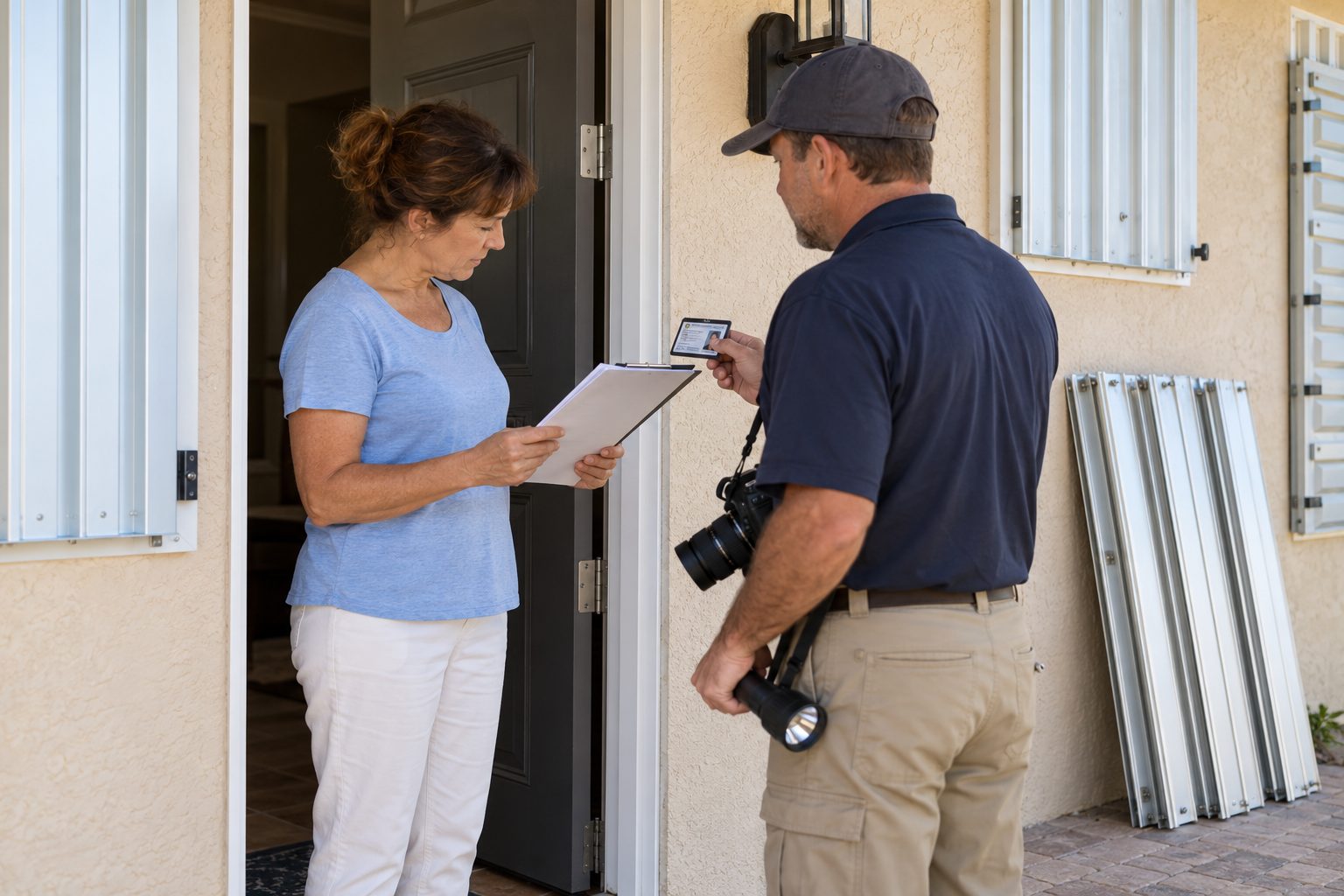
Check identification on arrival and resolve any mismatch before work begins.
4. Define the evidence and photograph package
Request a written deliverables list covering the signed current-form report, supporting feature photographs, validation records and how inaccessible or undocumented features will be recorded. Latent Insurance’s guide identifies seven feature areas: building-code era, roof covering, roof-deck attachment, roof-to-wall connections, roof shape, secondary water resistance and opening protection. [5]
Do not use the old form as today’s photo checklist. The superseded form called for accompanying validation documents and at least one photograph for each attribute marked in questions 3–7. [2] That PDF does not establish the exact Rev. 04/26 photograph requirements; ask the inspector to specify the evidence package for the current form. [2][4]
As a process example, DMI says its reports and related photographs are transmitted internally and all undergo quality-control review under its in-house Florida professional engineer. [1] Internal transmission is not delivery to you: request a deadline and delivery method for the signed report and supporting files.
5. Prepare records and access
Kin recommends gathering these records before the appointment: [3]
- Roof permits and roofing contracts identifying materials and attachment methods. [3]
- Product-approval numbers for impact windows, doors and garage doors. [3]
If records are missing, request them from the installer or check with the county building department. Clear stored items from the attic-access opening, and make windows, doors and the garage door accessible for inspection. Kin notes that attic access allows examination of roof-deck attachment and roof-to-wall connections. [3]
Ask the inspector about roof-viewing arrangements and anticipated access limitations. Do not climb the roof or enter an unsafe attic yourself. Before the visit, establish which records could resolve an unobservable feature, whether another visit would be needed and what it would cost.
6. Get an itemized total and delivery terms
Request a stand-alone wind mitigation quote and, if the insurer needs both documents, a combined wind mitigation/four-point quote with separate reports. The inspections serve different insurance purposes. [3]
Latent Insurance, a Florida-market brokerage rather than an inspection company, publishes an approximate $75–$150 inspection range. Treat it as background guidance, not a DMI quote or a universal Florida price. [5]
DMI’s cited page does not state stand-alone or bundle prices, visit duration, customer report-delivery deadlines, or cancellation, rescheduling and reinspection terms. [1]
What to confirm with each provider
- Service: appointment availability at the property’s address, field inspector and signer credentials, and required access.
- Total payable: stand-alone or bundle cost, any additional charges, and when payment is due.
- Deliverables: separate signed reports, supporting photographs and records, file format and delivery date.
- Corrections and repeat visits: what is corrected without another visit, what triggers reinspection and the applicable fee.
- Booking terms: cancellation and rescheduling charges or deadlines.
Choose on the completeness of the written scope and total quote—not a promised premium reduction.
7. Check the report before submitting it
Check the delivered package against your written scope:
- Confirm the property details and inspection date, and check for Rev. 04/26. [4]
- Check that the report is complete and signed by an eligible professional licensee. [4]
- Match the photographs and supporting records to the agreed deliverables, including the roof and opening-protection records you supplied. [3]
Raise omissions with the inspector, then submit the completed package to your insurer or agent. The insurer reviews the documented features and applies eligible credits. [3]
DFS says admitted carriers are required to accept a valid form completed and signed by an eligible professional licensee, while retaining verification rights. That does not promise acceptance of an incomplete package or a particular credit. [4] Keep the report and accompanying evidence with your policy, as the superseded form’s retention instruction also recommends. [2]
References
- Don Meyler Inspections (windstorminspections.com)
- Uniform Mitigation Verification Inspection Form (floir.com)
- Wind Mitigation Requirements in Florida (kin.com, 2026)
- Mitigation Notices, Inspections and Forms | Consumer Services | Florida Department of Financial Services (myfloridacfo.com, 2008)
- Florida Wind Mitigation Inspection & Credits: 2026 Guide (OIR-B1-1802) | Latent Insurance (latentinsure.com, 2026)