HROUS
Adhesion Testing for US Steel Owners: Pull-Off Requirements
Before commissioning coating pull-off adhesion testing, assemble the coating records and agree on the method, setup, acceptance criteria, reporting, and repair responsibility. Separate project requirements from recommended scope provisions: the cited testing-service pages establish neither a universal US minimum strength nor a complete mandatory test procedure. [2][3]
- Governing requirements: Identify the project specification, applicable test method and edition, and acceptance provisions.
- Recommended commissioning controls: Document coating history, resolve setup choices, agree on failure-plane reporting, and assign retesting and repair responsibility.
- Unresolved acceptance: If criteria are missing, scope the work as an investigation rather than promising a pass/fail decision.
Build the coating-system information package
Element’s Germany-based technical page, used here as background rather than a US service recommendation, identifies coating type, film thickness, cure schedule, surface preparation, substrate, exposure history, and acceptance criteria as useful pretest inputs. [3]
Use those categories to organize the following recommended information package. Attach available records and distinguish documented information from reported or unknown details.
- Coating type and layers: Provide the system description and identify individual layers where known. Attach product information and application records; flag unidentified layers or uncertain product names.
- Film thickness: Supply available readings linked to the proposed test area. Identify uncertainty about which layers were measured.
- Cure schedule: Provide application dates, recorded curing conditions, and relevant product information. Distinguish recorded conditions from an assumed cure schedule.
- Surface preparation: Attach preparation and inspection records, identifying areas where the history is unknown.
- Steel substrate: Identify the substrate as specifically as asset or material records allow.
- Exposure history: Describe service conditions and known changes, supported by location-linked maintenance records where available.
- Acceptance criteria: Attach the controlling specification or owner-approved criteria and flag missing or conflicting provisions.
Keep system history separate from acceptance authority. Use the records to describe what was applied and its history; identify the project document that controls the acceptance decision separately.
Agree on acceptance before authorizing tests
Decide whether the objective is maximum-load measurement for an investigation or verification against a specified minimum-load criterion. Element describes both objectives and treats minimum-load acceptance as application- or specification-dependent. [3]
Put the following recommended decision rules in writing before acceptance testing:
- Governing provision: Identify the specification clause and the person authorized to resolve missing or conflicting criteria.
- Strength and failure location: Agree how glue-limited results, mixed failures, indeterminate areas, and substrate-related failures will affect acceptance, rejection, or an inconclusive finding.
- Evaluation unit: State whether decisions apply to individual results or a defined group. Specify any averaging or other statistical treatment rather than leaving it implicit.
- Follow-up authority: Establish retest triggers and who may authorize additional testing, accept the work, require corrective action, or determine final disposition.
Failure-location rules matter because the weakest plane may be the test glue, a coating layer, an intercoat boundary, or the coating/substrate interface. [3] Do not invent a pass/fail threshold after seeing the results. If criteria remain unresolved, state in the investigation scope that measured results will not, by themselves, determine contractual acceptance.
Confirm pull-off testing answers the question
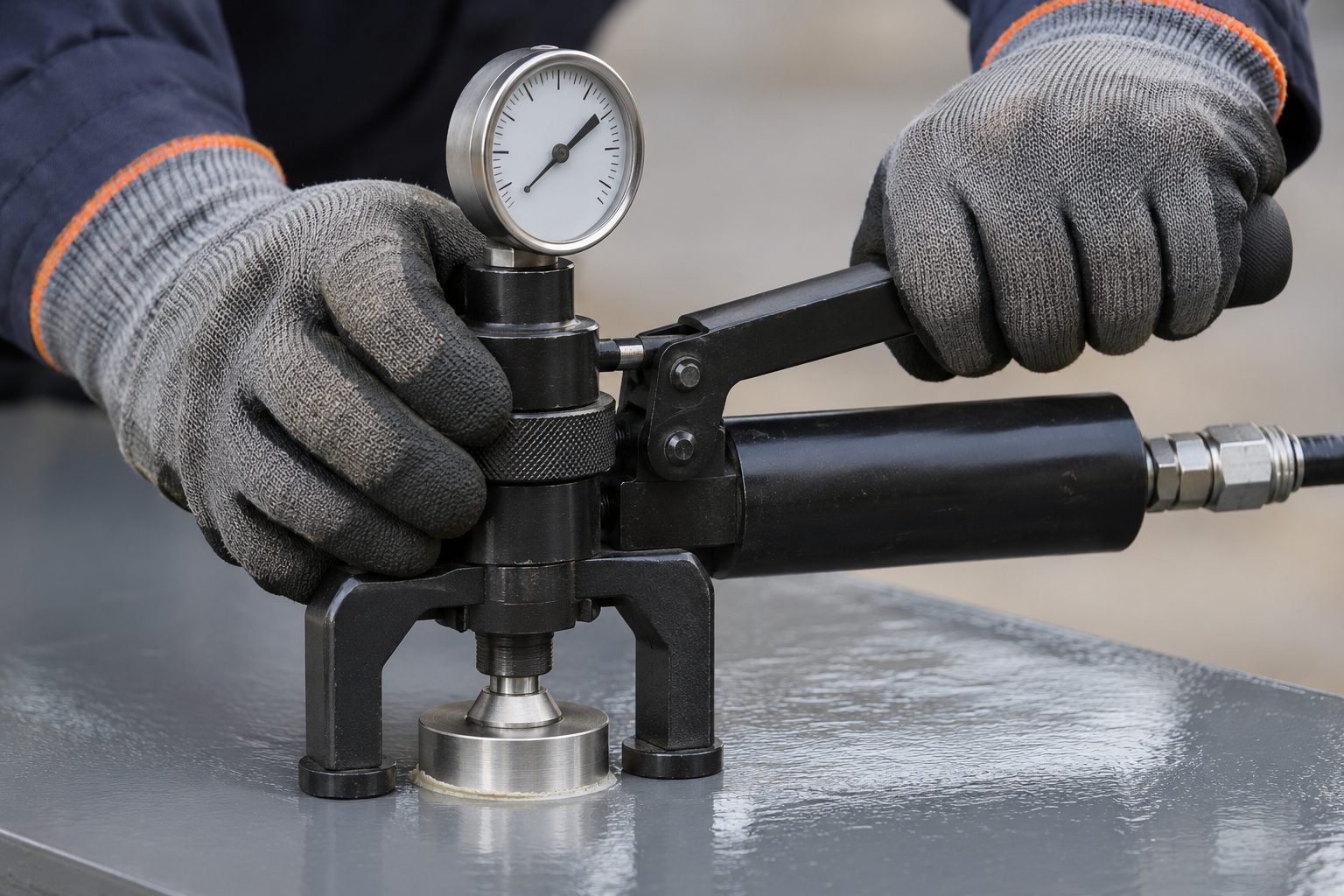
Pull-off testing uses a bonded dolly loaded perpendicular to the coating. Element describes recording the detachment force and failure type. [3] Applied Technical Services (ATS) describes pull-off as quantitative, unlike its qualitative cross-cut test, which assesses coating removal using cuts and pressure-sensitive tape. [2]
Do not substitute a tape or knife rating for pull-off strength. The cited service descriptions provide no conversion between those outputs. [2][3]
For a pull-off scope, identify ASTM D4541 and the applicable edition. Element lists ASTM D4541, while ATS prints “ASTM 4541”; neither cited service page supplies the standard text or establishes the edition and mandatory procedure. [2][3] Resolve the designation and edition in the work order rather than copying a service-page label.
Specify setup, specimens, and locations
ATS describes on-site and laboratory pull-off testing for single- and multi-coat systems on flat surfaces. That describes its service, not a universal restriction on surface geometry. [2]
The cited ATS and Element pages describe testing apparatus and evaluation scales but do not establish dolly dimensions, adhesive cure times, loading rates, specimen dimensions, test counts, or spacing. [2][3] Resolve these details through the governing method, project specification, and testing team’s written procedure.
Recommended work-order provisions
- Method and edition: Carry the agreed designation and edition into the work order and identify the written procedure.
- Instrument: Specify instrument type and how identification and calibration status will be recorded.
- Dollies: Resolve size and geometry, including suitability for the selected surface and access conditions.
- Test adhesive: Identify the adhesive and document preparation, application, cure provisions, and how readiness for loading will be determined.
- Scoring or cutting: State the selected approach and procedure rather than leaving cutting around the dolly to an unstated assumption.
- Loading and environment: Define loading provisions and the temperature, moisture, and other conditions to control or record.
- Setting and specimens: Choose on-site or laboratory testing. Document surface geometry and, for submitted specimens, suitability and preparation.
- Locations: Agree on selection, count, spacing, and identifiers connecting each result to a marked location or specimen.
Link location selection to the investigation objective. Distinguish visibly questionable areas from locations intended to represent the wider work. Record departures from the agreed setup and obtain agreement on their treatment rather than silently treating changed conditions as equivalent.
Read strength together with the failure plane
A pull-off result reflects failure at the weakest plane in the complete test assembly—not necessarily the interface the owner intended to assess. Element identifies these possible failure locations: [3]
- Test glue: Separation involves the glue attaching the dolly and may indicate a setup limitation rather than the coating’s limiting adhesion. [3]
- Within a coating layer: Separation occurs inside the coating material. [3]
- Intercoat boundary: Separation occurs between coating layers. [3]
Do not automatically label glue failure a coating failure or an invalid test. As a reporting provision, request the actual materials or interface involved rather than the ambiguous label adhesive failure alone.
Make mixed-failure reporting explicit
For mixed failures, request observed area percentages by named plane, supported by photographs, using an agreed reporting convention. Define how visually indeterminate areas will be described. These are recommended scope provisions: Element’s explanation does not establish percentage-allocation methods, rounding rules, allowable percentages, or automatic invalidation criteria. [3]
Read each result in this order: measured strength, observed failure location, then the project acceptance rule. Element describes testing against a specified minimum-load criterion, not a universal threshold. [3]
Check comparability before combining results
The cited service descriptions provide no validated conversion between adhesion methods or correction for different pull-off setups. Documenting a difference does not establish equivalence. [2][3]
Before ranking results or treating a change as improvement or deterioration, compare:
- Method and setup: Method and edition, instrument, dolly size, test adhesive and cure, scoring, and loading conditions.
- Condition and history: Temperature, moisture condition, coating type, thickness, coating cure, preparation, substrate, and exposure history.
- Outcome: Measured strength alongside the observed failure plane.
The Bureau of Reclamation’s adhesion dataset records wet, dry, and knife adhesion separately. It illustrates keeping conditions and methods distinct, not a coating-acceptance benchmark. [1]
Retain individual results and their conditions before any project-authorized grouping or summary. If a historical report omits critical setup information, identify the comparison limitation rather than applying an unsupported correction factor or converting its results into another method’s scale.
Assign test-site repair and records
Pull-off testing pulls the dolly until detachment, which may occur in the glue rather than remove coating. [2][3] Include damage documentation and repair closeout in the scope, not only the test report.
Before testing, agree who authorizes locations, documents damage, specifies and performs repairs, and accepts the completed work. Use a location-linked record containing:
- Location and dolly or test identifier.
- Photographs, measured result and units, and failure description.
- Extent of test damage and the applicable repair-procedure reference.
- Repair and acceptance responsibilities, with closeout status.
This is a recommended project template. The cited service pages establish neither a repair recipe nor a required deadline, warranty outcome, or mandatory record fields. [2][3] Identify the applicable project repair procedure for surface preparation, materials, thickness restoration, cure, and inspection.
Also assign authority and payment responsibility for additional locations when results are inconclusive or retesting is requested. Keep those locations linked to the original investigation.
Check the scope before work starts
Mark each item resolved, unknown but acknowledged, or action needed:
- Coating records assembled, with gaps identified.
- Acceptance testing or investigation objective stated.
- Acceptance criteria and decision authority identified.
- Method, edition, setup, and locations agreed.
- Failure-plane labels, mixed-area percentages, and indeterminate-area reporting agreed.
- Inconclusive-result handling and retest authority assigned.
- Repair, inspection, payment, and recordkeeping responsibilities documented.
Request a report linking each location to its setup, conditions, result and units, failure observations, photographs, deviations, and project-specific evaluation. Keep measurement reporting separate from authority to accept the coating or assign corrective responsibility. If the acceptance basis remains unresolved, pause acceptance-oriented testing or proceed under an explicitly limited investigation scope.
References
- Department of the Interior – S&T Project 22014 Data: Adhesion Test Data (data.gov, 2024)
- Coating Adhesion Testing – Applied Technical Services (atslab.com)
- Coating and Paint Adhesion Testing | Element (element.com)