What POM-C means—and what it does not
POM-C is polyoxymethylene copolymer, a semi-crystalline engineering thermoplastic in the acetal family.[1][2][4][5][6] Whether it fits a part depends on the exact grade, operating environment and supporting compliance documents—not the POM-C label alone.[1][2][5] 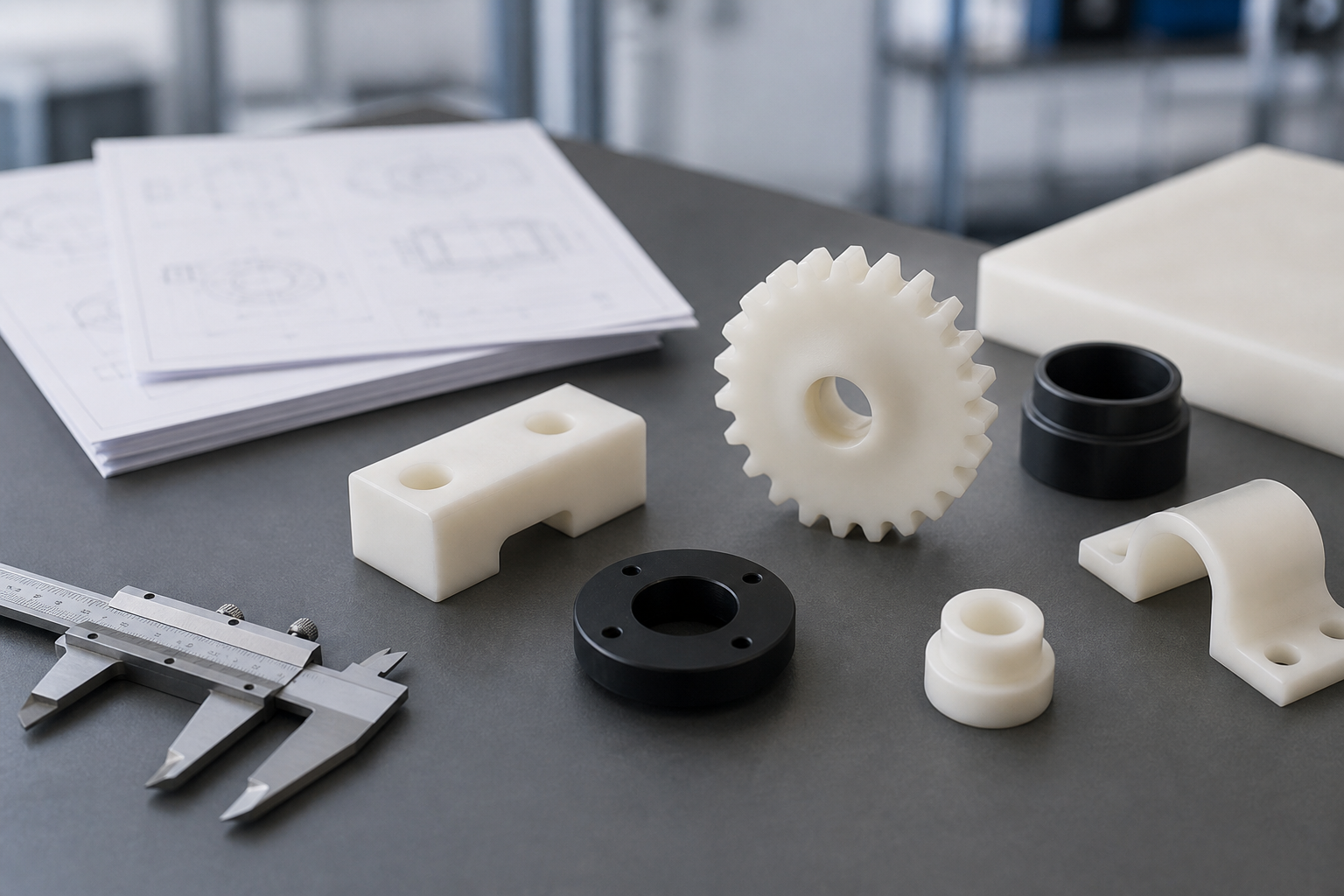
POM-C is also called copolymer acetal, acetal resin, polyacetal, POM plastic or polyformaldehyde.[2][4][5][6] However, acetal is the broader family containing POM-C and homopolymer POM-H. Delrin® is identified as POM-H, not as another name for POM-C.[5]
Both POM-C and POM-H are semi-crystalline. Mitsubishi describes POM-C as “more amorphous” than POM-H, which has higher crystallinity; this does not mean POM-C is fully amorphous.[1]
Drawings, purchase orders and material approvals should identify POM-C or POM-H and the exact manufacturer and commercial grade. Avoid ambiguous callouts such as acetal or Delrin/POM-C.[5]
Why supplier POM-C values differ
A property table may describe a named grade rather than every material sold as POM-C.[1][2] Mitsubishi reports thermal conductivity of 0.31 W/(K·m) for its tested standard unfilled POM-C material, while Ensinger reports 0.39 W/(K·m) for TECAFORM AH natural.[1][2]
TECAFORM AH natural is a specific unfilled, porosity-free, white POM-C stock-shape grade with a density of 1.41 g/cm³; Ensinger also offers it in blue.[2] The sources do not establish that Mitsubishi and Ensinger used identical conductivity test conditions, so the figures should not be treated as interchangeable or averaged.[1][2]
Use the datasheet for the exact grade and form being purchased. For a design-critical property, obtain the applicable test method, conditions and tolerance from the supplier. If those details are unavailable, record the uncertainty rather than presenting a generic value as grade-specific.
Comparison pages also require scrutiny. ProtoXYZ states that its properties are unguaranteed and intended only for comparison, but its POM-C property fields contain no numerical data.[3]
Verify food-contact status by exact grade
The supplied sources do not show that every POM-C grade is FDA compliant. ePol identifies its own acetal as FDA approved and says approved grades are available, while Mitsubishi separately offers food-contact-compliant grades.[1][5] These statements apply to particular materials, not the entire POM-C family.
Before approving a material for food-processing or packaging equipment, obtain documentation identifying the exact grade and intended food-contact conditions. A generic “food safe” description does not establish the status of a different grade.[1][5]
The sources do not provide U.S. FDA regulation numbers, migration limits, certificates or other U.S.-specific compliance details for a proposed grade.[1][2][3][4][5][6] Those requirements must be verified for the material named in the purchase specification.
Match POM-C to the operating environment
POM-C combines strength, rigidity, toughness, dimensional stability, low moisture absorption, low friction, wear and creep resistance, electrical insulation and machinability.[1][2][4][6] Applications include gears, bearings, bushings, rollers, fasteners, pumps, valves and seals.[1][4][5][6]
Wet and fluid-handling environments can favor POM-C because of its low moisture absorption, low porosity, hydrolysis and chemical resistance, dimensional stability and wear behavior.[1] Mitsubishi identifies valves and seals as fluid-management applications.[1]
Published guidance reports resistance to many solvents, lubricants, oils, greases, fuels, industrial cleaners, hot water or steam, ketones, esters and aqueous acid or alkali solutions.[1][6] Strong acids or alkalis, phenols, cresols, halogens and strong oxidizing acids are identified as poor matches.[1][6] Because the sources do not cover every concentration, temperature, exposure period or applied stress, compatibility should be checked under the intended service conditions.
Limitations include poor UV resistance without stabilization or protection, limited surface adhesion and difficult bonding.[2][6] Temperature limits are also source- and grade-specific: Ensinger lists a 100°C long-term service temperature for TECAFORM AH natural, while Weerg’s general guide gives an approximately 110°C continuous-use ceiling.[2][6] Use the named grade’s limit rather than treating either figure as universal.
Compare POM-C with POM-H by the critical property
Favor POM-C when humidity or chemical exposure, dimensional precision, low-friction movement or machinability drives the decision.[1][5][6] Consider POM-H when greater stiffness, tensile strength or hardness is more important, or when the application prioritizes dry, elevated-temperature dimensional stability or thermal transfer.[1][5][6]
Neither variant is universally superior. Selection should follow the part’s load, environment, temperature, tolerances and most consequential failure mode.
Do not approve Delrin® as a casual substitute for specified POM-C. Delrin® is identified as POM-H, so the substitution changes the polymer variant rather than only the trade name.[5] The supplied sources provide no universal substitution rule or equivalent-grade list.[1][2][3][4][5][6]
Specify the grade before requesting quotes
State POM-C, the manufacturer and the commercial grade on the drawing, specification and request for quote. Published values may apply only to a named, unfilled stock-shape material.[1][2]
- Material configuration: Record whether the material is filled or unfilled, its stock form and color, and any porosity requirement.[2]
- Critical properties: Identify the required mechanical, thermal, wear and dimensional values. Request results and test details for the offered grade because reported properties can vary by grade and method.[1][2]
- Operating environment: Document moisture, chemicals, friction, load, temperature, UV exposure, bonding and tolerance requirements.[1][2][6]
- Food contact: Require documentation for the exact grade and intended use. The availability of compliant grades does not establish compliance for every POM-C product.[1][5]
Manufacturing route also matters. POM-C supports CNC turning and milling as well as injection molding. CNC machining can provide tight tolerances and good surface finishes, while molding offers fast cycles and predictable shrinkage but requires attention to venting and mold humidity.[6] The cited general guidance describes FDM as unsuitable for functional POM-C parts compared with CNC machining or molding.[6]
The supplied evidence does not confirm U.S. prices, availability, tariffs, ASTM certification requirements, FDA regulation numbers, OSHA exposure limits, warranties, legal restrictions, process parameters, shrinkage values, tooling costs or manufacturing prices.[1][2][3][4][5][6] References