HROUS
Glass Lifter Hire in Sydney: Vacuum Head or Glazing Robot?
For a Sydney shopfront replacement, choose the lifting arrangement before comparing hire rates. A suspended vacuum head needs a suitable carrier; a self-propelled glazing robot combines movement and glass handling in a different package. The useful quote is for the complete arrangement your supplier approves for the pane and site, rather than the cheapest machine with a large enough headline capacity.
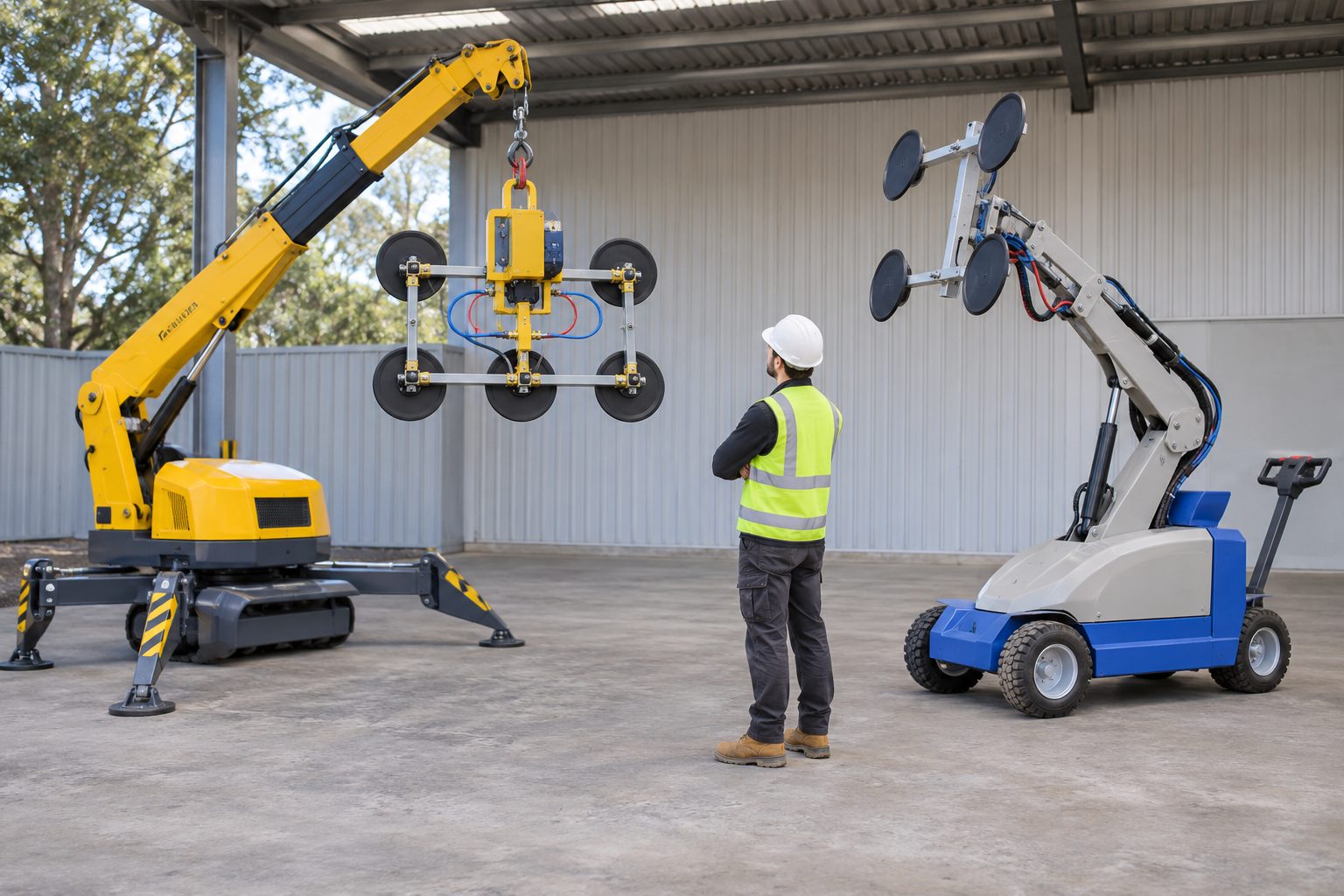
FX Engineering publishes separate automatic-vacuum-head and glazing-robot hire descriptions. Parramatta Cranes describes its Glassboy 600 as an attachment hired with a spider crane. These are three ways to scope a booking, not interchangeable machines or a lifting plan for your job. [1][2][3]
A vacuum head and a glazing robot solve different parts of the job
A suspended head grips the pane while a separate crane or other compatible carrier supports and positions the load. Your quotation therefore needs to identify that carrier, the operator, the attachment and the responsibilities for the combined arrangement. A head-only price leaves those questions open.
FX Engineering describes its 350 kg Intellitech Glaslift 351 as self-propelled, intended for ground-floor shopfront installations, supplied with an operator and able to travel through an 850 mm opening. Those dimensions do not establish that your pane can make a doorway or turn. [2]
Send the supplier the route as well as the glass schedule. A machine may pass an opening while the pane, its orientation or the space needed to manoeuvre does not. Ask the supplier to assess the complete movement and identify any site condition that changes its proposed equipment.
Read the named model and its configuration
FX Engineering’s P1 Battery Pack Lifter is listed with a 320 kg working load limit for flat, smooth, dry and clean sheets. Its page describes 180-degree rotation and 90-degree tilt, with rotation or tilt performed separately rather than together. Those details distinguish a particular head from a generic promise to “lift glass.” [1]
Parramatta Cranes lists the Glassboy 600 as a below-the-hook lifter with a 600 kg capacity and a 55 kg head weight, paired with its spider-crane service. The provider describes an operator-inclusive engagement. A head’s stated capacity and a crane’s maximum rating must not be combined into an assumed capacity for an actual lift. Have the supplier confirm the usable arrangement for the required reach and panel position. [3]
None of these published figures approves a lift. Keep the equipment identity, attachment configuration and supplier assessment together in the quotation. If the proposal names only a generic “glass lifter,” request the model and the assessed configuration.
One shopfront pane, two quotations to request
Consider an illustrative job with a flat pane measuring 2.0 m by 1.2 m and a glass-schedule mass of 150 kg. The site has a measured 900 mm doorway, a turn beyond it and a ground-floor shopfront opening. These are assumed project inputs, not an example lift approved by either supplier.
The mass is below the headline limits of the P1 and Glaslift 351, but that comparison alone does not choose the equipment. Likewise, a 900 mm doorway compared with a published 850 mm machine-passage figure does not prove that the panel and complete arrangement will fit.
Request two scoped proposals:
- Suspended-head proposal: name the head and carrier; state the required access or setup area; identify the operator and the assessment of reach and panel orientation; and list head, carrier and transport charges.
- Robot proposal: name the machine and operator; have the supplier assess the doorway, turn, travel surface and final placement; and state the booked hours, travel allowance and any site preparation the customer must provide.
If one supplier cannot approve the assumed route, ask for its alternative arrangement and revised scope. Do not convert a machine specification into instructions for your crew to make an unsuitable route work.
Compare complete bookings rather than three headline prices
The suppliers publish different charging units. Keep their stated inclusions and tax treatment attached to each figure:
- FX Engineering P1 head: the page lists $320 plus GST per day for the head. Treat it as a component price until the carrier, operator and logistics for your job are specified. [1]
- FX Engineering Glaslift 351: the page lists $140 plus GST per hour, with a six-hour minimum, including travel and an operator. Six times $140 is $840 plus GST for that published minimum booking. This is arithmetic using the listed terms, not a quotation or completion-time estimate for the example job. [2]
- Parramatta Cranes Glassboy 600: the page lists an additional $400 per day on top of crane hire. It describes the attachment as hired with a spider crane and its operator; obtain the complete crane engagement and confirm the tax treatment rather than treating the surcharge as the total. [3]
A $320 head-only figure and an $840 operator-inclusive minimum answer different purchasing questions. Ask what must be added to each proposed arrangement before comparing totals. Do not import one provider’s operator or travel terms into another provider’s price.
For a head booking, separate delivery and collection from the carrier engagement. For an hourly booking, ask when chargeable time starts and finishes, what happens if access is delayed, and how extra time is approved. Obtain the actual date, availability and written terms before relying on a published rate.
Give the supplier a usable site and panel brief
Prepare the information that lets the hire company assess an arrangement instead of quoting against a machine name:
- The pane: its dimensions, stated mass, flat or curved form, and the handling information supplied with the glass.
- The route: measured openings and turns, the starting and finishing locations, and photographs showing access constraints.
- The placement: the opening and the required final position, including information the supplier requests about reach or overhead restrictions.
- The booking: the site address, proposed date, available delivery window, other trades and who will be present to give access.
Ask the supplier what additional information or inspection it needs. Ground conditions, support, route suitability and the lifting method belong with the supplier or competent person responsible for assessing the job. This guide does not provide rigging instructions, suction-pad settings or a self-certified lifting plan.
Keep a changed panel, changed access route or changed placement separate from the original assessment. Send the revision back to the supplier before relying on the earlier equipment proposal.
Approve the arrangement and the commercial scope together
Before booking, ask for a written proposal naming the equipment and configuration, who operates it, the supplied carrier where relevant, the approved job assumptions and the full charging period. Add delivery, collection, waiting time, minimum booking, applicable GST treatment and the process for authorizing changes.
The key decision is whether the site calls for a separately supported vacuum head or an operator-supplied robot arrangement. Use the providers’ published descriptions to frame that question, then choose between quotations assessed against the same pane, route and placement. A larger capacity number or lower component rate cannot replace that comparison.
References
- Glass Vacuum Lifters for Hire — FX Engineering (fxengineering.com.au)
- Mobile Glass Lifters (Glazing Robots) for Hire — FX Engineering (fxengineering.com.au)
- Glassboy 600 Hire — Parramatta Cranes (parramattacranes.com.au)