HROUS
Automating an Existing Industrial Shutter: UK Warehouse Choice
Motorising a working warehouse shutter is worth considering when its curtain, guides and supporting assembly are sound; repair suits continued manual use, while a worn or unsuitable assembly may justify replacement, according to UK Doors & Shutters and Kinetic Door Systems.[1][4] The decision starts with a condition survey—not a motor or remote control.
Which parts can remain? Let the survey decide
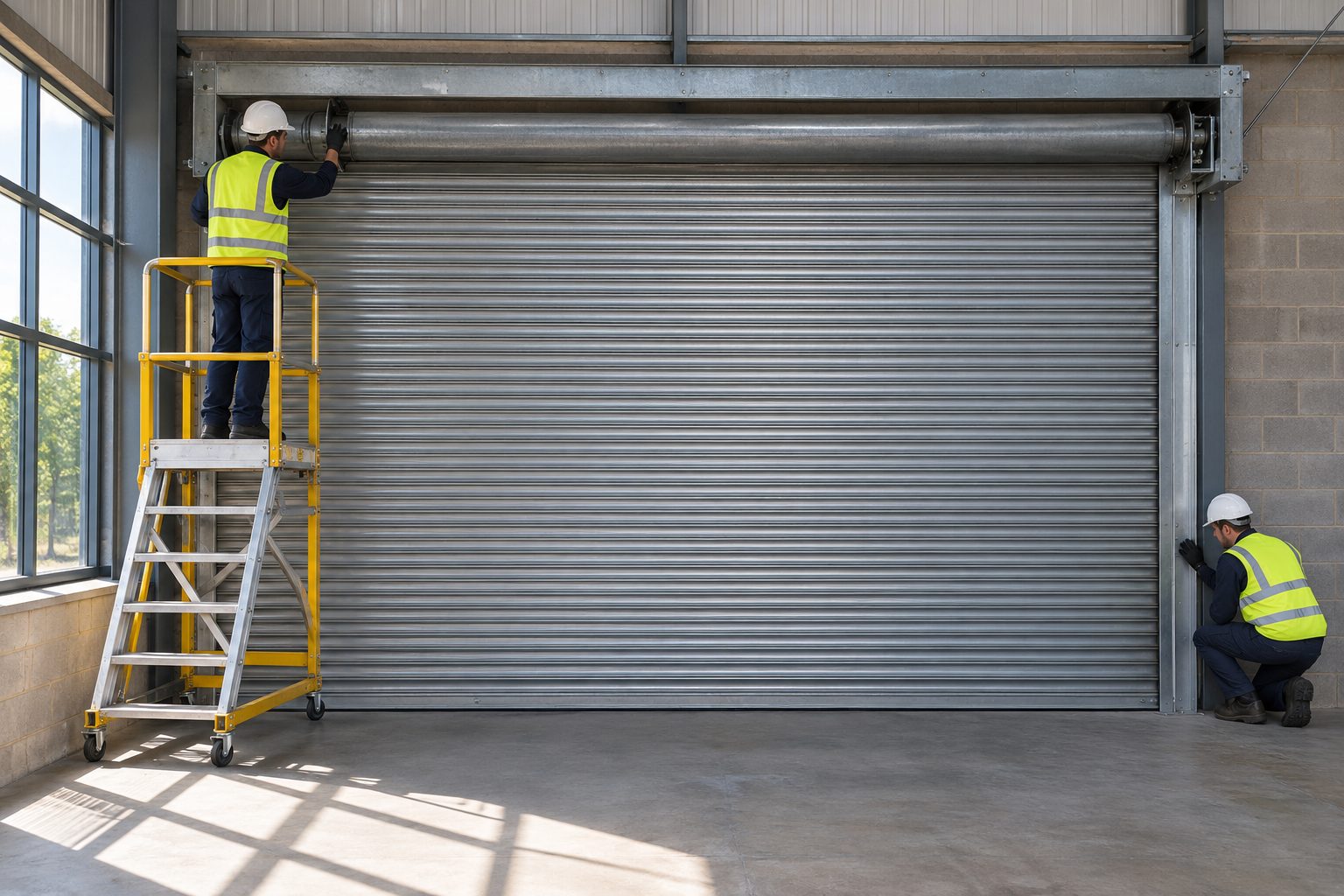
UK Doors & Shutters says the existing curtain and guide rails can often remain.[1] Keeping the barrel or shaft is a separate question: its condition, shape and available space affect the conversion arrangement, which may involve a new motorised barrel assembly.[1] Kinetic also describes checking the curtain, guides and springs before conversion.[4]
Ask the surveyor to separate the assessment into:
- Condition: are the slats straight, the guides secure and aligned, and the curtain travelling smoothly and evenly before closing properly?[1]
- Geometry: what are the opening dimensions, curtain weight and shaft type, and is there enough barrel space and headroom for the proposed arrangement?[1]
- Services: can a suitable power supply be provided, with practical routes for the electrical connection and controls?[1][3]
Awkward operation needs explaining, not powering through. UK Doors & Shutters flags sticking, dropping, sideways pulling, repeated jamming, damaged slats, rust and loose guides as warning signs; it advises repairing a failed or jammed shutter before assessing conversion.[1] Have these symptoms professionally assessed rather than assuming a motor will resolve them.
The work may remove or bypass the manual mechanism, add a motor or motorised barrel, and provide controls, an electrical connection and correctly set travel limits.[1] This changes the operating system without necessarily replacing the whole shutter. UK Doors & Shutters says motorisation does not automatically improve insulation, noise control or impact resistance, or strengthen a bent curtain or damaged guides.[1]
Compare UK Doors & Shutters and IRSD
Both installers advertise manual-to-electric conversion, but their published service descriptions and booking arrangements differ.[1][2] Compare the conversion offer rather than assuming a new-door package describes what an existing shutter will receive.
UK Doors & Shutters
- Published conversion scope: assessed manual-to-electric conversion, potentially retaining the curtain and guides while adding a motor, controls, wiring and associated installation work; the survey determines which components can remain.[1]
- Stated coverage: emergency coverage across North West England. This is an emergency-service statement, not confirmation of conversion availability at every postcode; check the installation address.[1]
- Survey/quotation arrangements: a free site survey, with conversion costs dependent on the shutter, controls, access, electrical work and preparatory repairs.[1]
Industrial Roller Shutter Doors (IRSD)
- Published conversion scope: manual-to-electric motor upgrades, listed separately from electric-door design, manufacture and installation.[2] IRSD says all its electric shutters include advanced safety and protection systems; ask how that applies to a retrofit.[2]
- Stated coverage: Industrial Roller Shutter Doors advertises nationwide electric roller shutter installation across the UK.[2]
- Survey/quotation arrangements: a free quotation through enquiry or telephone, with an advertised “immediate response”.[2] Ask whether that includes a site survey of the existing shutter.
Separate response, production and installation times. UK Doors & Shutters says it can often respond to North West emergency call-outs within 1–3 hours; that is not a conversion installation timescale.[1] IRSD advertises production in as little as three days—a manufacturing claim, not a promise to complete a conversion within that period.[2] Request a site-specific completion date.
Compare three routes with an illustrative cost calculation
Kinetic Door Systems gives rough UK industry estimates of £500–£1,500 for manual-to-electric conversion, depending on condition, and £3,000–£8,000 or more for a large electric industrial shutter. These are industry benchmarks, not Kinetic’s own prices.[4]
Illustrative calculation—not an installed quotation. The example combines published figures from Kinetic and Huxley & Co to demonstrate the comparison method; it is not a combined supplier offer.[4][5]
Fictional example: a professional survey finds an otherwise retainable manual shutter assembly needing guide realignment and lubrication. Assume these are separately chargeable, non-overlapping preparatory jobs. For replacement, assume the existing assembly will be removed rather than repaired.
- Route 1 — repair and keep manual. Huxley & Co lists guide channel realignment at £200–£400 including labour and any necessary adjustments to the shutter box, and professional lubrication at £75–£130.[5] The resulting £275–£530 is arithmetic, not a published repair package.[5]
- Route 2 — repair and convert. Adding the conversion benchmark gives (£200 + £75) + £500 = £775, and (£400 + £130) + £1,500 = £2,030: an illustrative £775–£2,030 total.[4][5] Check itemisation before adding repair allowances to a conversion quote, so preparatory work is not counted twice.
- Route 3 — replace. Use the £3,000–£8,000-or-more large-industrial benchmark as the category reference, without adding repairs to the assembly assumed to be removed. This does not establish a price for the fictional opening.[4]
The small-manual and electric-shopfront categories are not substitutes for the large-industrial benchmark; likewise, Huxley’s standard-shutter motor-replacement price of £350–£650 including labour is not a complete manual-to-electric conversion price.[4][5]
The arithmetic shows why conversion can merit a quotation when existing components remain serviceable—not which route wins for an unsurveyed door.[1][4] Size, curtain weight, access, electrical work, controls and preparatory repairs affect conversion cost.[1] Confirm VAT treatment and the full installed scope before comparing totals.
Choose the route from the survey findings
- Repair and keep manual when faults are repairable and manual operation still suits the workload. UK Doors & Shutters treats repair-only as a valid route; Sunrise identifies smaller openings used once or twice daily as suitable for manual operation.[1][3] Repair need not be a holding measure before automation.
- Convert when the retained assembly is suitable and easier operation justifies the complete powered system. UK Doors & Shutters and Sunrise make condition central to that decision; assess the motor, controls, power connection and installation-specific safety provisions together.[1][3]
- Request a replacement alternative when retention looks questionable. UK Doors & Shutters identifies damaged, undersized or outdated shutters, while Kinetic says replacing an old or damaged shutter may offer better long-term value.[1][4] These are supplier decision triggers, not a universal cost threshold.
Ask the surveyor to explain all three routes against the same findings. If conversion approaches replacement cost, compare what each retains, renews and excludes rather than applying an arbitrary percentage cut-off. Supplier guidance gives no universal break-even point, remaining service life or payback period.[1][3][4]
Request like-for-like quotations
Give each installer the same written scope. Ask for a repair-only alternative where manual operation remains practical, a conversion proposal identifying retained components, and a replacement alternative where condition makes it relevant.
- Condition and suitability: “Record which components you would retain, repair or replace. Explain why the curtain, guides, barrel and available space are suitable for conversion. Separate necessary preparation from optional upgrades.” These are central survey considerations in the conversion guidance.[1][3][4]
- Installed equipment: “Itemise the motor or motorised-barrel arrangement, controls, power connection, access requirements, travel-limit setting and applicable safety devices.” UK Doors & Shutters and Sunrise describe these as parts of an installation-specific conversion.[1][3]
- Power-cut operation: “Explain the proposed manual override, who should operate it and any changes to existing locks or manual operating arrangements.” Override arrangements vary by system, according to Sunrise.[3]
- Commercial terms: the total installed price, VAT position, quotation validity, exclusions, removal and disposal, making good, any separate electrical contractor, deposit and payment schedule, cancellation terms, warranty on motor, parts and labour, and evidence of insurance and competence.
- Servicing: UK Doors & Shutters says heavy-use shutters often benefit from servicing twice a year; ask each installer for its servicing charge and any maintenance conditions attached to the warranty.[1]
Where a line item is missing, ask whether it is included, excluded or unnecessary—and why. Keep a free quotation distinct from a free site survey: UK Doors & Shutters offers a free site survey, while IRSD offers a free quote.[1][2] Compare totals after matching scope and retained condition, not before.
Receive the complete powered-door handover
Ask the installer to demonstrate the completed shutter, not simply show the motor running. UK Doors & Shutters’ guidance covers travel, closure, controls and stopping positions as part of conversion.[1] Use these practical acceptance checks:
- Travel and closure: watch the curtain move smoothly and squarely, close properly and stop at the agreed upper and lower positions.[1]
- Controls: have the installer demonstrate each agreed control, such as the wall switch, key switch or remote, and explain its operation.[1]
- Existing defects: check that sticking, scraping, damaged guides or other faults included in the work have been resolved rather than powered through.[1]
- Safety devices: ask which devices are fitted, what they do and for a demonstration. IRSD advertises obstacle detection and auto-stop; Sunrise describes safety edges or photocells as installation-dependent, so do not assume every conversion includes the same package.[2][3]
- Power cuts: ask what happens when power fails, whether a manual override is fitted, how it works and who should operate it. Sunrise specifically recommends clarifying override operation and responsibility.[3]
Settle the paperwork before accepting the installation. Ask how its compliance basis is established and what conformity documentation, risk assessment, commissioning records and operating instructions will accompany it. Kinetic refers to powered-door safety standards and PUWER, but vendor guidance cannot settle which standard applies to your door; obtain authoritative confirmation of any open compliance question.[4]
Include servicing in the handover discussion. Sunrise says manual shutters still need springs, curtain, guides and locks checked, while powered shutters add motors, controls and safety devices.[3] Kinetic’s servicing checklist also includes travel limits, safety edges and manual override.[4] UK Doors & Shutters recommends twice-yearly servicing for heavily used shutters; this is supplier guidance, not an established legal interval.[1]
The purchase should resolve the operating problem with an agreed scope: repair where manual use remains suitable, convert where the assembly merits retention, and replace where condition makes retention poor value.[1][3][4]
References
- Electric Roller Shutter Conversion Guide 2026 | UK Doors & Shutters (ukdoorsandshutters.uk)
- Electric Roller Shutter Doors Industrial in London, UK | IRSD (industrialrollershutterdoors.co.uk)
- Manual vs Electric Roller Shutters: Which to Choose? (sunriseshutters.co.uk)
- Manual vs Electric Roller Shutters: Which Is Best? (kineticdoorsystems.co.uk, 2026)
- Roller Shutter Repairs: 12 Common Problems & How to Fix Them (huxleyandco.co.uk)