HROUS
Concrete Lifting vs Replacement: A Canadian Owner’s Comparison
Compare concrete lifting with replacement by first asking whether the slab is sound enough to retain, then comparing the proposed drainage, repair scope and settlement terms. Capital Landscapes assesses lost support and slab suitability before recommending either approach; Concrete Lifting Calgary directs severely fragmented or crumbling slabs toward replacement.[1][3]
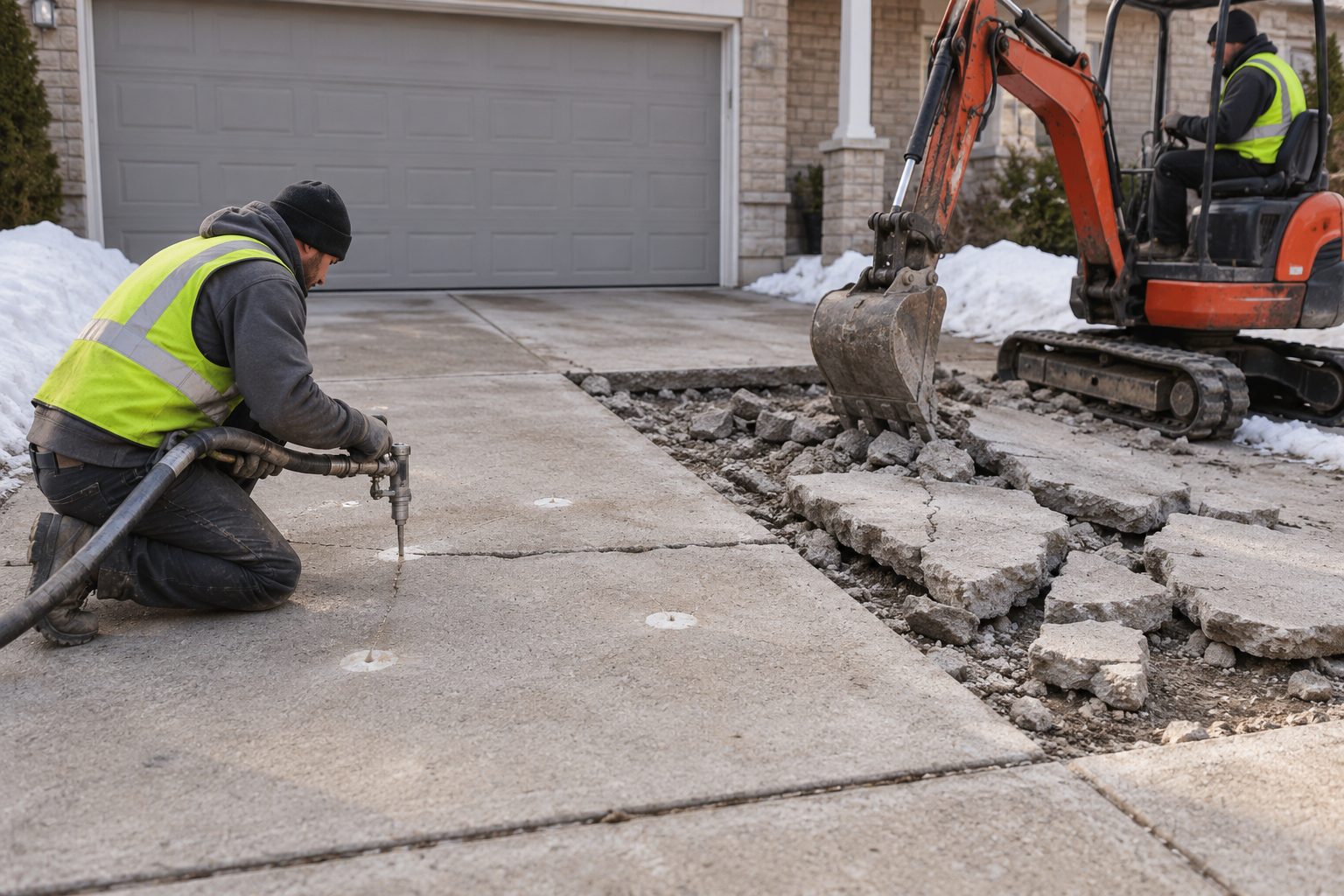
Concrete lifting vs replacement: compare three dimensions
Concrete lifting
- Suitable slab condition: Capital Landscapes assesses whether the existing slab is structurally suitable to retain, considering lost support, soil movement, drainage and voids.[1]
- Work involved: Capital describes assessment, small injection-access holes, controlled polyurethane lifting, hole patching and cleanup.[1]
- Expected result and limits: Capital describes lifting “back toward level”; Concrete Lifting Calgary says aligning cracked sections does not erase the visible crack.[1][3]
Slab replacement
- Suitable slab condition: Concrete Lifting Calgary points to replacement for severely fragmented, crumbling or severely scaled concrete.[3]
- Work involved: Capital Landscapes and Level-Up describe demolition and removal, base or site preparation, forming, pouring and curing.[1][5]
- Expected result and limits: Replacement provides a new slab rather than retaining the existing surface; Level-Up says long-term performance still depends on proper maintenance.[5]
Assess suitability before comparing quotations
Ask what supports retaining the particular slab—not simply whether its cracks fall below a quoted number. Capital Landscapes describes assessing settlement, lost support, soil movement, drainage and voids before recommending lifting or replacement.[1]
Seek qualified assessment if foundation movement appears active. Aztec advises licensed assessment or structural-engineer review before lifting if the foundation itself is moving, highlighting stair-step foundation cracks, sticking doors or windows, and corresponding movement inside and outside.[4]
Organise the provider’s explanation around these questions:
- Is the slab sound enough to retain? Concrete Lifting Calgary describes candidates as sound concrete in one panel or two to four large sections.[3] Merit instead describes structurally sound panels with hairline or isolated fractures affecting less than 30% of panel area.[6] These are provider-specific criteria, not a universal crack cut-off.[3][6]
- Where has support been lost? Capital says it investigates lost support and voids rather than judging suitability from the surface alone.[1] Ask the assessor to identify the affected areas.
- What could be driving movement? Capital identifies shifted, compacted or washed-away soil and considers drainage and soil movement.[1] Ask how those findings affect the recommendation.
- Can equipment reach the slab? Merit says lifting generally requires equipment access, drilling clearance and at least three inches of slab thickness; restricted access or geometry may favour partial replacement.[6]
Agree on drainage—not merely “level concrete”
Capital Landscapes describes lifting “back toward level”, Merit describes restoring original grade, and Concrete Lifting Calgary describes laser adjustment to establish drainage pitch away from a structure.[1][3][6] These descriptions are not interchangeable promises.
Ask the contractor to document these outcomes on the quotation or an attached sketch:
- Elevation: mark reference points and the proposed finished position.
- Drainage: draw the intended direction of water flow rather than accepting “level” as the specification.
- Interfaces: show how the slab should meet garage thresholds, door tracks, adjoining panels and foundations—interfaces the providers identify for attention.[1][3][4]
Concrete Lifting Calgary advertises adjustment in 1/16-inch increments; this is a capability claim, not a confirmed finished-surface tolerance for the property.[3] Request an acceptable finished result and an agreed response if it cannot be achieved.
Separate alignment from appearance. Concrete Lifting Calgary says lifting can bring the sides of an existing crack flush but cannot erase it; it describes flexible waterproof sealing afterwards.[3] Have the quotation distinguish alignment from crack-sealing work.
Define scope, access and reinstatement
Have each quotation spell out what gets disturbed, repaired and cleaned up:
- Lifting: specify drilling, hole patching, existing-crack sealing and cleanup. Capital describes patching and cleanup, with holes colour-matched as closely as possible; Concrete Lifting Calgary describes flexible waterproof crack sealing.[1][3]
- Replacement: itemise demolition, hauling and disposal, site preparation and landscape reinstatement rather than assuming they are bundled together.[1][5]
- Access and protection: assign responsibility for fence access, narrow routes, landscaping, irrigation, low-voltage wiring and adjacent panels. Provider discussions flag these concerns without assigning contractual responsibility.[1][3][4][6]
Agree on downtime separately. Level-Up describes lifting in hours versus replacement over days to weeks; Aztec says return to use depends on the method.[4][5] Get written access restrictions, return-to-use instructions and scheduling conditions rather than treating those descriptions as the project schedule. Aztec recommends unfrozen, unsaturated ground for its Cochrane work.[4]
Separate durability claims from settlement coverage
Capital and Merit link performance to soil and drainage conditions; Level-Up warns unstable soil can make lifting temporary.[1][5][6] Capital’s “life of the concrete” language and Merit’s decade-or-more mudjacking claim are performance statements—not written warranty durations or promises to correct renewed settlement.[1][6]
Ask both lifting and replacement bidders what underlying cause their proposal addresses, what remains unresolved, and who would arrange further assessment if movement continues.
What to confirm with each provider
The cited Capital Landscapes, Aztec and Merit pages do not state complete contractual pricing, finished-level commitments, cancellation terms or written settlement-warranty coverage.[1][4][6] Request comparable written proposals covering:
- Total charges in Canadian dollars: taxes, minimum charges, included work, exclusions, and how extras would be calculated and approved. Concrete Lifting Calgary says replacement disposal typically adds $200 to $500+ in dumping and trucking costs; ask lifting and replacement bidders to price the same stated outcome, separately identifying drainage correction, sealing and reinstatement. [3]
- Commercial terms: quote expiry, deposit, payment schedule, and cancellation and refund terms.
- Achievable result: target elevations, acceptable tolerances, drainage direction, threshold treatment and responsibility if the agreed result cannot be reached.
- Recurrence coverage: what counts as renewed settlement, coverage duration, exclusions, maintenance obligations and transferability.
- Claim and remedy: how to submit a claim, how it will be assessed, available corrective work, and charges for return visits, reassessment or further soil and drainage work.
Resolve differing assumptions before comparing totals. Consider lifting when assessment supports retaining the slab and the proposed outcome is acceptable; consider replacement when assessed damage or access constraints make retention unsuitable.[1][3][6]
References
- Concrete Lifting | Capital Landscapes (capitallandscapes.ca)
- Concrete Lifting vs Replacement: Which Is Better? | Calgary Guide (concreteliftingcalgary.ca)
- Concrete Lifting Cochrane 2026: Best Fix for Sunken Slabs – Aztec Spray System (aztecspraysystems.ca, 2026)
- Comparing Methods: Concrete Lifting vs. Replacement | Level-Up Concrete (levelupconcrete.ca)
- 7 Things to Know About Concrete Edmonton Homeowners (meritconcrete.ca)