HROUS
Building Envelope Commissioning: US Owners’ Scope Comparison
Build the enclosure commissioning scope from NIBS Guideline 3 and ASTM E2947, then compare proposals by coverage, verification and delivered evidence—not package labels.[2][3] GHP’s published new-building service appears below only as an example of how a vendor describes its offer, not as an equivalent alternative to the standards-based scope.[5]
Compare coverage, verification and follow-through
NIBS Guideline 3 project-specific scope
- Coverage: Owner’s Project Requirements (OPR)-led design, construction and occupancy activities tailored to the building and owner’s objectives.[2]
- Verification: Technical reviews, mock-up participation, sampled installation observations and testing during installation.[2]
- Evidence and follow-through: OPR and a preliminary commissioning plan, owner training and enclosure review before the initial warranty period ends.[2]
Example: GHP’s published new-building service
- Coverage: GHP describes third-party support from inception through occupancy and operations.[5]
- Verification: GHP describes design review, meetings, installation monitoring and final review; the cited page does not state exact testing quantities.[5]
- Evidence and follow-through: GHP describes commissioning documentation, inspection findings, maintenance recommendations and post-occupancy evaluation for up to one year after completion.[5]
Build the bid scope from NIBS Guideline 3 and ASTM E2947; use GHP’s description only as an example when checking what a vendor’s offer includes. Neither the guidance nor a vendor description is an itemized project agreement.
Construction Specifier’s 2016 article identifies “Fundamental” and “Enhanced” as ASTM E2813 commissioning levels.[4] Do not accept either label in place of a task schedule.
Resolve the ASTM edition and obligation question
ASTM’s historical E2947-15 page, updated April 12, 2016, identifies E2947-25 as active.[3] Name the agreed edition in procurement documents rather than copying an older search result.
The cited NIBS and ASTM guidance establishes no nationwide mandate to commission every new-building enclosure.[2][3] Check requirements with the project’s authority having jurisdiction and review the project contracts before treating commissioning as mandatory.
The historical ASTM edition says its methods do not replace contractual obligations or change legally assigned roles.[3] Keep commissioning duties distinct from the design and construction teams’ existing responsibilities; do not treat commissioning as a replacement product warranty.
Turn owner requirements into a verification schedule
NIBS describes enclosure commissioning as validation against owner objectives and requirements documented in the contract documents. It identifies the OPR as the controlling direction and the Basis of Design (BOD) as the technical bridge to those documents.[2]
Ask bidders to connect each selected requirement to:
- The assembly or interface covered.
- The design-review task and observation or test.
- The responsible party, timing and evidence deliverable.
Moisture control, air flow, thermal performance and maintainability are supported requirement categories; scope can include roofs and below-grade assemblies as well as walls and windows.[2] Set those boundaries and project acceptance values explicitly in the agreement.
Specify design reviews and mock-up decisions
Name the design submissions, critical interfaces, written comment deliverables and response checkpoints—not simply “design review.” NIBS describes technical review, coordination of enclosure requirements and preparation of a project-specific commissioning specification.[2]
Aldous’s commissioning-plan paper identifies continuity of water-management layers, flashings, air barriers, insulation and thermal breaks as review topics.[1] Include interfaces with HVAC and other interdependent systems.[2] Aldous also identifies hygrothermal evaluation as potentially necessary to assess condensation risk; ask bidders whether it is included or separately scoped.[1]
Ask whether the scope includes laboratory or site mock-ups, technical-submittal and shop-drawing reviews, preconstruction meetings and project-specific checklists—activities identified in NIBS guidance.[2] Agree on mock-up triggers and test selections: NIBS’s annex resources, including window-water and whole-building air-leakage testing, are examples, not universal testing requirements.[2]
Specify observation and testing coverage
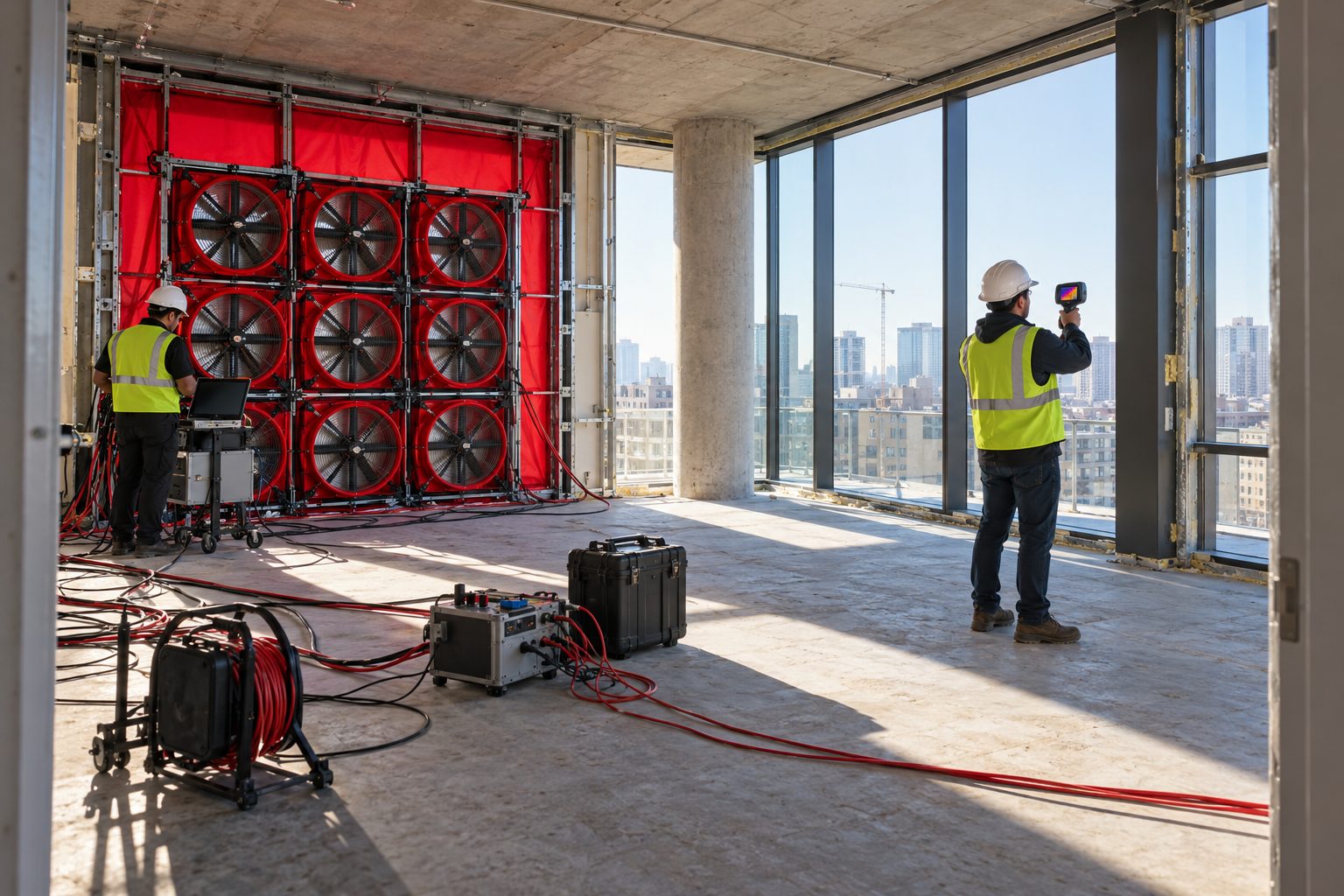
NIBS calls for visual observations using statistical sampling and verification testing throughout installation.[2] Ask each bidder to define:
- Observations: Milestones, covered assemblies, sampling approach, visit allowances and scheduling assumptions.
- Testing: Methods, quantities, timing, and who arranges and performs each test.
- Follow-up: Added-visit, failed-test and retest assumptions, including who pays and what follow-up is included.
Do not defer all testing until completion. NIBS explains full performance verification requires an enclosed building, but deficient subsystems can then be expensive to access.[2]
Assign decisions and correction responsibilities
The commissioning review gives the owner an impartial assessment without superseding the architect-of-record; concerns go to the owner and project team, while the owner determines the course of action.[1][2] NIBS recommends direct owner engagement of the enclosure specialist when feasible and identifies relevant commissioning experience, enclosure knowledge and familiarity with performance criteria and tests as qualifications.[2]
Put a responsibility schedule in the agreements: name who reviews, responds, designs corrections, performs corrective work, retests and authorizes issue closure. Keep the owner’s decision-making role distinct from contractual acceptance authority, and confirm warranty terms separately.
Define issue closure and handover evidence
Ask for evidence of resolution, not simply a final report. Aldous calls for reporting and comprehensive documentation throughout the process.[1] Specify a handover package containing requirement references, review comments and responses, observation records, test reports, corrective-action evidence and unresolved items.
Include operating information and follow-through: NIBS identifies owner operation-and-maintenance training and an enclosure review before the initial warranty period ends as occupancy activities.[2] Ask each proposer to state its deliverables and follow-up commitments in the agreement rather than assuming the same duration across services.
What to confirm with each provider
The cited NIBS, ASTM, Construction Specifier and GHP pages do not establish the following project-specific or commercial terms.[2][3][4][5] Resolve them before comparing final proposals:
- Coverage: Design-review milestones, mock-up triggers, observation sample sizes, test quantities and pass/fail thresholds.
- Issue closure: Correction assignments, response and retesting deadlines, acceptance authority and treatment of unresolved deficiencies.
- Commercial terms: Itemized fees, reimbursables, additional-service rates, payment schedule, contract length and cancellation or termination provisions.
- Standards and jurisdiction: Detailed Fundamental and Enhanced requirements, applicable E2947-25 clauses, and local adoption or permit requirements.
- Provider availability: Confirm GHP’s service territory rather than assuming its published description establishes local availability.
Give bidders the same OPR, enclosure boundaries and verification schedule. Choose documented tasks, evidence and responsibilities—not a level label alone.
References
- Developing an Exterior Enclosure Commissioning Plan (ornl.gov)
- NIBS Guideline 3-2012: Building Enclosure Commissioning Process BECx (wbdg.org)
- E2947 Standard Guide for Building Enclosure Commissioning (astm.org)
- Building Enclosures: Understanding the commissioning process – Construction Specifier (constructionspecifier.com)
- Building Enclosure Commissioning Process: A Guide for New Buildings — GHP (ghp1.com)