HROUS
How to Choose an Archival Book Cradle for a UK Reading Room
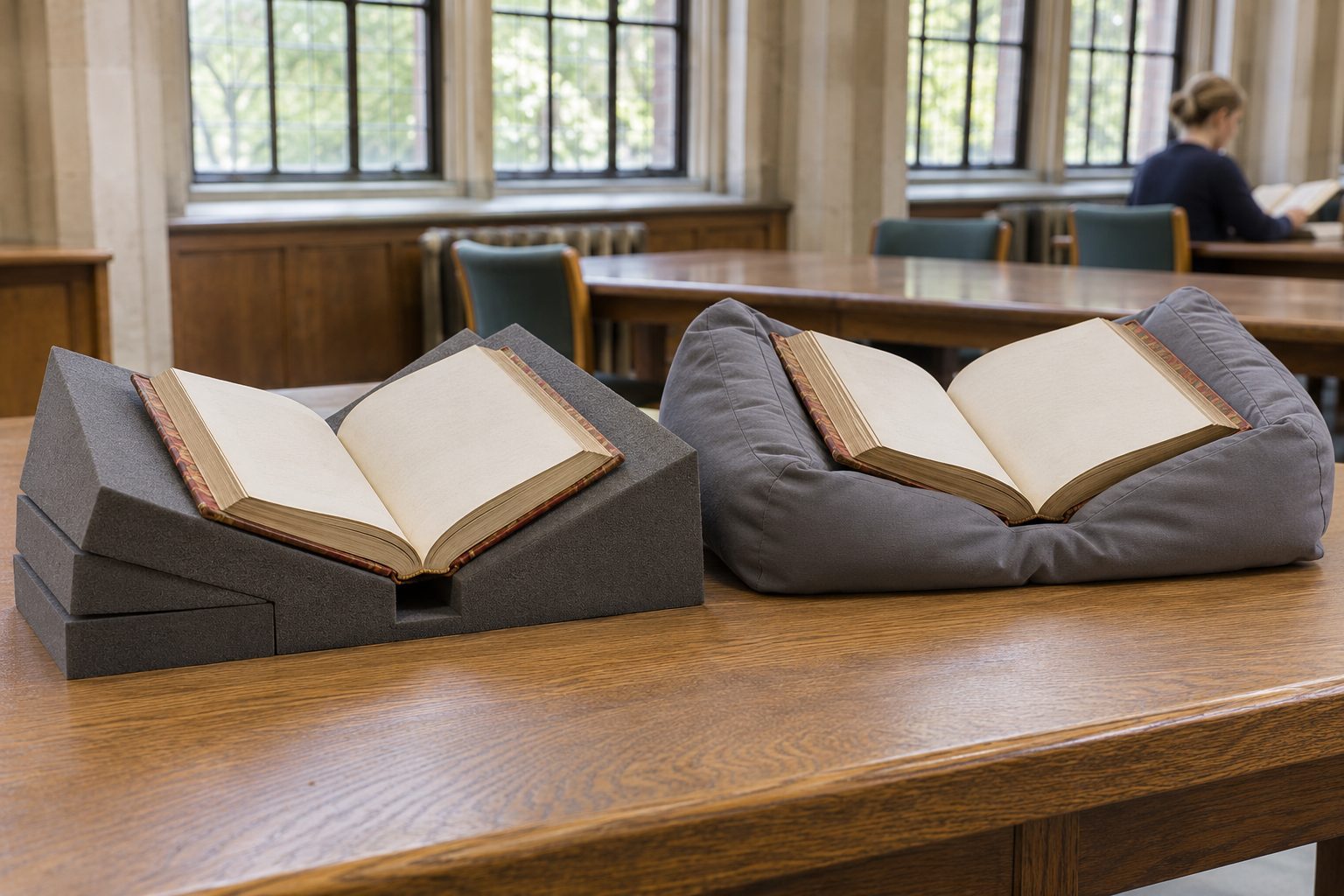
Choose adjustable foam wedges if your UK reading room serves volumes of different sizes or a thick book needs more support as you turn from front to back. A shaped book cushion can suit a set of similar volumes if it supports both boards at each opening the reader needs. Fit either option to the individual binding with collections staff before putting an original on it. [1][2]
Start with the binding and the pages the reader needs
Record the height and width of the closed volume, its spine width and the pages that will be consulted. Ask collections staff to show how far that copy may open. The permitted opening depends on the construction and condition of the binding. At Merton College, Oxford, the handling guidance illustrates how hollow-back and tight-back bindings move differently. Both need room for the spine to move, and some tight-back volumes may need a separate spine support selected by staff. [1][2]
Choose between a wedge set and a shaped cushion
Adjustable wedges for varied or thick volumes
Choose wedges that reach beneath both boards. Matching pads let staff raise the side that needs support as the weight of the text block shifts. Merton College provides three sizes of foam support and illustrates the different support needed at the front, middle and back. Its guidance calls for lifting the book off the support before changing any pads. [1]
The Clarkson Book Support System from Conservation Resources (UK) is one example of a modular set supplied with a main wedge, two side wedges, two pads and a spine support. Its published 20-degree wedge angle describes the product geometry. For an individual volume, use the opening permitted by collections staff. Ask the supplier for the dimensions of the specific kit size and the footprint of the pieces when arranged on the desk.
A shaped book cushion for a recurring size range
Bristol Archives keeps small and large book sofas alongside foam wedges. Try a shaped cushion when the same sizes of volume come out regularly and staff can set it up consistently. The cushion earns its place only if both boards rest securely without the book rocking, the spine has the clearance it needs and the reader can reach the required pages without holding the volume farther open. Check it with a representative test volume first.
Run two desk trials before ordering
- Small bound volume. Use a representative test book at the permitted opening. Check that the boards sit fully on the support, the lower corners stay put and the spine has clearance. Then turn to the pages near the back and repeat the check.
- Thick or large volume. Check support near the front, middle and back. Include the full width of the open book and the support when you measure the desk. If the support needs padding at different points, check whether staff can set and reset it while a second person handles the test book.
On the purchase order, record the support dimensions, the sizes of volume tried, which pads or spine pieces come with the set and the shelf space needed to store it. Keep the selected pads together so staff can recreate the setup. If a model cannot fit both trial volumes, order the sizes you have tested or use adjustable supports for the range that varies most.
Decide how pages will be held in place
Use the handling aids supplied or approved by the reading room. The Warburg Institute and Bristol Archives provide snake weights, with use guided by their staff. For a fragile page or any sign that a binding is resisting, pause and ask the collections team to choose the next step. [2]
Frequently Asked Questions
- Can a single cushion serve books of different sizes?
- Try the small and large ends of the proposed size range using test volumes. If one cushion cannot support both boards at each reading position, choose separate sizes or use adjustable wedges with matching pads.
- Can readers adjust a pad while the original is on the cradle?
- Follow the institution’s handling procedure. Merton College’s guidance has the reader lift the book off the support before changing its pads. Ask reading-room staff to handle fragile or awkward volumes. [1]
References
- Merton College, University of Oxford — Handling Reading Room Material (ox.ac.uk)
- Warburg Institute Library — Handling: Using Book Supports (libguides.com, 2026)