HROUS
Bunded pallet requirements for Australian warehouse teams
Match the drum inventory to the pallet materials, available containment, load rating and access. Spill Crew’s DB4LP is a low-profile option for smaller drums. The DB4GIL arranges drums in a line and lists four 205 L drums in its specification. Check which design suits your inventory and working space. [1][2]
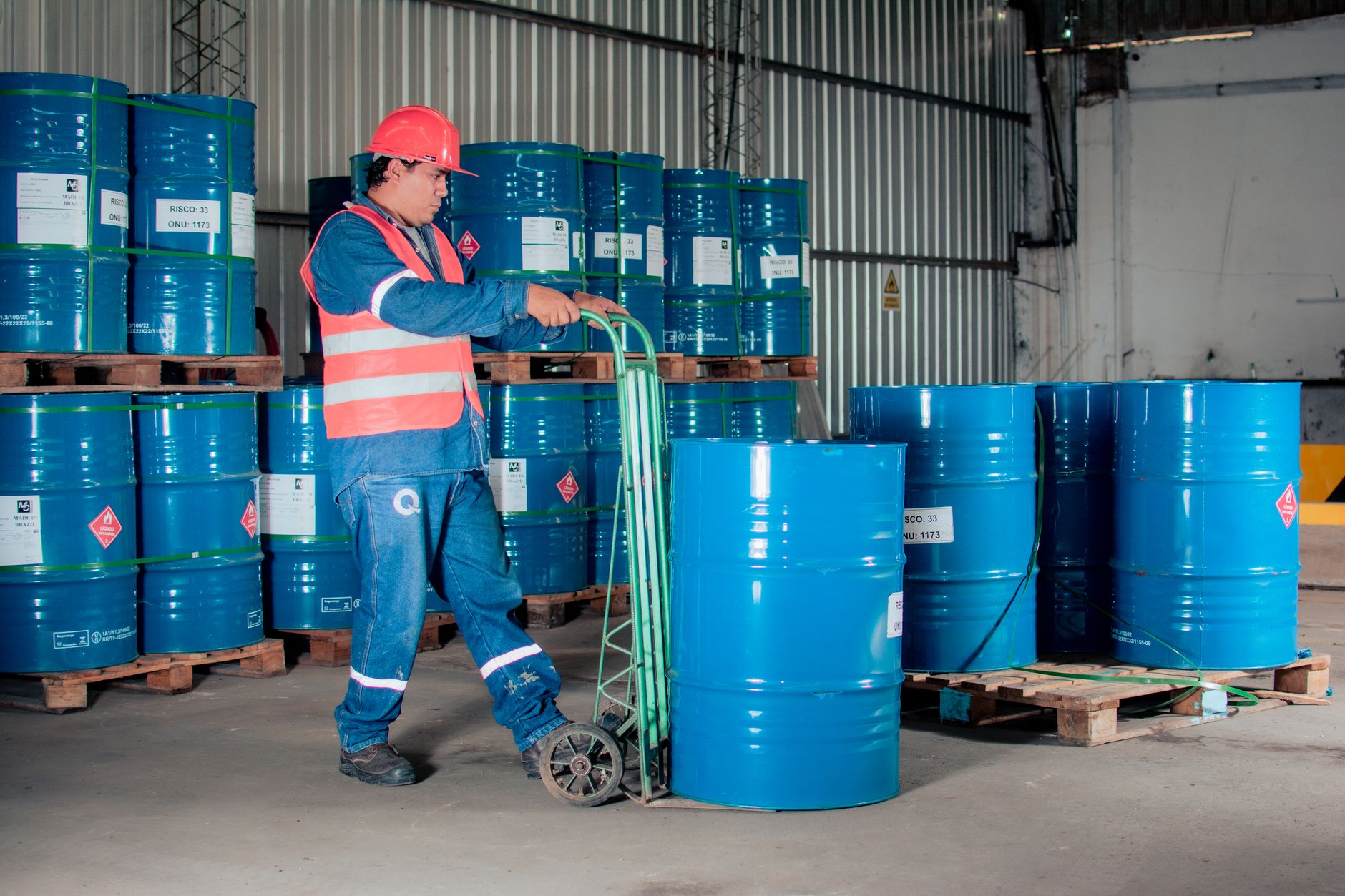
- Placement: locate the bund on level ground as the supplier directs. Confirm chemical compatibility for the actual liquids and make sure the selected pallet meets the containment and load requirements. [1][2]
- Optional equipment: DB4LP’s ramp is offered for wheeling or loading drums onto the bund.[1]
A “four-drum” label does not settle the selection. The two product pages describe different drum sizes, and both leave specification questions to resolve before ordering.[1][2]
1. Compare the model specifications
DB4LP: low-profile bund
- Drum fit: presented for 20 L and 60 L drums, smaller containers and batteries.[1]
- Sump capacity: 145 L.[1]
- Load rating: Spill Crew lists 2,800 kg UDL, meaning uniformly distributed load. Ask the supplier whether the proposed drum arrangement and individual loaded weights fit that rating. [1]
- Materials: polyethylene bund with a removable polypropylene grate.[1]
- Access: an optional ramp supports wheeling or loading drums; the removable grate provides access for cleaning and liquid removal.[1]
DB4GIL: inline bund
- Drum fit: the specification states four 205 L drums, while introductory text separately says “up to four 250 litre drum bunds”. Ask Spill Crew to clarify this wording and confirm the proposed drum inventory.[2]
- Sump capacity and load rating: obtain numerical values for both before assessing containment and payload.[2]
- Materials: the product specifications identify a recycled polyethylene bund and recycled polypropylene grate.[2]
- Access: removable grates provide sump access, and three drain plugs permit decanting. Spill Crew promotes the long, narrow layout for positioning along walls or walkways.[2]
The listed overall dimensions are 121 × 121 × 15 cm for DB4LP and 242 × 62 × 25.2 cm for DB4GIL.[1][2] Confirm these for the model being supplied, and request DB4GIL’s numerical sump capacity and load rating, plus fork-entry dimensions, tine clearance, loaded-forklift permission and inspection-spacing requirements for either model. Keep these outstanding details as open specification items, not assumed capabilities.
2. Match the inventory and check both materials
Prepare an inventory worksheet before comparing drum counts. Record the following for each container type:
- Count: the number to be stored.
- Capacity: the labelled volume of each container.
- Dimensions: the space each container occupies.
- Contents: the specific liquid or product.
- Filled mass: the container and contents together.
Compare that inventory with the model-specific description. DB4LP’s stated uses include 20 L and 60 L drums and smaller containers; DB4GIL’s specification identifies four 205 L drums.[1][2] Do not treat their “four-drum” descriptions as interchangeable.
Check each liquid against both the sump and the grate. DB4LP’s operating instructions explicitly require chemical compatibility with its polyethylene bund and polypropylene grate. Its broad description of suitability for most chemicals, acids, oils and fuels is not confirmation for every liquid.[1]
Spill Crew describes DB4GIL as resistant to hazardous acids, caustics and solvents.[2] Request written confirmation covering the specific contents and proposed storage conditions, with separate entries for the sump and grate.
For DB4GIL, use the product-specific recycled polyethylene and recycled polypropylene descriptions when requesting confirmation. Its page also carries a broader range-level statement about 100% rotationally moulded polyethylene; ask the supplier to identify the construction of the model being supplied.[2]
3. Assess containment separately from supported load
Keep separate specification fields for sump capacity in litres and supported payload in kilograms. DB4LP’s instructions require both compliance with sump capacity and staying within its UDL limit.[1] Neither check substitutes for the other.
- Containment: record DB4LP’s 145 L sump as a product specification, not as confirmation of adequate containment for the proposed inventory.[1] Ask the site’s spill-management adviser to establish the applicable containment criterion for the liquids, quantities and location.
- Supported load: compare the proposed filled-container payload with a confirmed model-specific rating. Distinguish DB4LP’s 2,800 kg UDL from the optional ramp’s 1,000 kg UDL when assessing the load specification.[1]
Request supporting test evidence where needed. Spill Crew reports that the bund design, including the grate, underwent a fully loaded compression test maintained for 28 days at 40°C. It says load testing was conducted by NATA-accredited Falcon Test Engineers in Victoria and that dynamic-compression certificates are available on request.[1][2]
Those testing statements do not supply DB4GIL’s missing numerical sump capacity and load rating.[1][2] Request the relevant certificate alongside the confirmed model rating, and keep the site containment assessment separate from the load assessment.
4. Confirm loading access and forklift handling separately
The optional DB4LP ramp supports loading drums onto the bund; it does not establish permission to lift or transport the bund itself.[1] Neither cited page states fork-pocket dimensions, entry direction, tine spacing, under-pallet clearance or permission to move the pallet loaded by forklift.[1][2]
Before selecting either model, request handling instructions covering the proposed operation:
- Drum loading: describe how drums will be placed onto the stationary bund and ask whether that method is supported.
- Fork arrangement: if forklift handling is proposed, request a dimensioned drawing showing entry direction, pocket dimensions, tine spacing and under-pallet clearance.
- Equipment fit: provide the handling equipment’s dimensions for comparison with the manufacturer’s requirements.
- Empty and loaded movement: request explicit instructions distinguishing whether, and under what conditions, the bund may be lifted or transported empty or carrying drums.
Keep fork fit and loaded-movement permission as separate entries in the specification. A drawing that establishes physical access is not a substitute for operating instructions, and a compression-test certificate should not be treated as handling permission.
5. Compare inline and square layouts for inspection
Start with the published footprint. The DB4LP is square at 121 × 121 cm. The DB4GIL is 242 × 62 cm and puts the drums in one line. Lay out the access needed to reach the drums, remove the grates and service the drain points. [1][2]
On each sketch, mark:
- Each drum’s position and the proposed loading approach.
- Where someone would stand to inspect every drum and the containment area.
- The access needed to remove grate sections and reach the sump.
- The liquid-removal points, including any facing a wall.
- Where removed grate sections would be placed during cleaning.
Compare the layouts using the documented access features. DB4LP’s removable grate permits cleaning and liquid removal; DB4GIL provides removable grates and three sump drain plugs for decanting.[1][2]
For each arrangement, check whether every drum, relevant grate section and liquid-removal point can be reached. If a wall position obstructs those tasks, revise the arrangement rather than relying on the inline positioning claim. Keep the loading approach visible on the same sketch so inspection space is not considered in isolation.
Use the published overall dimensions as the starting footprints for the layout, not as allowances for inspection or working access.[1][2] Ask Spill Crew about minimum inspection spacing, precise indoor clearances and the required inspection frequency. Take the proposed access allowances to the site’s spill-management adviser rather than inserting assumed clearances.
6. Set the location and complete the pre-order checklist
Check the surface and exposure before setting the location. Spill Crew warns that uneven positioning and distortion from heat can destabilise the load. [1][2]
For outdoor storage, its cover recommendation addresses rainwater entering the sump and causing overflow.[1][2] Record how weather exposure will be addressed without describing the cover as a mandatory supplier condition. For DB4LP, also record arrangements for removing captured liquid promptly, as its instructions require.[1]
Keep the supplier’s operating conditions separate from the site assessment. Ask the spill-management adviser to assess containment for the inventory and location, the proposed inspection and cleaning access, and weather exposure. Do not use a product’s sump figure or general suitability claim as a universal Australian compliance rule.
Before ordering, give each item below an evidence reference and mark it as confirmed, awaiting evidence or unsuitable for the proposed use:
- Inventory and fit: drum count, capacities, dimensions, contents and filled masses, matched to the selected model.
- Compatibility: confirmation for each liquid against both sump and grate materials.
- Containment: confirmed sump capacity and the site-specific containment criterion recorded with the adviser.
- Load: a reconciled model-specific rating and a payload comparison.
- Layout: confirmed footprint and access for inspection, grate removal, cleaning and liquid removal.
- Loading: the supported drum-loading method and any optional ramp selected.
- Fork handling, if proposed: matched entry dimensions and separate instructions for empty or loaded movement.
- Placement and operation: level-ground location, operating instructions, liquid-removal arrangements and the outdoor-cover decision.
Keep the confirmed specification, operating instructions and any requested test evidence together as the procurement record. Neither product page alone completes every selection check; resolve the gaps relevant to the intended use before ordering.[1][2]
References
- Low profile spill pallet | Four drum | Made in Australia | Spill crew (spillcrew.com.au)
- Inline four drum bund | Four drum inline spill pallet | Australian made (spillcrew.com.au)