HROUS
Blow Moulding for Australian Buyers: Compare Tooling, Closures and Batch Acceptance
To commission blow-moulded containers in Australia, give each supplier the same container drawing, resin requirement, neck and closure specification and order quantity, then compare written answers on minimum run, mould ownership, sample approval and batch acceptance. Plas-Pak in Perth, WA, and FPC Food Plastics in Campbellfield, VIC, are used below as examples of published service scope; they are not interchangeable local quotes.[1][3]
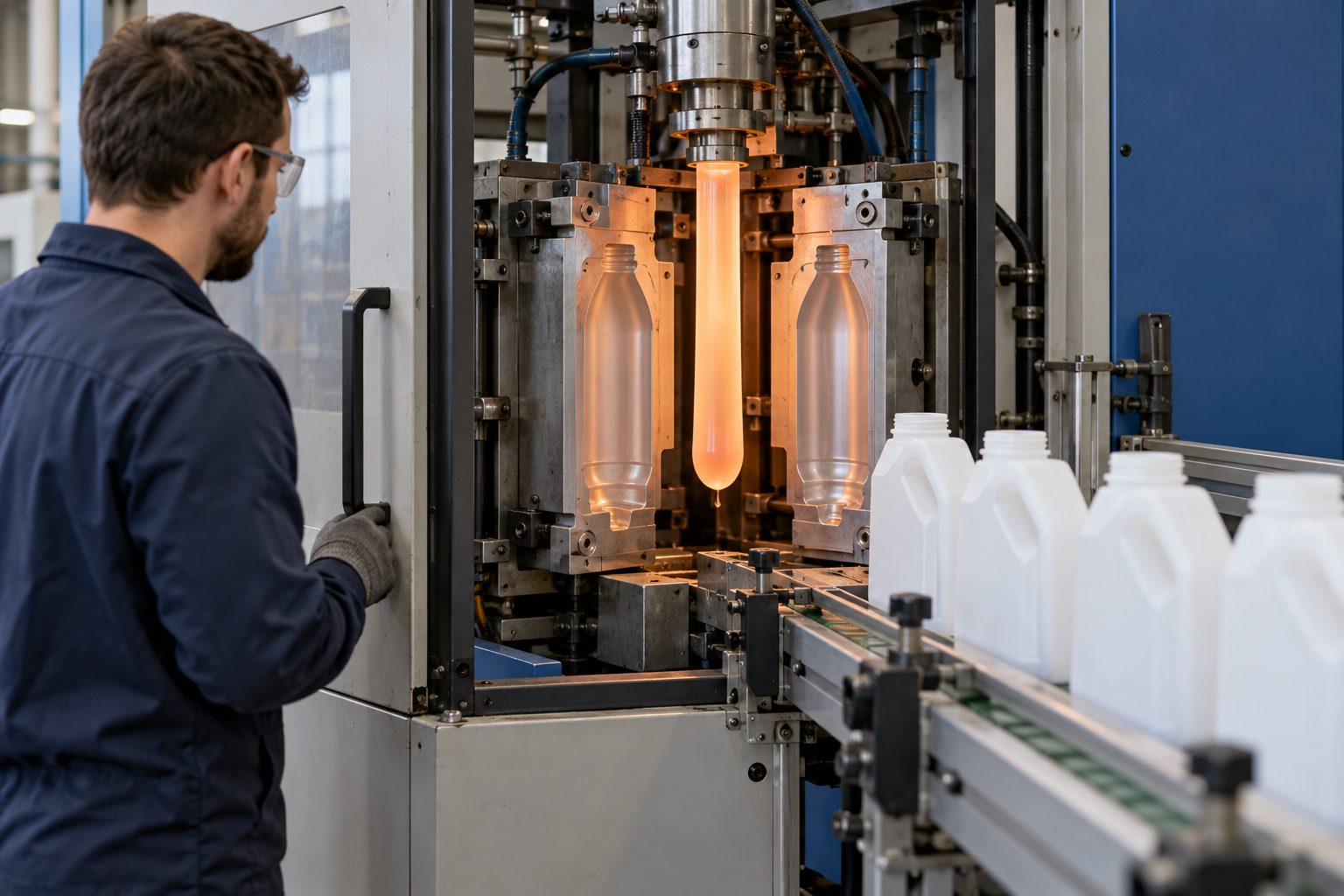
Start with the container duty, resin and process
Define what the container must hold, how it will be filled and closed, and how it will be stored and transported before asking for a price. Then check whether each supplier’s published capability covers it.
- Plas-Pak: uses extrusion blow moulding (EBM) and lists typical products from 50 ml to 10 litres in HDPE, LDPE or PVC.[1]
- FPC Food Plastics: lists HDPE extrusion blow moulding, HDPE injection blow moulding, PET preforms and blow moulding, and LDPE caps and closures, across more than 20 automated lines.[3]
A resin family name is not evidence that a container suits food, pharmaceutical, chemical or agricultural contents. Ask for the exact material grade and the supplier’s documentation for your intended contents, and run your own compatibility testing if the application needs it. Plas-Pak says it serves industries including pharmaceutical and agriculture, and FPC says it is HACCP certified for food packaging manufacturing; those describe each supplier’s operations, not the suitability of a particular grade for your product.[1][3]
Compare minimum runs and set-up charges
Minimum quantities change the unit price and decide whether a custom part makes sense at all. Plas-Pak asks for a minimum order of 2,500 units to avoid a set-up fee when the product is not a stock item.[1] FPC’s manufacturing page does not publish a minimum order.[3]
Neither supplier publishes set-up fees, unit prices or repeat-order minimums on the cited pages. Ask for these in writing, and ask whether a smaller first run is possible and what it would cost.[1][3]
Settle tooling, ownership and repeat-run rights
The mould is usually the largest upfront cost, so agree who pays for it, who owns it and where it is kept before design work starts.
Plas-Pak says it can work from your drawings or design a new product in CAD with its industrial designers and engineers. Tooling begins after all parties approve the design, and moulds are made by a toolmaker in steel or aluminium.[2] Plas-Pak lists three payment arrangements: outright purchase and ownership, paying the cost off over an agreed period, or part ownership with a limited period of exclusivity.[2]
FPC says it supports customers with new packaging formats from concept to delivery, but its page does not describe tooling ownership.[3]
Ask each supplier to state in the quote:
- Toolmaker and location: where the mould will be made and who is responsible for defects in it.
- Material and expected life: steel or aluminium, and the run volume the mould is expected to handle before refurbishment.
- Ownership: whether you own the mould outright, are paying it off, or share ownership, and what exclusivity applies.
- Removal rights: whether you can move the mould to another moulder, and what notice or fees apply.
- Storage and maintenance: who stores, insures and repairs the mould between runs.
Specify the neck finish and closure fit
The neck and closure are where most leak and fit problems start. Put the neck finish, thread or snap profile and the intended closure on the drawing, and say whether the supplier or you will supply the closure.
FPC manufactures LDPE caps and closures as well as bottles and containers.[3] Plas-Pak lists caps, lids and accessories in its product range.[1] If the closure comes from a different supplier, ask the moulder how it will check fit against a sample of that closure, and who is responsible when the two do not seal.
Ask for the neck dimensions the supplier will measure, the tolerance it will hold, and how often it will check them during a run.
Agree sample approval and leak checks before production
Approve samples against the drawing before the production run, not after. FPC says its quality approach is supported by leak detection and vision systems.[3] That describes its in-line process; it does not set the test conditions or pass criteria for your container. Plas-Pak’s cited pages do not describe a leak-test procedure.[1][2]
Write these into the purchase order:
- First samples: how many, from which mould cavity, and in which resin and colour.
- Dimensions: which measurements are checked, including neck dimensions, height, wall areas you care about and weight.
- Closure fit: application and removal with the actual closure you will use.
- Leak check: the test method, test conditions and pass criteria you both agree on.
- Sign-off: who approves the samples and how the approved samples are kept as the reference for later batches.
Define batch acceptance, rejects and repeat orders
Write down how a delivered batch will be checked and what happens when it fails. Agree the sampling plan, the defects that cause rejection, the time you have to report them, and whether the supplier replaces, reworks or credits rejected units.
Plas-Pak can colour-match containers to a brand colour, including pearlescent and metallic finishes.[1] Agree a physical colour reference and an acceptable variation between batches.
If recycled content matters, FPC says it can supply products made from recycled materials, including 100% recycled PET.[3] Ask how recycled content is documented for each batch.
What to confirm with each provider
- Plas-Pak: the set-up fee below 2,500 units, which tooling payment option applies, mould removal rights, and how it checks neck dimensions and closure fit.[1][2]
- FPC Food Plastics: minimum order, mould cost and ownership terms, which process suits your container, and the leak-test conditions it applies.[3]
- Both: lead times for tooling and first samples, freight from their location to yours, payment milestones, and the reject and replacement process.
Compare suppliers on the written answers to these points, not on the published size range or minimum run alone.
References
- Plastic Blow Moulding | Plas-Pak (plas-pak.com)
- Plastic Product Design and Tooling | Plas-Pak (plas-pak.com)
- Manufacturing | FPC Food Plastics (foodplastics.com.au)