HROUS
How to choose fire alarm commissioning in the UK: client checks
Choose a fire alarm commissioning service by requiring a quote tied to the agreed design, explicit testing coverage, a defects process and a complete handover file. Cardinal Fire describes commissioning as comprehensive testing against both the standard’s recommendations and the designer’s system specification—not simply issuing a certificate. This guide concerns newly installed, principally non-domestic systems. [3]
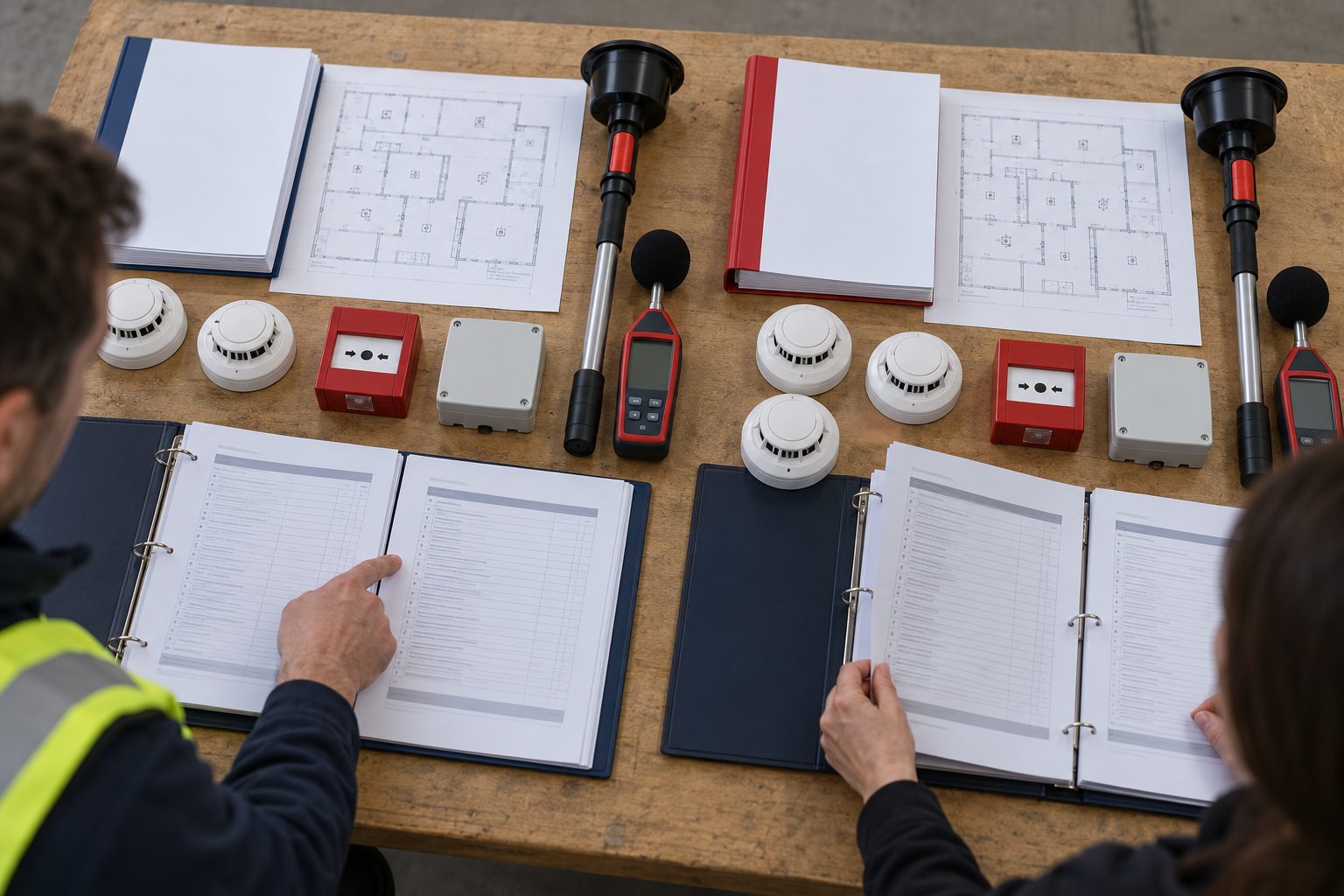
Use the checks below as procurement requirements, not a statutory checklist. Separate the design and certification records described by Cardinal from arrangements to negotiate, such as witnesses, user familiarisation and return-visit charges. [3]
Resolve the design basis before requesting commissioning
Assemble a design pack the commissioner can use as the testing basis:
- Agreed system category: ask the designer to confirm M, L1–L5 or P1/P2, rather than choosing a category from a generic article. Cardinal identifies category and the fire-risk assessment as design considerations. [3]
- Design drawings and specification: provide the agreed drawings, relevant fire-risk assessment and specification describing the intended system. Cardinal says the commissioner needs access to design drawings and reference materials. [3]
- Device schedule: include a project-specific device list so the contractor can describe its testing scope against an identifiable installation. Treat this as a procurement aid, not an express document requirement in Cardinal’s guidance. [3]
- Required alarm operation: record alarm zones, audible, visual or tactile warnings, and the intended evacuation operation, including any phased evacuation. [3]
Ask the designer to capture the required operation in a project-specific cause-and-effect matrix, linking initiating events to outputs and interfaces. This is a practical documentation recommendation: Protec requires full specifications to establish operation and functionality, while Cardinal identifies alarm zones and phased evacuation as design considerations. Agree the matrix format with the designer. [2][3]
Ask the quote to identify the applicable standard and edition, alongside the design documents it will test against. Protec and Cardinal refer to BS 5839-1 without identifying an edition. [2][3]
Identify specialist systems and interfaces explicitly
Request an interface schedule rather than accepting “fire alarm commissioning” as a catch-all description. Cardinal distinguishes the scope of BS 5839 Part 1 from specialist functions such as voice alarms and systems primarily intended to control or extinguish fire. [3]
Protec illustrates why itemisation matters. Its commissioning page separately lists fire, aspirating, sound-level and wireless fire-detection systems; VE-PA; AFILS; EVC; gas detection; and gas suppression. It assigns BS 5839-1 to the first group, BS 5839-8 to VE-PA, BS EN 60118-4 to AFILS and BS 5839-9 to EVC. Ask Protec to confirm the applicable standards for gas detection or gas suppression. [2]
Ask the contractor to explain specialist labels wherever they appear in the quote. For each relevant connected system, request:
- Equipment and expected operation: what should happen when the specified alarm or fault condition occurs?
- Scope boundary: is testing included, excluded or dependent on another contractor, and where does the commissioner’s work end?
- Responsibility and evidence: who proves the connected equipment works, and what record demonstrates the result?
Resolve these details before booking. Protec requires the full specifications identified in sections 8.0 and 9.0 of its commissioning request form before the requested commissioning date, so it can commission the required operation and functionality. Obtain the form early rather than leaving scope questions until attendance. [2]
Get the functional test scope and attendance plan in writing
Ask for a test schedule mapped to the design drawings, device schedule and cause-and-effect matrix. This makes the specification-based testing approach described by Cardinal traceable to the installation. [3]
Request the applicable tests for manual call points, automatic detection, control panels, audible, visual and tactile warnings, alarm-zone functions, fault alerts and relevant power arrangements. Keep the list specific to equipment actually installed. [3]
“Comprehensive” needs a defined scope. Ask the contractor to confirm device-by-device testing coverage and witness arrangements. Require proposed coverage, any sampling and exclusions to be stated explicitly, rather than accepting an undefined promise to “test the system”. [3]
As a procurement requirement, ask how each relevant input, output and interface will be demonstrated and recorded against the required operation. Where another specialist performs part of the work, agree a record identifying the test, result and evidence to be passed to the commissioner.
Agree an attendance plan covering:
- Who provides access to devices, panels and connected equipment?
- Who is authorised to isolate and reinstate connected equipment?
- Which specialist contractors attend, and for which tests?
- Who witnesses each demonstration, how long are they needed, and who signs the record?
Flag outstanding access or specialist-support dependencies before confirming attendance. Treat witness arrangements as contractual questions, not assumed inclusions.
Agree how defects, variations and retesting will be handled
Ask for a results and exceptions record identifying the test, observed result, unresolved issue, responsible party, corrective action and evidence needed for closure. It should show whether the relevant recommendations have been satisfied, consistent with Cardinal’s verification approach. [3]
For tracking, distinguish between:
- A fault requiring correction: something tested did not perform as intended.
- An untested item: performance remains unverified, rather than having passed or failed.
- A design variation: the installation differs from the original design specification.
These are suggested tracking labels, not formal defect classes. Keep variations from the original design specification in the handover record, as Cardinal recommends. [3]
Agree who authorises design changes, instructs corrective work, arranges retesting and pays for it. Put the answers in the appointment terms, including closure evidence and agreed rectification deadlines. Do not assume a return visit is free.
UK Fire, for example, says it issues a commissioning certificate once commissioning has been completed satisfactorily. Ask UK Fire to confirm its detailed defect-resolution and acceptance procedure in writing. [1]
Do not treat a commissioning certificate as automatic approval of an inadequate design or proof that every legal duty has been met. Cardinal describes separate design, installation and commissioning certificates, followed by contractual acceptance, and says one organisation should accept overall compliance responsibility. [3]
Specify the handover file and acceptance owner
Make the handover file an explicit deliverable. Cardinal’s guidance supports the following checklist:
- Separate design, installation and commissioning certificates, plus the acceptance certificate. [3]
- Accurate as-fitted drawings showing the installed system. [3]
- Maintenance manuals and system-specific operating documents. [3]
- Installation and commissioning records, including records of variations from the original design specification. [3]
- The system logbook, identifying the delegated fire-safety manager and recording scheduled and unscheduled system events. [3]
Cross-check these documents against the agreed device and interface schedules, test results and outstanding-items list. Keep missing records and unresolved discrepancies visible rather than treating delivery of a file as closure.
Name the responsibility roles in the contract. Cardinal distinguishes the organisation accepting overall compliance responsibility from the contractually responsible party, which supplies the acceptance certificate after certification. Identify who fulfils each role, even if the same organisation holds both. [3]
Cardinal describes formal handover as following design, installation and commissioning certification, after which day-to-day running and maintenance pass to premises management. [3] Agree who receives the documents and what user familiarisation is included: attendees, content, delivery, duration and cost.
Keep document production separate from site testing. Tradify supplies certificate and job-management software, not on-site commissioning; its features include digital forms, electronic signatures, PDF delivery and cloud record-keeping. Those features describe how records are produced and retained, not the testing purchased. [4]
Check competence for the agreed scope
Cardinal describes competence through relevant education and experience, up-to-date training, practical ability, and access to reference materials and design drawings. [3] Ask for the proposed personnel and evidence of their relevant commissioning experience, including experience with the installed equipment and specialist interfaces.
Request details of claimed qualifications, third-party accreditations and insurance cover. General descriptions such as “trained” or “experienced” on UK Fire’s page are not named credentials. [1]
Keep commissioning competence distinct from routine maintenance experience. Cardinal separates project certification from subsequent running and maintenance; UK Fire also presents commissioning and service and maintenance as distinct stages. [1][3] Ask how specialist support will be provided where the proposed commissioner’s work depends on another contractor.
Check the full price structure and postponement terms
The cited UK Fire and Protec pages do not state first-visit prices, return-visit charges or detailed cancellation terms. Request an itemised written quotation rather than budgeting from an assumed market rate. [1][2]
Use these questions to identify potential cost triggers—not to suggest every contractor charges each fee:
- First attendance: what labour and booked time are included? Are travel, parking, out-of-hours work and specialist attendance included or charged separately?
- Waiting and access: what happens financially if access is unavailable, another contractor fails to attend or the installation is not ready? When does waiting become an aborted visit?
- Incomplete testing: how is attendance charged if design information is missing or testing cannot finish within the booking? What will a return visit cost?
- Additional work: are fault-finding, corrective work, reprogramming and retesting included? Otherwise, what rates apply, who authorises the work and is written cost approval needed?
- Changes and payment: what cancellation and postponement notice periods and charges apply? What are the payment milestones, and is unused or unsuccessful attendance charged, credited, refunded or rebooked?
Ask bidders to price the same scope, access arrangements, attendance duration and specialist-support assumptions. Keep exclusions and separately authorised work visible alongside the headline total.
What to confirm with each provider
- Site coverage: confirm attendance at the project address, including specialist support.
- Booking and duration: confirm information deadlines, readiness requirements and the time allowed for testing.
- Commercial terms: obtain the written charges, return-visit arrangements, cancellation terms and payment conditions above.
- Credentials and handover: Protec describes over 350 directly employed, fully educated commissioning engineers; UK Fire promises a commissioning certificate after satisfactory commissioning. Obtain insurance details and confirm the acceptance route before appointment. [1][2]
Keep maintenance and monitoring offers separate from the new-installation commissioning purchase. UK Fire presents commissioning and service and maintenance as distinct stages, so assess any ongoing agreement as its own commitment. [1]
Approve the quote when the acceptance route is clear
Return a quote for clarification if it promises only to “commission and certify”. Before booking, check for:
- A resolved design basis and required operation.
- Explicit devices, outputs, interfaces and exclusions.
- Agreed access, attendance and witnesses.
- Competent personnel for the scope.
- A written defects, corrective-work and retesting process.
- Complete handover deliverables and named acceptance responsibility.
- Written charges, return-visit and postponement terms.
Refer unresolved design questions to the designer and acceptance questions to the contractually responsible party. Cardinal distinguishes those responsibilities from commissioning certification. [3] Choose the documented scope and acceptance route, rather than relying on the lowest first-attendance price.
References
- Fire Alarm Commission | UK Fire (uk-fire.uk)
- Protec System Testing & Commissioning | Protec Fire and Security Group Ltd (protec.co.uk)
- Fire Alarm Safety: Comprehensive BS5839 Guide (cardinalfire.net)
- Certificate of Design, Installation, & Commissioning | Tradify™ (tradifyhq.com)