Australian facilities buying fixed industrial air filtration should first define the process emission to be controlled. A collector advertised for industrial dust, an ambient room air cleaner and a portable cleaning vacuum are different purchase categories; a comparison that mixes them cannot establish a suitable process-extraction solution.
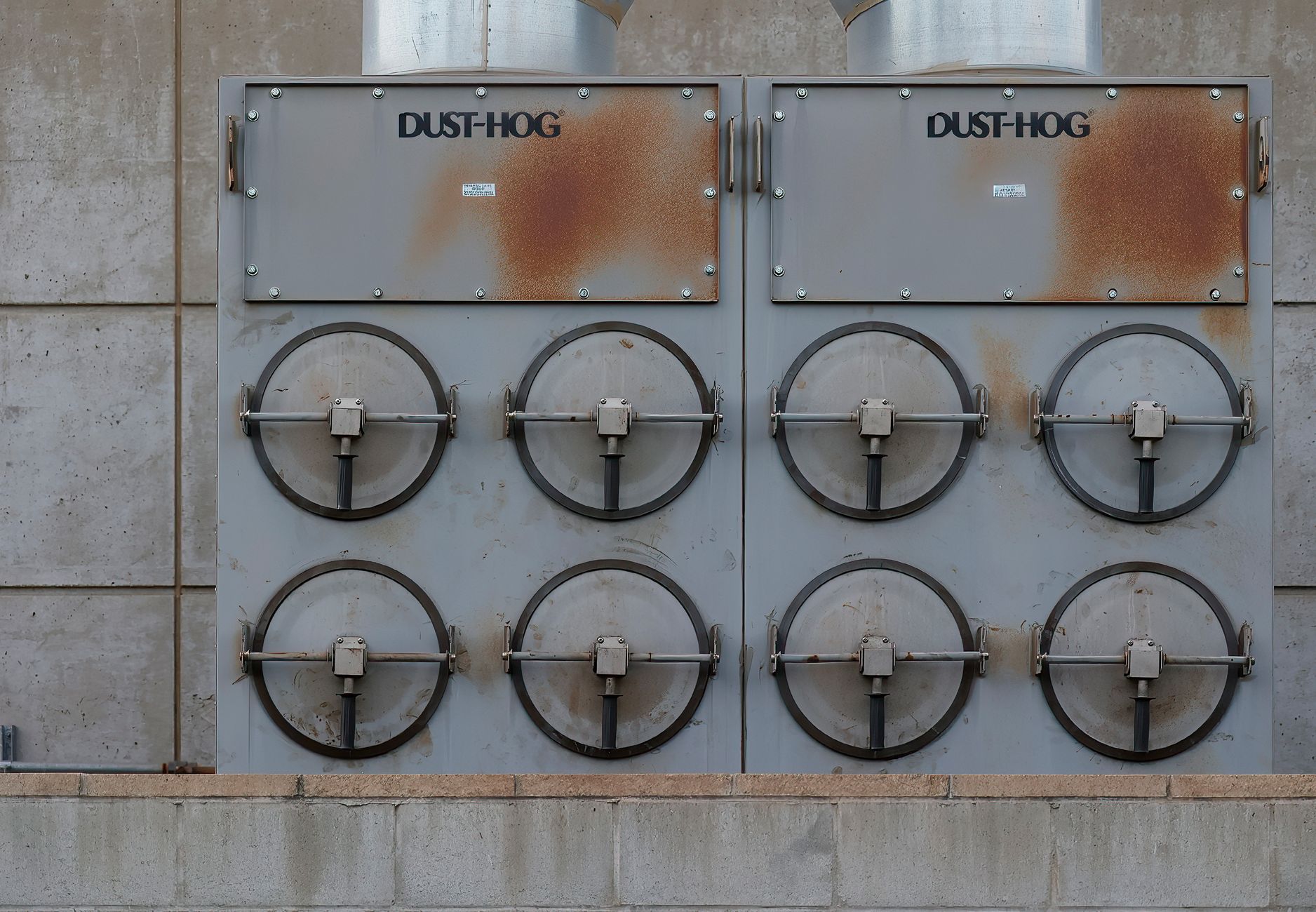
This guide considers Camfil and Donaldson as suppliers of industrial dust-collection equipment. It uses official material checked on 27 September 2026 and proposes a procurement framework. It does not select a collector size, determine a hazardous-area classification or certify a workplace as safe.
Start at the source of the emission
The UK Health and Safety Executive’s commissioning guidance asks assessors to identify the hazardous substances, emission process and operating conditions.[3] This is useful technical context, not a statement of Australian legal requirements. For a fixed process system, ask the competent specialist to explain the complete capture path, including the equipment and interfaces required for the actual task.
A collector catalogue alone does not establish that the extraction hood, ducting, airflow, discharge and process connection will work together. Record who designs and supplies each element, including controls and any specialist fire or explosion precautions identified by the assessment.
Compare like-for-like equipment proposals
- Camfil — Published equipment scope: Camfil’s Australian product material includes fixed dry-dust and fume collectors, including the Gold Series cartridge-collector range.[1]; What needs site-specific confirmation: The proposed model’s suitability for the assessed process, complete system interfaces, installation and service responsibilities.
- Donaldson — Published equipment scope: Donaldson’s Australian industrial range includes cartridge and baghouse dust collectors, plus other fume and mist categories.[2]; What needs site-specific confirmation: The selected collector category and model, process compatibility, replacement filters and support for the proposed installation.
Both suppliers offer multiple categories. Require each proposal to name the actual model and application assessment; do not compare a dust collector from one supplier with an unrelated room-cleaning product from the other. Overseas product markings or marketing descriptions alone do not settle suitability for the Australian site.
Give the specialist a useful process brief
- Process and material: describe the task, substances handled and available material safety information. Mark composition or hazard information that remains unknown.
- Operating pattern: record ordinary and peak production, simultaneous workstations, shift patterns and foreseeable process changes.
- Existing arrangement: provide available drawings, maintenance history and any relevant exposure or performance assessments.
- Site interfaces: identify available space, access, power, proposed routing and nearby activities that need consideration.
- Maintenance: explain who would inspect the system, replace filters, handle collected material and arrange specialist support.
These inputs help the specialist assess the system; they are not a substitute for that assessment. Do not infer that an exposure risk has been controlled because visible dust decreases or a filter has a high advertised efficiency.
Request commissioning evidence before selecting on price
Have the designer and competent commissioning party define the acceptance measurements, operating conditions and records required for the proposed installation. Ask how capture performance and relevant workplace exposure concerns will be assessed, and what happens if acceptance criteria are not met.
Include a baseline operating record, accessible inspection points, maintenance instructions, responsible personnel and training in the handover request. HSE’s commissioning guidance describes recording test results and performance benchmarks for later checks.[3] Have the local specialist establish the inspection and maintenance programme for the Australian site’s jurisdiction and assessed system.
Compare the whole operating obligation
Separate equipment, design, ducting, installation, electrical and control work, commissioning and any specialist protection in the quotations. Ask bidders to identify assumptions behind energy and consumable estimates. Request replacement-filter availability, planned service tasks, disposal responsibilities and the support response offered in writing.
Select the proposal that addresses the assessed process through a complete, verifiable system and assigns responsibility for its continued performance. If the process hazards or acceptance criteria remain unresolved, retain them as procurement hold points rather than declaring a catalogue model suitable.
References
- Camfil Australia — Dry dust and fume collectors (camfil.com)
- Donaldson Australia — Industrial dust, fume and mist (donaldson.com)
- UK Health and Safety Executive — Commission your local exhaust ventilation system (hse.gov.uk)