HROUS
Culvert inspection requirements for Ontario municipal road staff
Ontario municipal road staff should request an asset-linked culvert inspection record connecting identity, condition, inspection limitations and the next engineering decision. Separate applicable requirements from the report fields chosen for the contract:
- Applicable requirements: identify project-specific approvals, traffic control and worker-safety requirements separately from inspection guidance.[1]
- Draft provisions: distinguish MTO’s proposed “shall” requirements from its “should” recommendations; neither establishes municipal adoption.[1][3]
- Recommended contract deliverables: specify road and chainage, labelled inlet/outlet observations, measured defects, photographs, limitations and next actions—not as a prescribed municipal form.[1][4]
Separate applicable requirements from draft guidance
MTO’s September 2022 draft Culvert Inspection Guide is a technical reference, but its consultation was at “Review” stage.[1][3] The consultation closed on October 6, 2022.[3] These documents do not establish subsequent binding municipal adoption or how to classify a structure measuring exactly 3,000 mm.[1][3]
The draft covers water-flow culverts with the total diameter or span of all cells below 3,000 mm; it directs buried structures above 3,000 mm to the Ontario Structure Inspection Manual (OSIM).[1] Resolve the exact-boundary case when setting the scope.
Keep the distinction between draft wording and contractual requirements explicit. A draft “shall” expresses a requirement within the proposed MTO framework; a draft “should” is a recommendation.[1][3] Identify which provisions the municipal contract adopts.
Transport Canada’s Guideline for Culvert Safety Management addresses railway companies subject to the Railway Safety Act.[2][4] Its approach can inform report design, but its track-safety, railway-mileage, inspection-frequency and record-retention provisions are not Ontario municipal-road requirements.[4]
Specify one asset-linked record
Use a unique asset ID to link the inventory entry, observations, measurements and photographs. The following is a recommended contract record. MTO identifies GPS and stationing tools; Transport Canada provides railway inventory and inspection-record fields, but neither establishes this complete municipal field set.[1][4]
- Asset identity: Record the unique municipal asset ID and existing inventory reference.
- Location: Record the road name, chainage or stationing, stationing reference, coordinates and coordinate reference system. MTO identifies GPS for locating culverts and updating inventory records, and a measuring wheel for stationing.[1]
- Geometry: Record the material/type, length, diameter or span and rise, and cell count. These draw on railway inventory fields as background.[4]
- Inspection metadata: Record the date, inspector and inspection method. Transport Canada’s record model includes date, inspector and inspection type.[4]
- Observations: Record inlet, barrel and outlet observations, measurements and photograph references. Include a sketch or orientation reference distinguishing the ends.
- Photographs: Record asset-linked filenames, captions and view directions.
- Limitations: Record areas not inspected or obscured and the reason.
- Next action: Record the recommended review, survey or repair-planning step and supporting observation references.
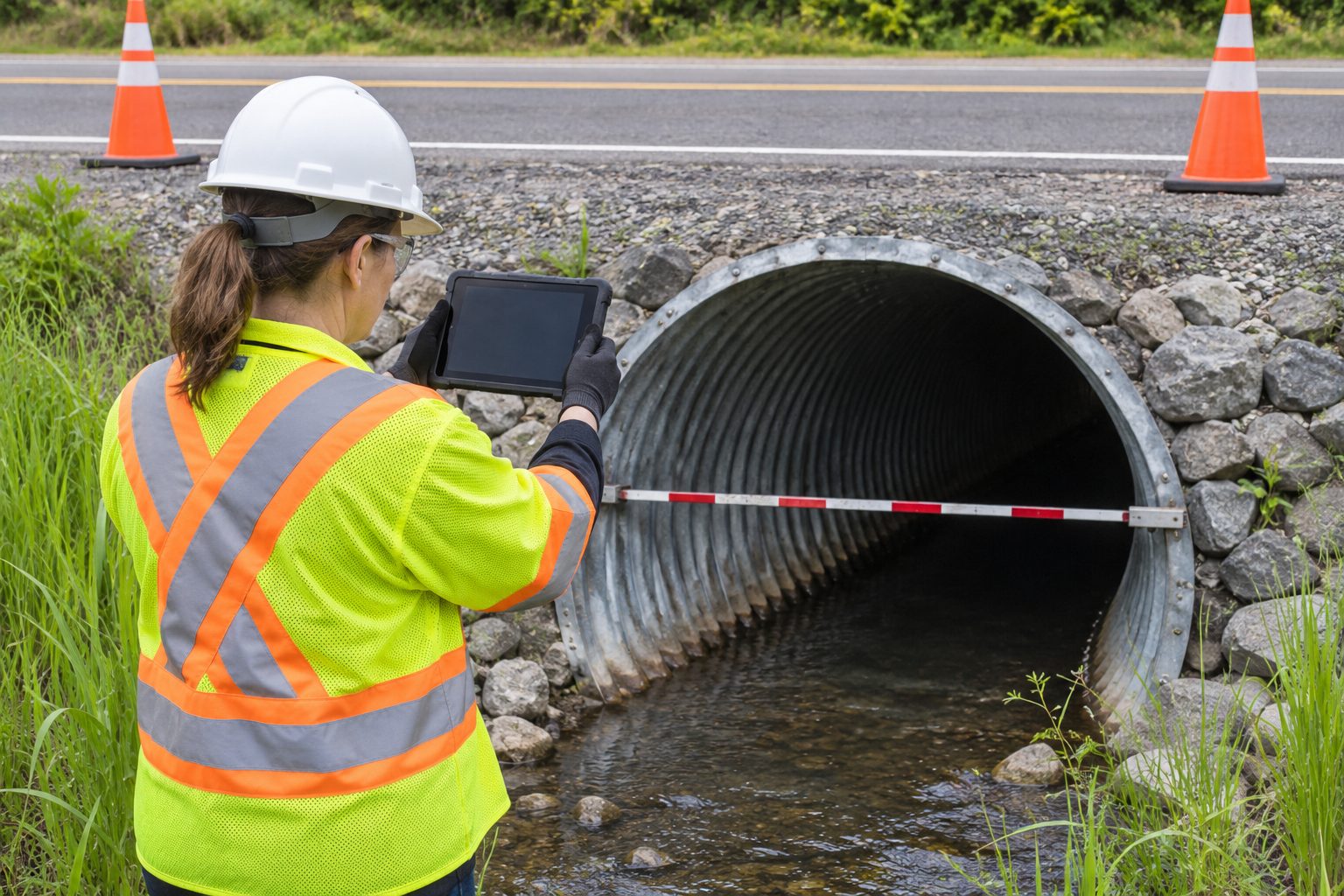
The MTO draft calls for a minimum of five photographs: one of the inlet and one of the outlet showing the culvert opening and upstream/downstream channel conditions, one of each embankment, and one of the road surface above the culvert.[1] Additional photographs should be taken where issues are identified.
Ask for photographs and measurements to carry the asset ID and an inlet, barrel or outlet label. Request an editable inventory export using the same identifiers and field names as the report.
Make defects measurable and limitations explicit
For each defect, request the component, position, extent, measurement, units, measurement method and linked photograph. These are recommended contract fields, not a prescribed municipal form or repair-priority table.
MTO identifies tools for measuring racking, tilting, alignment changes and pavement rutting, sag or humps—including a plumb bob, inclinometer, string line and straightedge.[1] Request the result and method rather than descriptions such as “badly deformed.” The draft text does not establish a complete municipal field set, measurement tolerances or repair thresholds for these observations.[1]
Request the location and visible extent of scour, erosion, obstructions and ponding, separating observations from suspected causes. MTO identifies scour and streambed-erosion hazards; Transport Canada adds waterway observations such as bank erosion, downstream obstructions and ponding as supporting railway background.[1][4]
Include an inspection limitations field for inaccessible sections, submerged or obscured surfaces, blocked views and dimensions left unverified. MTO identifies access restrictions and non-entry alternatives.[1] Define reporting labels in the contract:
- Not observed: the feature or condition could not be confirmed.
- Not inspected: the area was outside the inspection completed; state why.
- No defect observed: the identified area was inspected without a visible defect, within stated visibility limits.
These recommended labels distinguish missing evidence from a sound-condition finding. Ask the report to identify what access, measurement or non-entry investigation would resolve each uncertainty.
Choose timing for the evidence needed
MTO recommends different inspection windows for different purposes:[1]
- Lowest-flow period: where possible, inspect then for access to the interior, embankment and foundations.[1]
- During or immediately after heavy rain: use this timing for hydraulic-capacity observations.[1]
- Soon after scheduled cleaning: coordinate inspection to improve visual access.[1]
Specify whether follow-up visits are included rather than assuming one visit will answer both structural-visibility and rainfall-response questions.
The draft’s conditional provision is specific: when the Culvert Rating Index (CRI) is below 75 and visual inspection is impeded, enhanced inspection technologies shall be considered, subject to cost-benefit analysis.[1] Both conditions apply; this is a draft requirement to consider technology, not an unconditional municipal obligation to purchase it.[1][3]
Request a record of the evidence sought, visibility achieved, technology decision, cost-benefit rationale and unresolved questions as contract deliverables.
Prepare records, access and approvals
Before mobilisation, assemble the records MTO recommends reviewing: available watershed plans, floodplain and site maps, engineering drawings, past contracts, stormwater-management reports and previous inspection reports. Check for changes to the structure, road and site, and seek drainage and flooding history from the relevant maintenance office.[1]
Turn access-planning considerations into assigned tasks:
- Identify gates, access points, entry requests and landowner or business notifications.[1]
- Record special equipment needs and utility or emergency-responder coordination.[1]
- Flag potentially applicable environmental permits and aquatic-habitat or stream-morphology concerns.[1]
Assign responsibility for confirming permissions before work proceeds. The draft does not establish a universal municipal approval list, permit sequence or processing time.[1]
Include traffic-control planning under Ontario Traffic Manual Book 7 and address applicable worker-safety requirements.[1] MTO identifies circumstances unsuitable for in-person entry, including plugged or dammed barrels, high-velocity flow and restricted diameter, and directs consideration of non-entry or remote inspection instead.[1] Resolve the inspection method during planning rather than assuming entry.
Connect observations to the next decision
Request a decision register linking each asset and finding to its evidence, confidence level, unresolved limitations, proposed action, responsible party and agreed target date. This recommended deliverable adapts Transport Canada’s railway review approach; it is not a municipal statutory escalation matrix.[4]
- Potential safety concern: refer for prompt engineering review, identifying supporting observations.[4]
- Obscured condition: request a decision on access or enhanced inspection rather than treating unseen areas as satisfactory.[1]
- Unresolved geometry or hydraulic performance: define the question a survey or engineering evaluation must answer.[1][4]
- Supported defects: carry evidence into maintenance or repair planning, distinguishing the inspector’s recommendation from the engineering decision.[4]
MTO assigns a CRI during initial inventory and calls for evaluation of structural integrity, hydraulic performance and roadside compatibility.[1] It provides component condition-rating guidance and MTO inspection and immediate-action thresholds, although the published intervals leave some CRI values uncovered.[1]
If referencing the draft’s repeat-inspection examples, preserve its wording:
- CRI ≥ 85: inspect every 10 years.[1]
- 84 > CRI > 75: inspect every five years.[1]
Have the municipal owner confirm repeat-inspection responsibilities and an agreed follow-up schedule. These draft intervals and railway inspection frequencies are not universal municipal duties.[1][4]
Separate service costs from permit fees
Budget the survey separately from permit charges. Mississauga’s fee schedule lists an Access Modification Permit application for driveway widening involving culverts, curb cuts or curb improvements at $139, HST-exempt and non-refundable—not a culvert-inspection package.[5]
Depending on the work and applicable permit, other Mississauga charges may include:
- Alteration of Roadway or City Equipment Road Occupancy Permit application: $594 plus 13% HST; the Commissioner of Transportation and Works may waive this fee for internal parties.[5]
- Permit extension/revision application: $216 plus 13% HST, excluding waste-bin, moving/storage-container and complex-construction permits.[5]
- Additional inspection: $360 per incident plus 13% HST—a municipal charge, not a specialist condition-survey package price.[5]
These are local fee examples; the cited schedule does not establish inspection-service prices, booking terms or service turnaround times.[5]
Request an itemised quotation separating fieldwork, access, enhanced inspection technology, reporting, return visits and third-party charges. Ask for booking terms and delivery dates, and identify any included permit charges.
Scoping and report-acceptance checklist
Use the agreed scope as the acceptance checklist. These are recommended contract checks, not a prescribed municipal form.
Before commissioning
- Scope: Confirm the asset population, size boundary and status of referenced standards; identify adopted MTO draft provisions.[1][3]
- Deliverables and costs: Agree the report format, itemised service costs, permit charges, inspection timing and follow-up responsibilities.
- Dates and ongoing duties: Set an owner-defined submission deadline and assign repeat-inspection responsibility. The cited guidance and fee schedule do not establish universal municipal survey deadlines, authority processing times or inspection-renewal duties.[1][3][5]
Before fieldwork
- Documents: Provide available drawings, inventory, inspection records, drainage reports, maps and flooding history.[1]
- Access and approvals: Confirm permissions, applicable environmental approvals and traffic control; assign responsibility for applications, processing-time enquiries and permit expiry or renewal checks.[1][5]
- Return visits: Assign responsibility for visits after cleaning, improved access or different flow conditions.
Before accepting the report
- Asset-linked evidence: Check identity, road and chainage, labelled inlet/outlet observations, measured defects and at least five photographs under the adopted draft-based specification.[1]
- Limits and next action: Check uninspected areas and obstructed visibility are explicit, with evidence-linked recommendations for investigation, engineering review or repair planning.
Can another staff member identify the asset, understand what was—and was not—inspected, and commission the next review or survey without reconstructing the field visit?
References
- MINISTRY OF TRANSPORTATION Culvert Inspection Guide For (on.ca)
- Guideline for Culvert Safety Management – Transports Canada (canada.ca)
- Culvert Inspection Guide for Culverts less than 3000mm | MTO Technical Consultation Portal (on.ca, 2022)
- 1 UNCLASSIFIED / NON CLASSIFIÉ Guideline for culvert safety management (gc.ca)
- Schedule “B-1” Transportation and Works Fees and Charges (mississauga.ca, 2026)