HROUS
HROUS Concrete Moisture Testing for US Flooring: Compare Options
Choose the acceptance rule before ordering tests
For a US flooring project, select the test method and acceptance criterion required by the exact flooring assembly and governing contract before ordering tests.[2][5][6]
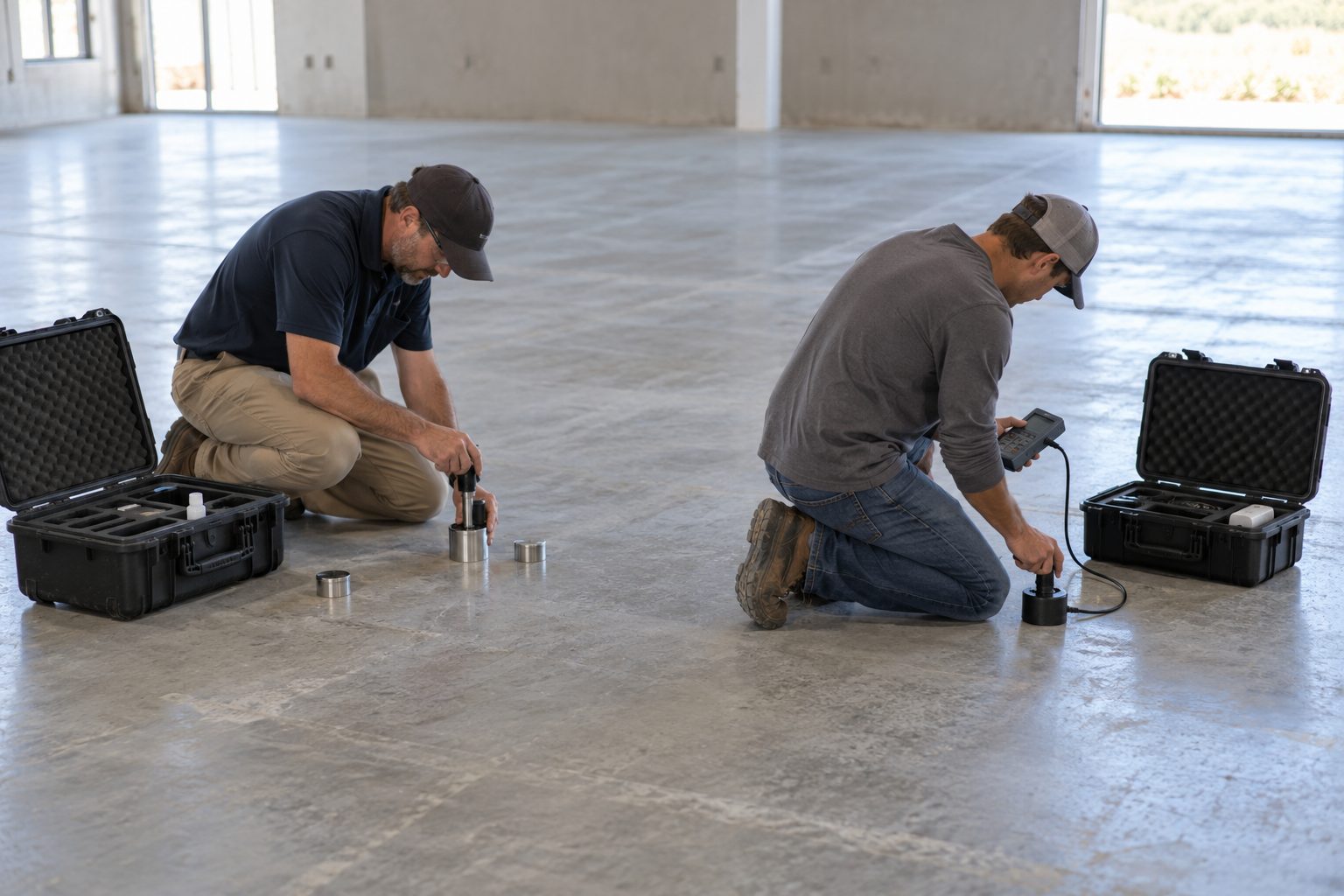
- In-situ relative humidity: ASTM’s F2170-19a method measures relative humidity inside the slab. Results describe conditions only at the tested locations and time.[1]
- Moisture-vapor emission rate: ASTM F1869 measures calcium-chloride MVER at the surface.[2][3][5]
- Screening methods: ASTM F2659 electronic meters and ASTM D4263 plastic sheets are screening methods.[2][3][5]
These methods assess different conditions and are not interchangeable.[2][3][5] “Meets ASTM” is not a passing threshold. Reconcile the applicable instructions for the flooring, adhesive, primer, underlayment, coating and moisture-control system with the governing project specification.[2][5][6]
Before requesting bids, document:
- The required method and edition, allowable result, pH criterion and mitigation provisions.[2]
- The exact installation products, slab type and available vapor-retarder information.[2]
- Known post-tensioning, radiant heat, electrical or plumbing hazards before authorizing F2170 drilling.[2]
Compare Croc Coatings, IFTI and TCG
The three play different roles: Croc is a regional coating installer, IFTI presents itself as an independent testing consultant, and TCG is a nationwide general contractor that self-performs flooring.[3][5][6]
Croc Coatings
Service coverage: Croc states that it serves North Idaho and Eastern Washington.[3] Independence or product-sales conflict: It also markets Penntek polyurea installation, so it is not presented as a product-neutral, testing-only firm.[3] Disclosed commercial terms: Croc offers a free quote and recommends separate prices for testing, preparation, repairs, mitigation and coating.[3]
IFTI
Service coverage: IFTI markets itself as an independent concrete slab moisture testing company serving businesses across North America but does not publish a specific service territory.[5] Independence or product-sales conflict: IFTI describes itself as an independent third party with no flooring or coating product to sell, although the page mainly documents floor-flatness and levelness work rather than completed F2170 or F1869 testing.[5] Disclosed commercial terms: IFTI does not publish proposal terms.[5]
TCG
Service coverage: TCG describes itself as a nationwide commercial general contractor licensed in 38 states and lists service cities across several US regions.[6] Independence or product-sales conflict: TCG says it self-performs commercial flooring while an independent agency performs testing; the proposal should identify which entity will test and sign the report.[6] Disclosed commercial terms: TCG does not quote its own testing price; it estimates that independent testing agencies typically charge $150–$300 per F2170 probe and $75–$150 per F1869 dish plus mobilization, or about $4,000–$8,000 for a full scope on a 40,000-square-foot slab.[6]
Croc may suit a regional coating project where its installation role is disclosed. IFTI may suit procurement that prioritizes its stated independence, subject to evidence of moisture-testing performance. TCG may suit multi-region work where the testing agency’s role is clearly defined.[3][5][6]
Put traceable deliverables in the testing scope
Require a location-by-location record, not an unsupported average or one-line pass/fail statement. The scope should include:
- Defined coverage: Identify every slab area to be evaluated and representative locations for known variations, including exterior-wall zones, thickness transitions and construction-history concerns.[5]
- Traceable locations: Provide a marked floor plan showing every location, with a unique identifier connecting it to its individual reading.[5]
- Method and equipment records: State the ASTM designation and edition, test dates, instrument or probe identification, calibration documentation and confirmation that the tested equipment matches those records.[5]
- Complete readings: Report every result rather than only an average. Include ambient temperature and relative humidity, procedural deviations, and the named manufacturer document or project specification supplying the acceptance limit.[5]
- Site conditions: Record slab temperature, ventilation and recent water exposure.[3] Disclose existing flooring, adhesive residue, curing compounds, sealers, coatings, patches and leveling materials because they can interfere with some methods.[2][3]
- Drilling hazards: Identify known post-tensioning, radiant heat, electrical and plumbing components before drilling.[2]
Resolve conditioning, timing and method conflicts
Condition the space to its expected service temperature and humidity, and document ambient conditions for at least 48 hours before testing. TCG also advises maintaining those conditions during the test.[5][6]
General timing guidance conflicts. MFMA advises against moisture testing within 60 days after the pour for synthetic-flooring projects. TCG says F1869 requires concrete to be at least 28 days old and recommends scheduling F2170 testing 14–21 days before installation.[4][6]
The sources also differ on method status. MFMA and WSFI recognize F2170 as their method for reading moisture within a slab and characterize calcium-chloride testing as a pre-test. Croc and TCG treat F1869 as acceptance data when the selected system specifies MVER.[3][4][6]
The cited pages do not establish a universal order of precedence or conflict-notice procedure. Before testing, obtain written direction from the party designated by the contract and the complete-system manufacturer identifying the controlling method, edition, timing, conditioning requirements and acceptance threshold.[2][5][6]
Accept the report before judging the slab
Check the report for completeness before using its results. Confirm that required areas were tested and that the report includes marked locations, the exact method and edition, test dates, individual readings, ambient conditions, disclosed deviations and matching equipment-calibration records.[5]
Reject an average-only conclusion. In-situ RH readings describe conditions only at the tested locations and time, so favorable readings do not resolve an undocumented or above-limit location.[1][5] Verify that the acceptance limit comes from the applicable literature for the complete flooring assembly, not an unspecified product family.[2][3]
Leaks, flooding, drainage changes or major HVAC changes after testing may justify investigation or retesting because slab conditions may have changed.[1][3] Obtain a corrected report for missing fields, unclear locations or unsupported acceptance criteria before authorizing flooring work.
Classify every reading and record its disposition
Evaluate each location against the selected assembly’s limit; do not average away an above-limit result. Record the classification and disposition beside each reading on the marked floor plan.[2][3][5]
- Within limit: Cite the applicable manufacturer criterion, record that the individual reading satisfies it and complete the assembly’s other required substrate checks.[2][3]
- Near limit: Define “near” in the project procedure because there is no universal margin. Require written manufacturer direction on whether to install, investigate further or use an approved moisture-control system.[2][3]
- Above limit: Flag the location, investigate the cause and document whether the contract and manufacturer instructions call for drying, repair, mitigation or retesting.[2][3]
Before approving mitigation, verify compatibility with the complete assembly, including the concrete, primer, basecoat, aggregate and topcoat. Check substrate profile, adhesion, curing, exposure, recoat windows and warranty conditions.[3]
Assign failed-test costs, authority and schedule risk
Attach a responsibility matrix to the contract assigning:
- Testing: Initial testing and reporting, site conditioning, access, preparation, return visits and retesting.
- Corrective work: Investigation, repairs, drying or mitigation, followed by flooring or coating installation.
- Decision authority: Who may authorize mitigation, obtain manufacturer approval and issue contractual direction.
- Risk: Who bears added costs and schedule impacts, and whether installation constitutes acceptance of the slab.
Do not adopt a provider’s customary allocation without checking the contract. For synthetic flooring, MFMA assigns the general contractor responsibility for providing a dry, flat slab and the flooring contractor responsibility for verifying compliance before installation.[4] TCG says testing is usually owner-paid through the GC’s testing or inspection line or concrete allowance, but this is a vendor-reported practice rather than a universal contract allocation.[6]
Require separate prices for testing, preparation, repairs, mitigation and installation, or allowances for repairs that cannot yet be priced; confirm reporting, return visits and retesting, with exclusions stated.[3] Define notice deadlines, change-order procedures and delay responsibility in the contract.
What to confirm with each provider
The cited provider pages do not fully state every project-specific commercial and qualification term.[3][5][6] Obtain written confirmation of:
- Local availability and the entity that will perform and sign the testing report.
- Technician qualifications, certifications and insurance.
- Total price, mobilization charges, minimum job size and allowances.
- Payment and cancellation terms, proposal validity and warranty terms.
- Exclusions for failed tests, investigation, repairs, mitigation, return visits, retesting and delays.
Use a written authorization gate
Issue a decision record identifying the test report, tested areas, governing assembly document, acceptance criterion, disposition for each location, exceptions and accepted deviations.[1][2][5] Attach written manufacturer direction for near-limit results before approving installation or a compatible moisture-control system.[2][3]
Obtain written authorization from the parties designated in the contract before installation, mitigation or retesting. If the report, controlling criterion or responsibility allocation remains unresolved, withhold authorization; ASTM compliance alone does not establish acceptance by the flooring-system manufacturer or contract.[2][5][6]
References
- F2170 Standard Test Method for Determining Relative Humidity in Concrete Floor Slabs Using in situ Probes (astm.org)
- Concrete Moisture Testing for Flooring: Methods & Guide | Flooring Magazine (podovi.org)
- Moisture Test Costs Before Floor Coating | Concrete Coatings – Garage Floor Coating North Idaho and Eastern WA (croccoatings.com, 2026)
- Concrete Moisture Testing Recommendation – MFMA (maplefloor.org)
- How to Choose a Concrete Moisture Testing Company: Vendor Checklist – IFTI Flooring Experts (ifti.com)
- Commercial Flooring Moisture Testing Guide (2026) | TCG (terrapincg.com, 2026)