HROUS
Wedding Floral Proposals for Canadian Couples: Compare Scope
Compare full-service wedding floral proposals by putting every florist’s arrangements, substitution promise, rentals and venue labour into the same line-item scope before comparing totals.[1][2][3][5]

Compare service models and locations first
Full-service floristry can include setup and teardown, while an à la carte order may provide arrangements without the same event support. Count only the services identified in the proposal.[1][6]
Wild Theory
- Service model: Bespoke full-service weddings with consultation, a custom proposal, rentals, setup and end-of-night teardown.[1]
- Service area: The Greater Toronto Area and surrounding regions, operating from Vaughan. Travel beyond its standard area is available, with travel and accommodation addressed in the custom proposal.[1]
- Published minimum-spend policy: Wild Theory says it has no minimum budget and prices each event according to its aesthetic, guest count and logistics.[1]
Flowers by Janie
- Service model: Statement wedding florals supported by labour for delivery, setup, staffing, teardown and cleanup.[4]
- Service area: Calgary, Canmore, Banff and surrounding Canadian Rockies areas.[4]
- Published minimum-spend policy: The Calgary minimum is $5,000 plus GST, with higher minimums in August and for Canmore, Banff and surrounding areas.[4]
Small Flower
- Service model: Full Service for weddings requiring service support and À La Carte for smaller celebrations that do not.[6]
- Service area: Calgary and the Canadian Rockies.[6]
- Published minimum-spend policy: The cited wedding-service page does not state a minimum-spend figure.[6]
These are vendor-published policies for particular providers and regions, not Canadian price standards or independent findings about service performance.[1][4][6]
Normalize every arrangement
A proposal becomes comparable when each arrangement has its own line. Event-area subtotals can conceal differences in quantities, dimensions, mechanics and visual impact.[2][3][5]
- Personal flowers: Record bouquets and boutonnieres separately, with a quantity and description for each type.[1]
- Ceremony and architectural work: For arches, floral structures, hanging installations and stairway florals, record quantity, dimensions, floral coverage, mechanics and viewing angles. These differ in scope from arrangements carried into a venue.[1][2][4]
- Reception work: Separate tablescapes, centrepieces, candles and décor. Note quantities, dimensions, flower varieties, fullness, proportions and whether the design is viewed from one direction or several.[1][2][3][5]
Words such as lush, full, large, elevated and statement are creative descriptions, not equivalent specifications.[1][2][3] Translate each description into one format:
Arrangement; quantity; dimensions; flower or foliage direction; coverage; mechanics; viewing angles; reference image; included labour; unit price; extended price.
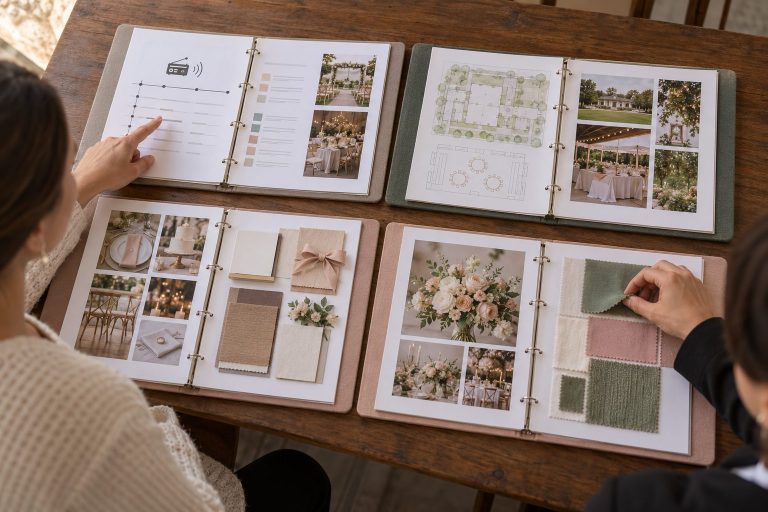
Compare each proposal with complete wedding portfolios and past work at a similar ceremony and room scale. Images and descriptions should show how the full design works together, not only isolated arrangements.[2][3][5]
Test substitutions and design previews
A cohesive design does not necessarily promise an exact flower recipe. Ask whether the substitution clause protects named varieties or the overall colour palette, mood, texture, value and scale. Weather can affect crops and specific varieties can become unavailable, while shipments may arrive damaged, colours may vary naturally, and rare or short-season flowers may cost more.[2][4]
Wild Theory says it may replace an unavailable or substandard requested bloom with premium designer’s-choice alternatives while prioritizing the intended mood, colour palette and texture.[1] For any substitution clause, ask:
- Is approval required before a substitution?
- What makes the replacement equivalent: colour, variety, size, value or visual impact?
- How and when will the change be communicated?
Do not treat inspiration images, proposal visuals, digital renderings and physical mockups as interchangeable. Ida Mayes says it provides specific renderings for key designs, but this does not establish that a physical mockup is included.[3]
Separate flowers, vessels, candles and décor
Give flowers and floral-design labour their own lines, then separate every vessel, candle, glass holder, stand, furniture piece and décor accessory. For each reusable item, record the quantity, whether it is rented or purchased, and who handles delivery, placement, collection and cleaning.[1][3][5]
A candle charge may cover more than wax: Ida Mayes says its pricing can incorporate glassware, cleaning, storage and transportation.[3] Wild Theory offers floral rentals and event-design elements, while furniture and additional table accessories may come through preferred vendors.[1]
For every reusable item, confirm:
- who owns it and whether it is rented or purchased;
- who delivers, places, collects and cleans it;
- the return deadline and location;
- any damage deposit and refund conditions;
- charges for missing or broken items; and
- the replacement value used to calculate liability.
Map installation, repurposing and teardown
Break “delivery and setup” into vehicle loading, delivery windows, loading-dock or elevator access, unloading distance, access waits, onsite construction, ladder use, staffing and installation time.[2]
- Venue access: Record when the florist may enter, where unloading occurs, how long installation is allowed and when the room must be cleared.[2]
- Repurposing: For each ceremony piece moving to the reception, identify who moves it, where it goes, the available time and the route. Check doorway fit, weight, guest visibility and whether cocktail hour overlaps the room flip.[2]
- Labour: Itemize delivery, initial setup, onsite building, candle placement or lighting, room-flip work, dismantling and end-of-night collection.[2][5]
Provider wording shows why line-item confirmation matters. Wild Theory says its full service includes day-of setup, complete floral installation and end-of-night teardown.[1] Flowers by Janie says its labour covers delivery, setup, staffing, teardown, cleanup and washing vases and buckets.[4]
Keep travel separate. Wild Theory says travel and accommodation costs for events beyond its standard GTA area are addressed in the custom proposal.[1]
Compare the equivalent total
Match arrangement quantities and scale first, then add substitutions, rentals, delivery, installation, repurposing, teardown, travel and taxes shown in the proposal.[1][2][3][5] A higher total may reflect flower selection, season, mechanics, labour, staffing, travel, service level, experience or overhead rather than an identical product at a higher price.[2][3][4][5]
Wild Theory states no minimum, while Flowers by Janie uses location- and season-specific minimums. Neither policy establishes a Canadian benchmark.[1][4]
- Price: Compare the complete equivalent total, not the floral subtotal.
- Inclusions: List every arrangement, rental and venue service covered.
- Exclusions: Identify work or products assigned to the venue or another supplier.
- Fit: Check the required service model, service area and applicable minimum.
What to confirm with each provider
The cited pages do not provide comparable terms for the following points, so obtain them in the proposal or contract.[1][2][3][4][5][6]
- deposit amount, due date, refundability and payment schedule;
- cancellation, postponement, force-majeure and transfer terms;
- revision limits, change-order fees, guest-count deadlines and the final design-lock date;
- rules for increasing or reducing scope;
- exact flower recipes, stem counts, dimensions and substitution-approval rights;
- physical-mockup availability, price, timing and fee credits;
- rental ownership, returns, damage deposits and replacement charges; and
- exact delivery, installation, room-flip, teardown, travel and accommodation charges.
Ida Mayes operates in Austin, Texas, and Erica Gravel Design is based in Northern California; their material supports proposal-comparison guidance here, not Canadian pricing, service areas or contract terms.[3][5]
Eliminate florists whose service model or location does not fit, check the applicable minimum, normalize the design scope, add rentals and venue labour, and then compare substitution terms and complete contracts.
References
- FAQ – Wild Theory Floral & Event Design : Award-Winning Wedding Florist Toronto (wildtheoryfloral.com)
- SEO title: How to Choose a Wedding Florist in Toronto | Derêves Floral Studio — Derêves (derevesstudio.com)
- How to Read and Compare Wedding Floral Design Proposals — Ida Mayes Floral Design House (idamayes.com)
- The Truth About Wedding Flower Pricing (flowersbyjanie.com)
- Why Are Wedding Florist Quotes So Different? A Guide to Comparing Floral Proposals – Erica Gravel Design (ericagraveldesign.com, 2026)
- Calgary Wedding Florist | Bespoke Wedding Flowers & Elopements | Small Flower (smallflower.ca)