HROUS
How to Choose Heat Exchanger Cleaning: Ontario Planners
Choose a shell-and-tube heat exchanger cleaning scope by specifying whether the quote covers assembled flushing, bonnet-off tube cleaning or bundle-out treatment—and which records are required before restart.
Define where the cleaning scope starts and stops
Require the quote to name the access state, cleaning method, handling boundary and restart deliverables. Do not infer these from “heat exchanger cleaning”.
T.H. Industrial Solutions (THS) offers onsite and offsite shell-and-tube service across Canada, with its head office in Pickering and a service centre in Hamilton, Ontario. [1] Its service descriptions illustrate distinct scope boundaries, not interchangeable cleaning packages.
In-place flushing
Access: Specify that the exchanger stays assembled and installed. Method: THS describes a portable pump, tank, filter and hose system circulating a citrus-based chemical or mild-acid solution, with debris collected in the filter. [1] Handling boundary: Specify whether bonnet removal, mechanical cleaning and bundle extraction are excluded.
Bonnet-off mechanical tube cleaning
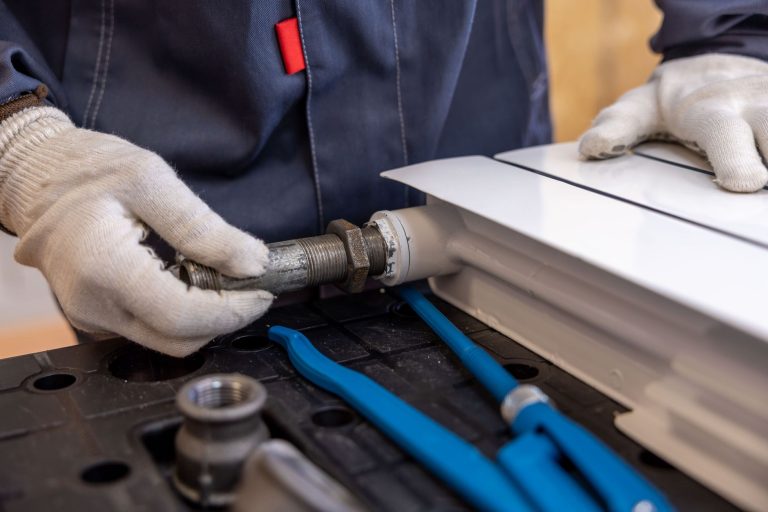
Access: THS describes removing the bonnet to reach the tubes. [1] Method: Its process uses tube-by-tube high-pressure cleaning and/or Roto-Jet rods fitted with brushes and drills to cut or grind away contamination. [1] Handling boundary: Assign bonnet removal and refitting explicitly.
Bundle-out offsite treatment
Access: THS’s offsite service accepts a tube bundle or complete exchanger. [1] Method: Treatment includes chemical circulation and, for extreme fouling, heated-bath treatment followed by high-pressure washing. [1] Handling boundary: Specify who extracts the bundle, supplies lifting equipment, transports it and reinstalls it.
Propose owner isolation duties and obtain agreement. THS says flushing success depends on contamination type and quantity; for hardened scale, it recommends tube cleaning, which requires bonnet removal for access. [1]
Build the outage around the complete work sequence
THS describes 6–8 hours of circulation for portable flushing and offsite chemical treatment. [1] For extreme fouling, it describes four hours in a heated chemical bath, followed by removal and high-pressure washing, repeated if contamination remains. The four hours cover the bath stage—not the complete bath-and-wash sequence or outage. [1]
THS also lists service windows of 1–2 days onsite/offsite, 2–3 days onsite/offsite and 2–3 weeks offsite. [1] Ask THS which window applies to the quoted work rather than assigning one to a method yourself. Ask THS to confirm a complete outage duration, transport allowance and guaranteed completion time. [1]
Assign a responsible party and elapsed-time commitment to each applicable stage:
- Owner isolation and access preparation, followed by baseline records.
- Opening the exchanger or extracting the bundle, then outbound transport.
- Cleaning, including an agreed allowance for additional treatment.
- Inspection and testing, followed by return transport.
- Reassembly and the owner’s release to operations.
Identify dependencies, hold points and contingency allowances. Specify who authorises the next stage and how missed milestones affect the planned return to service.
Treat replacement as a separate escalation. THS gives approximate delivery periods of 2–4 weeks for stock replacement and 6–10 weeks for custom fabrication. Without drawings, the bundle must be removed and measured before fabrication. THS also lists a 2–10-week offsite replacement window; these are replacement lead times, not cleaning durations. [1]
Agree on restart evidence and acceptance criteria
Separate the contractor’s records, the owner’s acceptance criteria and the named restart authority. Write these as distinct requirements, not a single “clean and ready” sign-off.
THS documents before-and-after flow readings for offsite chemical cleaning, before-and-after borescope examination of tube interiors, and pressure testing of the shell and bundle. [1] Do not assume the entire package accompanies every in-place job. THS also offers onsite or offsite pressure testing, individual-tube vacuum testing and plugging of leaking tubes; identify each as included work or work requiring separate authorisation. [1]
Request a handover package containing:
- Equipment identification and dated baseline and post-cleaning records.
- Measurement conditions alongside flow readings.
- Borescope images labelled with tube locations.
- Test procedures, conditions and results.
- Repairs, plugged tubes and unresolved exceptions.
Ask THS to agree on numerical acceptance thresholds, detailed test conditions and a reporting format, and name the owner’s restart authority. [1] Agree on these fields before work begins:
- Flow: required result under agreed measurement conditions.
- Inspection: expected tube condition and inspection coverage.
- Pressure testing: procedure, test conditions and acceptance limits.
- Tube plugging: engineering approval requirements for proposed or completed plugging.
Name the reviewer and restart authority. Require a written disposition when records are missing or criteria are unmet: further work, additional testing or an authorised exception. Treat the contractor’s test record as evidence for review, not the owner’s restart authorisation.
Set rules for persistent deposits and waste
THS filters debris during chemical flushing and describes repeating heated-bath treatment and high-pressure washing if contamination remains. [1] Ask THS to confirm waste-disposal responsibility, repeat-treatment pricing and a change-order procedure.
Put these controls in the work order:
- Define a treatment cycle: list included cleaning, washing and inspection steps, and the evidence needed to justify another cycle.
- Set the pause point: require approval before additional treatment, supported by findings, proposed work, added cost and schedule impact.
- Name the approver: record the owner’s contact, written authorisation method, charging basis and spending or schedule limit requiring renewed approval.
For spent solution, filter contents, wash water and removed deposits, assign responsibility for collection, containment, storage, characterisation where required, transport and disposal. Agree on the disposal route, charges and handover records.
Mark repeat-treatment and waste-handling charges as included, excluded or provisional. For provisional items, specify the charging basis and approval limit.
Write the in-place work order
Select the method explicitly, including any bonnet-off work. Use the following items as proposed contract wording, not as THS’s contractual responsibilities.
- Equipment and outage: Record the equipment ID and location, owner-supplied service conditions, suspected deposits, available drawings, the outage start and end, and where the scope starts and stops. State that bundle removal and offsite treatment are excluded.
- Method—select one:
- Assembled chemical flushing: Record the agreed chemistry, circulation arrangements and debris collection. State that bonnet removal and mechanical tube cleaning are excluded from this selection.
- Bonnet-off mechanical cleaning: Remove the bonnet and clean each tube using the agreed high-pressure and/or Roto-Jet brush-and-drill method described by THS. [1] State whether a chemical stage is included.
- Owner readiness—proposed allocation: Owner to isolate, drain and make equipment available. Confirm the allocation, site procedure, responsible person and readiness handover.
- Task allocation: Name the responsible party, and whether the price includes it, for access preparation, temporary connections, bonnet removal, lifting and access equipment, cleaning, debris collection, waste disposal, gaskets and consumables, reassembly and connection restoration.
- Evidence: Attach the evidence schedule for baseline and final records, and confirm which records and tests are available for this scope. [1] Record the acceptance criteria and the reviewer.
- Completion and changes: Record the included cleaning cycles; who may authorise extra cleaning or escalation to mechanical work, and on what charging basis; the cleaning-complete, reassembly-complete and evidence-handover milestones; exclusions; and the restart authority.
Write the bundle-out work order
Extend the responsibility chain from extraction to reinstatement.
- Equipment and scope: Record the equipment ID, whether the removed bundle or the complete exchanger is sent, owner isolation and access responsibilities, and who performs bonnet removal, bundle extraction and transport preparation and supplies lifting equipment.
- Handling and handovers: Assign loading, outward transport, shop receipt inspection, storage, return delivery, unloading and reinstatement. For each transfer, identify the releasing and receiving parties, handover point and condition record.
- Cleaning: THS describes offsite mild-acid circulation with filtered debris collection and before-and-after flow readings. Record the selected treatment, included cycles, the inspection hold point before any repetition, and the extra-work approver and charging basis.
- Evidence and acceptance: Specify before-and-after flow records, before-and-after borescope records, and shell-and-bundle pressure-test results, as applicable to the selected THS service. [1] Record the test conditions, acceptance thresholds and evidence recipient. Add a stop-and-quote hold point before plugging, repair or replacement: THS offers these services, with repair/replacement timing dependent on part availability. [1]
- Reassembly: Name who reassembles the exchanger and who supplies replacement gaskets and consumables, restores connections and carries out final site checks. Record each price inclusion rather than assuming shop cleaning covers reinstatement.
- Completion and changes: Record the committed return date and reinstatement-complete date; the contingency and approval authority if acceptance fails; waste responsibility through final disposition; the evidence-handover milestone; exclusions; and the name, signature and date of the owner’s restart release.
Check price, exclusions and cancellation terms
Price the completed work order, not just cleaning. The cited THS page does not state prices, hourly rates, travel or disposal charges, deposits, payment schedules, cancellation terms, a change-order procedure, warranties or performance remedies. [1] Obtain written terms rather than estimating market prices.
- Pricing basis: Specify fixed-price, time-and-materials or another agreed basis. Identify inclusions, allowances and exclusions for labour, equipment, chemistry, access, handling, transport, testing, consumables, disposal, reassembly, travel and applicable taxes.
- Included treatment: Record quantities or cycles, standby arrangements, extra-cycle rates or their pricing basis, and who approves additional work in writing.
- Commercial deadlines: Require quote validity, payment milestones, rescheduling and cancellation deadlines, and associated charges. Make these contractual terms, not assumptions about cancellation rights.
- Failed acceptance: Agree on remedies, responsibility for further investigation or treatment, associated costs and the next approval point.
Request company and technician qualifications, insurance evidence and proposed technical standards separately. Attach the selected work-order template and evidence schedule to the accepted quotation, resolve contradictions in writing, and name the people authorised to approve changes and restart.
References
- T. H. Industrial Solutions – Services (th-is.ca)