 HROUS
HROUS Choose the investigation depth before choosing the firm
For an existing BC building, first decide whether the assignment needs a condition baseline, investigation of a particular leak, or repair design and verification. EGBC’s Building Enclosure Engineering Services guidelines distinguish assessment purposes and recognise that the required investigation and reporting vary with the decision being made.[1]
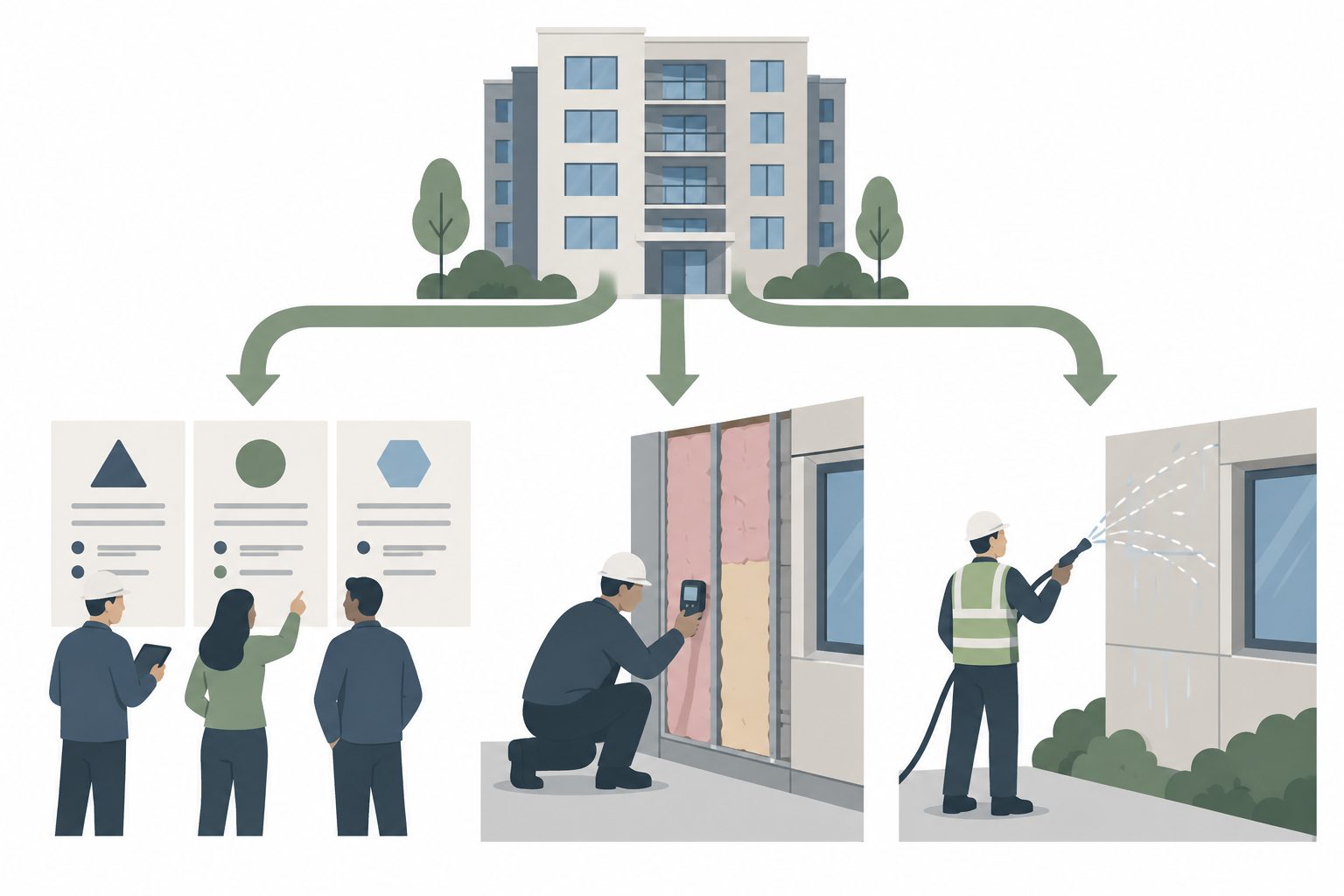
- Condition snapshot: Look for document review, interior and exterior observations, a dated condition report, priorities, and maintenance or repair timelines. ABSI publishes a workflow covering drawings and records, site assessment, findings, recommendations, timelines and priorities.[4]
- Unresolved leak: Paterson’s Leak Investigation service describes reproducing leakage through water-spray testing, sometimes using depressurization, then tracing water migration and developing a repair scope.[5]
- Renewal project: Confirm the proposal includes repair design or specifications, contractor instructions, construction review and defined post-repair testing. Paterson publishes these later-stage services, but they should not be assumed to follow automatically from every assessment.[5]
Compare published methods and verify BC coverage
The firms below illustrate different service scopes, not a verified shortlist for every BC property. ABSI’s page names Ontario locations and Paterson lists Ontario offices.[4][5] Their technical descriptions can help frame a request for proposals, but do not establish BC availability or BC regulatory requirements. RJC has BC enquiry channels; confirm the local team and assignment scope in writing.[3]
ABSI/Accent Building Sciences
- Investigation depth: ABSI describes reviewing drawings, structural plans and maintenance records before an interior-to-exterior inspection.[4] Optional methods include exploratory dismantling, component or laboratory testing, moisture readings and mapping, water-penetration testing, thermography, air-leakage methods, roof-uplift testing and sounding where delamination is suspected.[4]
- Repair path: Its report may document observations, unsafe conditions and recommendations addressing expected service life, maintenance or repairs, priorities and timelines.[4] ABSI does not publish a sequence for repair design, construction review or post-repair confirmation.[4]
- Suited to its published description: An envelope-condition snapshot, purchase due diligence or renovation planning where diagnostic methods may be added to the visual assessment.[4]
Paterson Group
- Investigation depth: Paterson describes a condition and visual-performance assessment investigating causes of exterior deficiencies. Depending on the property and client needs, it may include façade or roof thermography, exploratory openings or other specialized testing.[5]
- Repair path: Paterson’s related leak-investigation service covers leak reproduction and tracing, repair-scope development, contractor instructions, repair observation and confirmatory spray or flood testing.[5] For replacement projects, it also lists specifications, tendering, construction review, reporting and contract administration.[5]
- Suited to its published description: An unresolved leak, condensation or excess-cold problem, or a renewal project intended to continue from investigation into repair and verification, provided each stage is included in the proposal.[5]
RJC Engineers
- Investigation depth: RJC positions Building Envelope Condition Assessments for new or old, large or small, commercial or residential buildings.[3]
- Repair path: RJC’s November 2019 article does not publish an investigation sequence, testing menu, sampling plan, report contents, repair-development process or verification method.[3]
- Suited to its published description: RJC may merit a proposal request where its broad building positioning is relevant, but the proposal must establish the investigation and repair pathway.[3]
Compare the investigation methods, deliverables and limits described above. A supplier’s service description does not establish comparative diagnostic accuracy or the suitability of an assigned team for a particular property.
Check for asbestos before exploratory openings
Health Canada says building materials that may be disturbed should be verified as asbestos-free before renovation, remodelling, demolition or additions. Unless an asbestos-management plan already addresses the material, laboratory testing is needed except where the material source is known.[2]
Asbestos-containing material in good condition and isolated from the indoor environment does not present a significant health risk; encapsulation or isolation may be permitted in some circumstances instead of removal.[2] When repair or removal is required, Health Canada says a qualified asbestos-removal specialist should complete the work before other work begins and follow applicable regulations.[2]
Before authorizing openings, require the proposal to specify:
- who reviews existing asbestos-management information;
- who arranges and pays for required laboratory testing;
- where openings may be made and which materials could be disturbed;
- who reinstates walls, membranes, finishes or cladding; and
- how hazardous-material work will be sequenced before the envelope investigation continues.
Separate the assessment from a strata depreciation report
BC’s depreciation-report requirements apply to strata corporations with five or more lots and establish a five-year reporting cycle, subject to the applicable initial and transition deadlines. This is a common-property inventory and long-term cost-planning requirement, not a fixed interval for every detailed enclosure investigation.[6]
A depreciation report can identify a need for further investigation, but its visual review should not be assumed to include exploratory openings, leak reproduction or repair design. For a leak or unresolved deterioration, ask for a separate scope that explains what uncertainty each test will resolve. EGBC distinguishes visual due-diligence reviews from more detailed condition and performance investigations.[1]
Agree the investigation and report before authorising openings
- Starting records: Supply drawings, repair history, maintenance records, photographs and a log of symptoms, locations and weather conditions.
- Access and sampling: Agree the assemblies and areas to be represented, access equipment, occupied-space arrangements and approval for additional openings. Ask why each location is relevant.
- Evidence and limits: Require a location-indexed record of observations and tests, distinguish observed conditions from inferred causes, and identify inaccessible areas and unresolved questions.
- Repair choices: Ask for alternatives, their technical advantages, further investigation needed and a clear boundary between assessment, design and construction review.
- Acceptance: Specify who receives and may rely on the report, the questions it must answer, the correction process and any next-stage testing.
These are proposed procurement checks, not a prescribed BC sample count. Have the responsible professional justify the project-specific methods. EGBC notes that durability and service-life assessments support decisions but do not guarantee actual service life.[1]
What to confirm with each provider
- Decision and deliverables: State whether the work must support condition and budget planning, diagnosis of a specific symptom, or development and verification of a repair. Define the required report, drawings, specifications and testing records.
- Investigation scope: Confirm document inputs, assemblies and areas covered, access assumptions, testing methods, criteria for adding openings, hazardous-material prerequisites and responsibility for reinstatement.
- Leak investigation: Confirm whether the contract includes leak reproduction, water-migration tracing, repair options, contractor instructions, repair observation and confirmatory testing. Paterson publishes these stages across related services; include each desired stage explicitly in the project proposal.[5]
- Renewal work: Identify who prepares drawings or specifications, manages tendering, reviews construction, records deficiencies and assesses the completed work against the agreed criteria. Paterson publishes these capabilities for several replacement and restoration categories.[5]
- Eligibility: Confirm service availability for the property’s location, height, occupancy, ownership type, age and envelope materials.[3][4][5]
- Commercial terms: Obtain a project-specific quotation specifying professional fees, access and testing costs, reinstatement, taxes, payment milestones, revision allowances, delivery dates and cancellation terms.
Select the least extensive scope capable of answering the project’s decision question. Where acceptance depends on establishing the cause and showing the repair worked, retain cause tracing and defined confirmatory testing in the proposal.
References
- Engineers and Geoscientists BC — Building Enclosure Engineering Services, Version 2.0 (egbc.ca)
- Health Canada — Guidance for indoor air quality professionals (canada.ca, 2025)
- RJC Engineers — Building Envelope Condition Assessments (rjc.ca)
- ABSI — Building Envelope Assessment Steps (absi.ca)
- Paterson Group — Building Envelope Engineering (patersongroup.ca)
- British Columbia — Strata Property Regulation, section 6.2 (depreciation reports) (bc.ca)