HROUS
ASTM D1894 for US film buyers: requirements for comparing lots
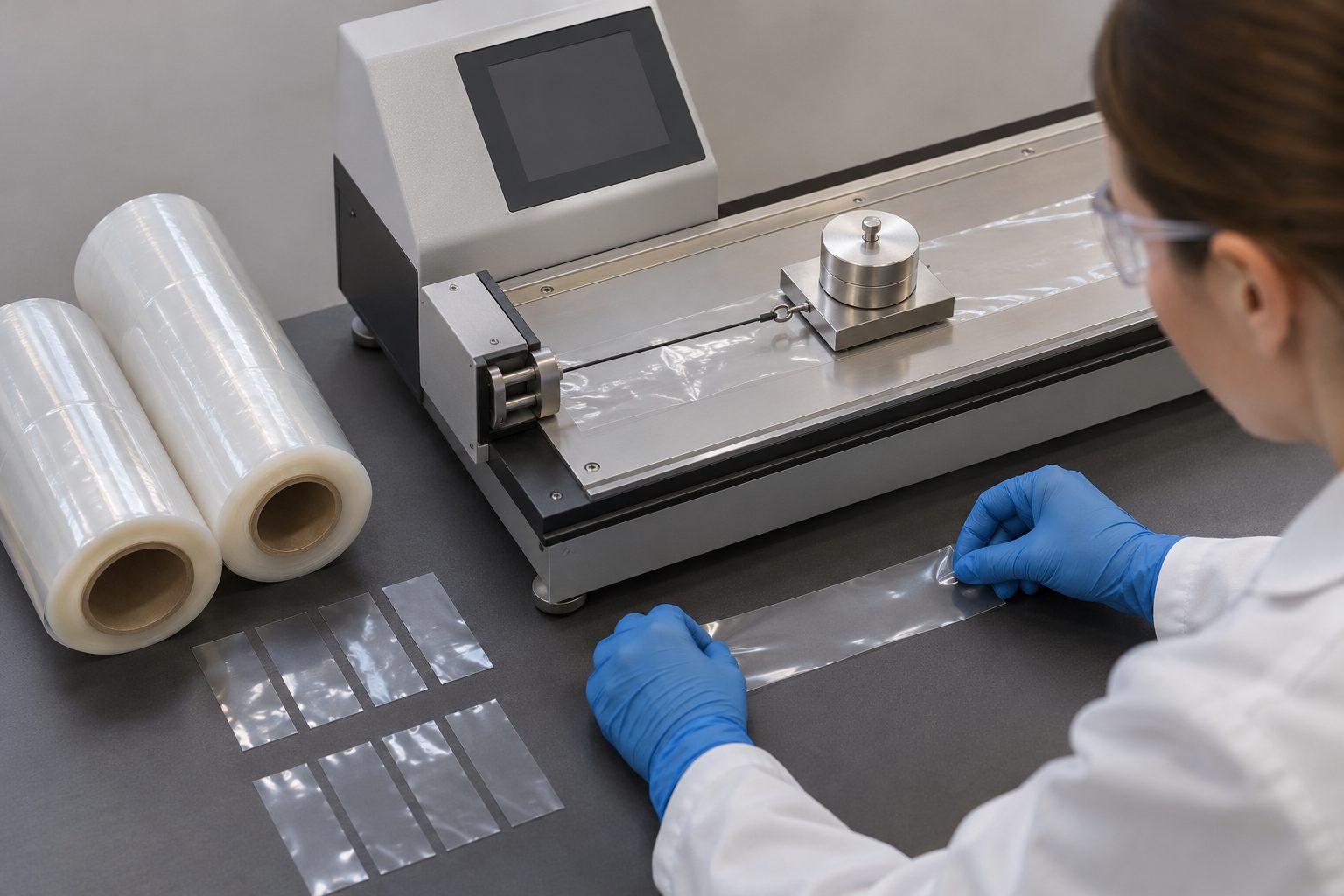
For an ASTM D1894 test of a film slip complaint, identify the two contacting surfaces and give the laboratory the exact method edition, film-face labels and direction of travel. Request separate starting and sliding friction results for each pair. ASTM’s published D1894-24 scope covers film or sheeting sliding over itself or another substance. [1]
Specify the edition and acceptance basis
ASTM lists D1894-24 as active and D1894-01 as historical. Start with the edition named in your purchase specification. Ask the laboratory to confirm which edition it will use and document any departures before the test. [1][2]
Use the lab’s method to establish conditioning, apparatus and test settings. Agree the sampling labels, face combinations, optional replicate reporting and interpretation needed for your complaint. Put any contractual acceptance limit and the decision rule in a separate field. [1]
Identify the surfaces in contact
Start with the actual contact involved in the complaint. ASTM’s scope includes film sliding against itself and film sliding against another material. [1]
Example: a reel with two different faces
Suppose a reel has distinguishable faces labeled A and B. If the complaint involves contact with a non-film material, label that counterface C. These are illustrative labels, not ASTM terminology.
Define A and B using an annotated photograph or identification sheet. For example, identify A with an arrow on the photograph and B as the opposite face. Rather than relying on “inside” and “outside” alone, give the laboratory and supplier the same visual reference.
- A against A: select this pairing if the contact being investigated places face A against face A.
- A against B: select this pairing if the relevant contact places the different film faces together.
- B against B: use this pairing for contact between two B faces.
- A or B against C: select the film face involved and identify the non-film counterface. Agree on its preparation and condition with the laboratory.
Choose the pair or pairs relevant to the reported handling problem, rather than automatically ordering every combination. If the complaint description leaves the contacting faces unclear, resolve that question before ordering.
For each pairing, ask the laboratory to record which face or material occupies the sled side and which occupies the plane side. Treat these assignments and identification aids as proposed instructions to agree with the laboratory, not as verified ASTM requirements.
Label faces, directions and lots
Give each submitted sample an identification sheet consistent with the test request. Agree on labeling fields, direction conventions, replicate counts and report formats with the laboratory rather than assuming they are ASTM requirements.[1] Use the following as a proposed submission checklist:
- Supplier: identify the film supplier separately from the sample identifier.
- Lot or batch: record the supplier’s designation.
- Roll identifier: keep this separate from the lot or batch field.
- Comparison status: mark the sample as new lot or retained reference.
- Sample location: record where the sample came from, if known; otherwise mark it unknown.
- Face-label key: explain what A and B mean for that film, using the same key on the samples and request.
Mark the machine direction on the identification sheet. Agree with the laboratory what “travel direction” means, whether travel will follow the machine or transverse direction, and how the contacting specimens will be aligned relative to each other. Use these as agreed descriptions rather than assumed ASTM instructions.
For the two-face reel example, a proposed instruction could read:
Label the new-lot specimens N and the retained-reference specimens R. Test face A against face B for each set. Before testing, document the agreed travel direction relative to the machine-direction marks and the relative alignment of the specimens.
Before sending samples, agree in writing on sample quantity, replicate count, conditioning, temperature and requested summary outputs. Ask the laboratory to record actual conditions and identify departures from the request.
Have the laboratory confirm these arrangements against the agreed edition. Ask it to flag any differences between the conditions requested and the conditions it will use. [1]
Request separate static and kinetic results
Ask for the static coefficient associated with starting motion and the kinetic coefficient associated with sliding under the test conditions. Request a separate result for each contact pair. [1]
Ask the laboratory to identify the calculation, reporting basis and interpretation of both results under the edition it uses. Set any acceptance limit with the purchasing or quality team before assessing the lot. [1]
Use this proposed reporting agreement to carry the submission details through to the results:
- Method: the exact ASTM D1894 edition used and any departures.
- Traceability: sample, lot and roll identifiers tied to each result.
- Contact: the film-face pair or film face and other surface, including sled and plane assignments.
- Orientation: travel direction and specimen alignment, using the agreed labels.
- Conditions: conditioning and test conditions used.
- Results: replicate count, individual measurements where agreed, and separate static and kinetic summaries with the summary basis explained.
Ask the laboratory: “What do these measurements support about the reported handling problem, and what remains outside this test’s interpretation?” Keep that explanation alongside the measurements when evaluating the supplier’s conclusion.
Compare the new lot with the retained reference
Request an aligned comparison of new lot N and retained reference R—not only their reported coefficients. Propose the same contact-pair definitions, orientations, edition, conditions and output labels for both, and ask the laboratory to explain differences.
Agree on a retained-reference procedure, allowable lot-to-lot difference, supplier-dispute rule and acceptance limit separately from the ASTM method citation.[1] The worksheet below is a planning aid, not an ASTM reference-testing procedure.
Comparison worksheet
For each entry, record new lot N / retained reference R / match or explanation needed:
- Edition: the exact method designation used.
- Material identity: film construction, supplier, lot and roll identifiers; distinguish expected lot differences from other differences.
- A/B definitions: the physical face identified by each label.
- Counterface: the selected film-face pair or other contacting surface.
- Sled/plane assignment: which specimen and face occupy each position.
- Travel direction: direction relative to each specimen’s marked film direction.
- Relative alignment: how the contacting specimens are oriented to each other.
- Conditioning and known sample history: storage and conditioning details, with unknowns marked.
- Test conditions: agreed settings and departures.
- Replicates: agreed count and number reported.
- Reported properties: separate static and kinetic outputs and the summary basis.
For retained-sample unknowns, ask the laboratory whether they limit interpretation. Do not assume storage changed the result or that an undocumented history is irrelevant.
Choose the conclusion the documentation supports
- Documentation aligns: assess the results against the explicitly agreed acceptance criterion. Identify the contractual specification or mutual agreement, if one exists.
- Differences are explained: limit the conclusion to the comparison the laboratory says it can support.
- Material details are missing or mismatched: request clarification or an aligned test before drawing a lot-to-lot conclusion.
Keep “the measured values differ” separate from “the lot fails.” Use the agreed acceptance basis rather than attributing a universal pass mark to ASTM D1894.[1]
Proposed instruction set for laboratory confirmation
Compare new lot N with retained reference R. Before testing, confirm the ASTM D1894 edition and document both samples’ lot and roll identifiers. Agree on face A and B definitions, contact pairs or counterfaces, sled and plane assignments, travel directions, specimen alignment, conditioning, test conditions and replicate count. Record known sample histories and mark unknowns. Report static and kinetic results separately for each lot and contact pair, explain the summary basis, and identify departures and interpretation limits. Explain what lot-to-lot comparison the results support. Assess acceptance only against an explicitly agreed criterion, if one exists.
References
- ASTM D1894-24: Static and Kinetic Coefficients of Friction of Plastic Film and Sheeting (astm.org, 2024)
- ASTM D1894-01: historical edition and version history (astm.org, 2017)